To enter Israel is to pass through a hall of mirrors. A nation exerting complete military dominance in the West Bank becomes one that, under an almost unimaginable peace accord, might be menaced from there.What does Cohen know about qassams and katyushas? What good is "complete dominance" and military superiority when terrorists can fire rockets at your cities and threaten the lives of thousands of civilians?
Showing posts with label qassams. Show all posts
Showing posts with label qassams. Show all posts
Friday, April 23, 2010
More Condescending Idiocy from Roger Cohen
It's always amusing to see journalists and academic critics belittling Israeli security concerns, which these know-it-alls dismiss as a mixture of manipulation and pathological paranoia. See for example Roger Cohen's latest column along these lines:


Tuesday, January 20, 2009
Random Things No One Will Remember
The video is not currently up unfortunately:
Footage of a presenter on the Arabic language television station Al-Arabiyaapparently confirms that Hamas fired at least one rocket from close to a building used by journalists during the 22-day conflict between Israel and Hamas in the Gaza Strip.
The Israel Defense Forces shelled the building, drawing international condemnation, and television networks with offices in the building denied that rockets had been launched from anywhere nearby.
But the recording, filmed by an Israeli and released Tuesday by Israel's Foreign Ministry, shows Al-Arabiya presenter Hanan Al-Masri saying that a Grad rocket had been fired from a location near the studios at Al-Shuruk tower in Gaza City. Al-Masri did not realize that she had been caught on camera (Ha'aretz).
Monday, December 29, 2008
Victims of Hamas
I wonder if the Knesset members from the Arab parties will mention these victims of Hamas's rocket attacks in their speeches:
One Israeli was killed and fourteen others were wounded by a Palestinian Grad missile which exploded near a construction site in the coastal town of Ashkelon.
Most of the victims were construction workers from the Galilee village of Manda and the Bedouin town of Rahat. Five were considered in serious condition, four sustained moderate wounds, and five suffered light injuries.
The man who was killed was named as 27-year-old construction worker Hani al Mahdi, from the Bedouin village of Aroer (Ha'aretz).
Thursday, December 25, 2008
Invading Gaza?
Video: Israel's Foreign Ministry Addresses the People of Gaza
Let's assume that Hamas is a rational political actor. What did the organization hope to achieve with the barrage of rocket, mortar, and missiles that it has fired at Israeli civilians since the conclusion of the cease fire? There are two separate but linked strategic aims that the Hamas government in Gaza is pursuing:
1. maintaining control over and legitimacy among the Gazan population against the challenges of other terrorist factions and Fatah
2. deterring Israel from attacking Hamas's fighters, political leadership, and infrastructure.
In order to maintain both control and legitimacy, Hamas has to reconcile two contradictory objectives. First, it has to ensure that the border crossings which deliver food, oil, and other supplies into Gaza stay open. Second, it has to prove its military superiority over other factions and local strongmen, by being at the forefront of the terrorist struggle against Israeli civilians and attacks on soldiers.
As far as Hamas's strategic objectives go, I am increasingly convinced that protecting Gaza's civilian population from being injured or killed by Israeli air force strikes and ground operations are not a priority. In fact, Hamas wants to draw Israel into bombing operations or incursions that will lead to dramatic footage of dead Palestinian "martyrs" being aired on Al Jazeera and other Arab television networks. Such deaths hardly seem to hurt Hamas's legitimacy, as they tend rather to stoke feelings of revenge and mobilize civilians to put aside dissatisfaction with their government in favor of unity against the enemy.
The calculus for Israel, on the other hand, looks different. The Israeli government's main aim is to protect its citizens from terrorist attacks - whether in the form of rockets or suicide bombings. Because of Hamas's commitment to armed struggle against Israel and its rejection of peace negotiations, the state of Israel has viewed Hamas's removal from power as a means to safeguarding Israel's security. A cease fire of limited duration, while providing some relief to Israeli civilians, is clearly not a viable long-term solution. The problem is that assuming Israel succeeded in dislodging Hamas from power, it is hardly realistic to expect Fatah to take over and stop rocket fire on Israel.
Israel's best bet, therefore, seems to me, to threaten Hamas with destruction - of its legitimacy and control in Gaza - while simultaneously holding out a deal by which Hamas might stay in power if it ceases its rocket attacks on Israel and other terrorist operations.
All this is easier said than done, of course. On the military front, the following is precisely what Israel does not need:
"If the Qassam [rocket] fire does not stop, the Israel Defense Forces will fight you with the same might with which it fought Hezbollah during the Second Lebanon War," said Hanegbi (Kadima), speaking to Army Radio (Ha'aretz).
Hanegbi wants a repeat of the Lebanon War? I.e., a hundred plus rockets raining on Israeli civilians every day for a month and many dead soldiers? The truth is that we do not know whether the IDF will be able to restrain Hamas's rocket attacks even if it embarks on a major ground operation. Might is not enough. The IDF will have to demonstrate a significant improvement in its rocket hunting capabilities in order to prevent a repeat of July 2006.
Beyond the military option, Israel must create as much diplomatic space as possible to maintain a crippling embargo on Gaza, should the Hamas government continue to terrorize Israeli civilians. It has come to the point where all measures ought to be on the table - including cutting off Gaza's power and certainly closing all crossings. Israel's message to Hamas and its supporters must be unambiguous: stop your terrorism in words and deeds, and you can live in peace and perhaps even prosperity.
Wednesday, December 03, 2008
Qassams on Gaza and the Dream of Palestinian Statehood

Of course, in a larger sense, every qassam attack on Israel is an own-goal by the Palestinians. The rocket attacks that have plagued southern Israel since the withdrawal from Gaza in August 2005 as well as the cross-border raids such as the one that led to the kidnapping of Gilad Shalit on June 25, 2006, imperil the likelihood of a future withdrawal from the West Bank more than anything else. The Gaza evacuation showed that both Israel's leadership as well as the majority of the Israeli population support a withdrawal from much of the territory captured in 1967. But no responsible leadership can authorize such evacuations, when it results in more attacks on Israeli citizens inside the country's recognized borders.
The Palestinians and their supporters will argue that settlement expansion and the IDF's actions in the territories have had a similar effect in undermining Palestinian trust as the qassams (and the suicide bombings before them) have had on Israelis. This kind of argument might fly in academia, but it is a dead end, especially for anyone who is serious about Palestinian statehood. Israel is in a position to grant Palestinians the land that they need for an independent state in the West Bank and Gaza. It depends on Israel to realize these ambitions. But the Palestinian dream of statehood requires the Palestinian organizations to demonstrate their trustworthiness to Israel, not vice versa.
The best analogy might be that of a lender and a hopeful borrower. Even if the lender has failed to repay debts to other people or to the would-be debtor himself, s/he is still the one with the capital that the debtor hopes to borrow. In order to procure the loan, it is incumbent upon the debtor to demonstrate to the lender ability to return the principal and interest in the future. Everything else is irrelevant.
I hope that my analogy, which equates Israel with a lender and the Palestinians with a debtor will not occasion yet another self-righteous diatribe on the alleged immorality of the Zionist enterprise. Those who believe that Israel does not have a right to exist or to be a "lender," are living in a dream world. They may continue idling away their time with stirring, moralistic pronouncements. But they would do well to remember that no state has been created on moral claims alone - not even the State of Israel, which, post-WWII had a stronger claim to a moral right for its existence than any other country in the world. Statehood is achieved by those who combine moral vision with pragmatic politics and, most importantly, attention to the contingencies of history and the vagaries of fortune.
Thursday, May 15, 2008
Countering the Qassam

The capabilities that the Palestinians demonstrated with yesterday's rocket attack on Ashqelon are impressive. Despite the limitations placed on them by the blockade and by occasional IDF operations, the terrorist groups in Gaza have consistently upgraded the range and power of their missiles. In comments to Ha'aretz today, Amos Yadlin, head of AMA"N (Military Intelligence Department), warned that two years from now, even Be'er Sheva might become a target. He did not announce any specific initiatives to forestall this threat.
The aims of Hamas and the other groups rocketing Israel's southern communities are various. One of the goals seems to be to pressure Israel into a truce that would result in lifting the "siege," whose effects have of course been greatly exaggerated by Hamas propagandists. Paradoxically, the Palestinians are trying to achieve this by demonstrating their ability to bomb Israeli civilians and by blowing up crossing points designed for the delivery of food and fuel.
Another aim of Hamas, which Yadlin also acknowledged in comments to the press, is to create deterrence against Israel comparable to the deterrence that Hizbullah achieved. Just like Hizbullah, Hamas wants to be able to strike at will deep into Israeli territory, turning Israeli civilians into its hostages in order to ensure that the IDF does not attack Hamas's fighters and leadership in Gaza.
These two aims suggest a number of different responses.
- Israel might agree to a truce and to the conditions imposed by Hamas, in return for an end to rocket attacks (diplomatic solution)
- Israel might acquiesce to Hamas's regime of deterrence and cease attacking its forces, in the hopes of quiet
- Israel can opt for its own policy of deterrence (military and economic)
- offensive operations to destroy the Palestinians' rocket-firing capabilities (military)
- defensive measures to limit the impact of the rocket strikes (military)
- Gives Hamas time to build up its forces for the next round; given the organization's ideology and support/pressure from Syria and Iran, it will not be turned into a pacific neighbor
- Same as above without even a formal set of protections; liable to break down at any moment.
- Hamas does not care if Palestinian civilians die as a result of IDF operations; in fact, images of civilian deaths or injuries aid its cause.
- the IDF has so far proven unable to do this; its efforts in this area during the Lebanon War of 2006 were unimpressive.
- expensive and so far ineffective
Wednesday, May 14, 2008
Ashqelon Hit Hard

The katyusha or Grad rocket attack on Ashqelon today surely marks a new chapter in the war between Israel and the Palestinian terrorist groups in Gaza. Since the disengagement from Gaza, we have seen a steady erosion of red lines, as more and more Israeli civilians have come under fire from Hamas and other armed Palestinian groups in the Strip. It may be important at the political level to distinguish among the various factions carrying out the rocket attacks and to evaluate particular motives. For the military, however, these kinds of considerations are irrelevant. What matters is that Palestinian terrorist groups have acquired and preserved the means to strike major Israeli population centers, despite a much-maligned "siege" of Gaza and numerous air force as well as ground operations. And even though the latter have often claimed the lives of many Palestinians - civilians and fighters - Israel has not been able to establish effective deterrence. Neither diplomatic nor military means have so far been able to protect Israeli civilians from these attacks. Despite countless announcements about an imminent truce this past year, we seem no closer to calm on the southern border than before. With Prime Minister Olmert's political career in limbo and Defense Minister Ehud Barak (Labor) possibly facing challenges from inside and outside the party, we may end up seeing the kind of major ground operation that the Israeli right has been agitating for. Such an operation may also be accompanied by assassinations of Hamas's political leadership.
Saturday, March 01, 2008
War of the Missiles Redux

What we are seeing so far is eerily reminiscent of the beginnings of the war between Israel and Hizbullah in the summer of 2006. So far, Hamas has demonstrated that its rocket attacks can reach at least as far as Ashqelon, and that it is capable of firing hundreds of missiles a day, if it so desires. IDF activity, so far taking place at the brigade level (Givati) and consisting of infantry forays together with armored units, engineers, and air force, has made no dent whatsoever in the qassam firing while killing many civilians, including children - though it has also managed to engage Hamas fighters. The army has even made statements to the effect that its activity in Gaza is not directly related to the rocket launchings; the claim seems to be that it is pursuing larger tactical or strategic aims.
The army appears to be testing the waters before embarking on a larger ground offensive. Barak may very well be unable to resist the calls (indeed it serves him in his own political aims against Olmert) for the "real thing" - the much-anticipated ground operation - if qassams hit a strategic installation in Ashqelon, end up killing a family, or strike a target similar to the train depot in Haifa during the Lebanon war.בכירים אומרים בנוסף כי ההחלטה להמשיך בפעילות היא ללא כל קשר למספר הקסאמים שנורים מהרצועה לעבר ישראל, וכי הצבא ממליץ על שורה של צעדים כנגד החמאס ולא להסתפק בתגובות נקודתיות בהתאם לשיגור הרקטות
Senior figures added that the decision to continue the activity is without any connection to the number of qassams that are fired from the Strip at Israel, and that the army recommends a series of steps against Hamas and not to make do with pin-point responses to rocket launchings (Ha'aretz).
What we have not seen so far are significant casualties of IDF soldiers. This suggests that the forays are still being conducted fairly cautiously, even though the military has apparently entered heavily defended areas.
UPDATE: As I write this, there is a report of 5 "seriously injured" soldiers.
Right now, it appears that Hamas is trying hard to force Israel into a truce that would see an end to the threats of assassinating the remaining political leadership. Israel, in the meantime, hopes to achieve some kind of near-knockout blow that would make it look as if it had won this round of the conflict. Destroying a few Hamas outposts will not do for this aim. If there is no large-scale ground offensive, we may see an attempt to assassinate a key Hamas figure before this fighting ends.
One thing that Israelis and Americans must get into their heads is that neither this activity, nor the assassinations, nor a large-scale ground operation will by themselves bring about regime change. The goal of regime change will continue to elude the allies. That is not to say that there isn't a great of dissatisfaction with the Hamas government in Gaza. But a revolution from below is a very unlikely prospect, especially while Gaza is under attack.
Wednesday, February 27, 2008
Escalations

Today's escalation in qassam rocket fire makes for an interesting case study. Hamas had been slightly increasing its rocket launchings in the past few days, hitting targets in the western Negev and Sderot that led to casualties. The Israeli air force's operation on Wednesday morning, which seems to have killed at least five members of Hamas's military brigades traveling in a van (New York Times), elicited a massive response from the organization. Hamas is reaching deep into its arsenal, employing those missiles capable of hitting Ashqelon, which suffered several hits today. In response, the Israeli air force struck hard, destroying Palestinian government buildings. One thing that this episode tells us is that Hamas reacts most strongly when senior members of its organization are killed, using its ability to strike Israeli civilian targets as deterrence against Israeli air strikes. For Israel, Ashqelon seems to have become the red line, at which it turns to considering assassinations of Hamas's political leadership.
UPDATE: Amos Harel has a good analysis of the escalation, which I think supports my take.
Sunday, February 24, 2008
The Gaza Offensive from Gaza

While the much-anticipated Gaza offensive by the IDF is far from operational, it appears that the Palestinians are planning an offensive of their own against Israel. We will find out in a few hours how Hamas's attempts to replicate last month's border-breaching action turn out. Unlike the well-planned events that transpired on the Egyptian border with Gaza in January, however, any such actions at the Erez crossing and other sites will lack the crucial element of surprise. It remains to be seen how the world would react to such a mass demonstration. It is likely to increase pressure on Israel to lift the blockade on Gaza, although the chaotic scenes on the Egyptian border did not exactly bolster the reputation of the Hamas government on the international scene.
A staged "popular" mass action, choreographed for international cameras, perhaps involving the deaths of a few civilians sent to the fence will provide plenty of ammunition for those long opposed to Israel's blockade of Gaza. From the beginning of this embargo, which followed the election of Hamas in January 2006, the blockade has been denounced for its injustice; the fence on Israel's southern border has been denounced as a "cage" and an "apartheid wall." Such condemnations are ludicrous. There is nothing immoral about Israel's blockade of the Hamas government in Gaza. We are talking about a fence that basically runs along armistice lines - the route of the border is not in dispute, except among those who oppose the existence of the Israeli state in toto. No state has an obligation to open its borders to non-citizens, let alone to those from a hostile country. It is quite telling that no one has ever described the blockades of Israel by the Arab states as "apartheid."
I may be wrong, but the practice of sending civilians to deliberately violate the sovereignty of a neighboring state seems to me unprecedented. It is, however, indicative of the mechanisms of rule employed by Hamas in Gaza and previously by the Palestinian Authority in the West Bank. When Israel unilaterally withdrew from Gaza, it did so with the expectation that the Palestinians would establish sovereignty in the territory and perhaps focus on building institutions resembling those of an independent state.
With Israeli forces and settlements gone, it seemed to many Israeli and international observers that the key motivations for armed struggle would be eliminated. But the Palestinians have done nothing of the sort. Instead, the terrorist organizations and later the Hamas government have banked on a kind of anarchic, anti-sovereignty to legitimate their authority and rule. From the beginning of this new state of affairs, Hamas has fostered all the attempts to improve the qassam rockets and launching operations that daily terrorize the residents of the western Negev. No real effort has been undertaken to better the economic situation of ordinary Gazans. The only improvement that Hamas rule has achieved is entirely destructive - the various gangs of terrorists have become better at firing rockets at Israeli civilians. I refer to this as "anti-sovereignty," because the Hamas government has deliberately abstained from establishing a monopoly of violence, instead fostering a competitive atmosphere of factions whose sole reason for existence is the violation of Israel's sovereignty, by continually endangering Israeli civilians.

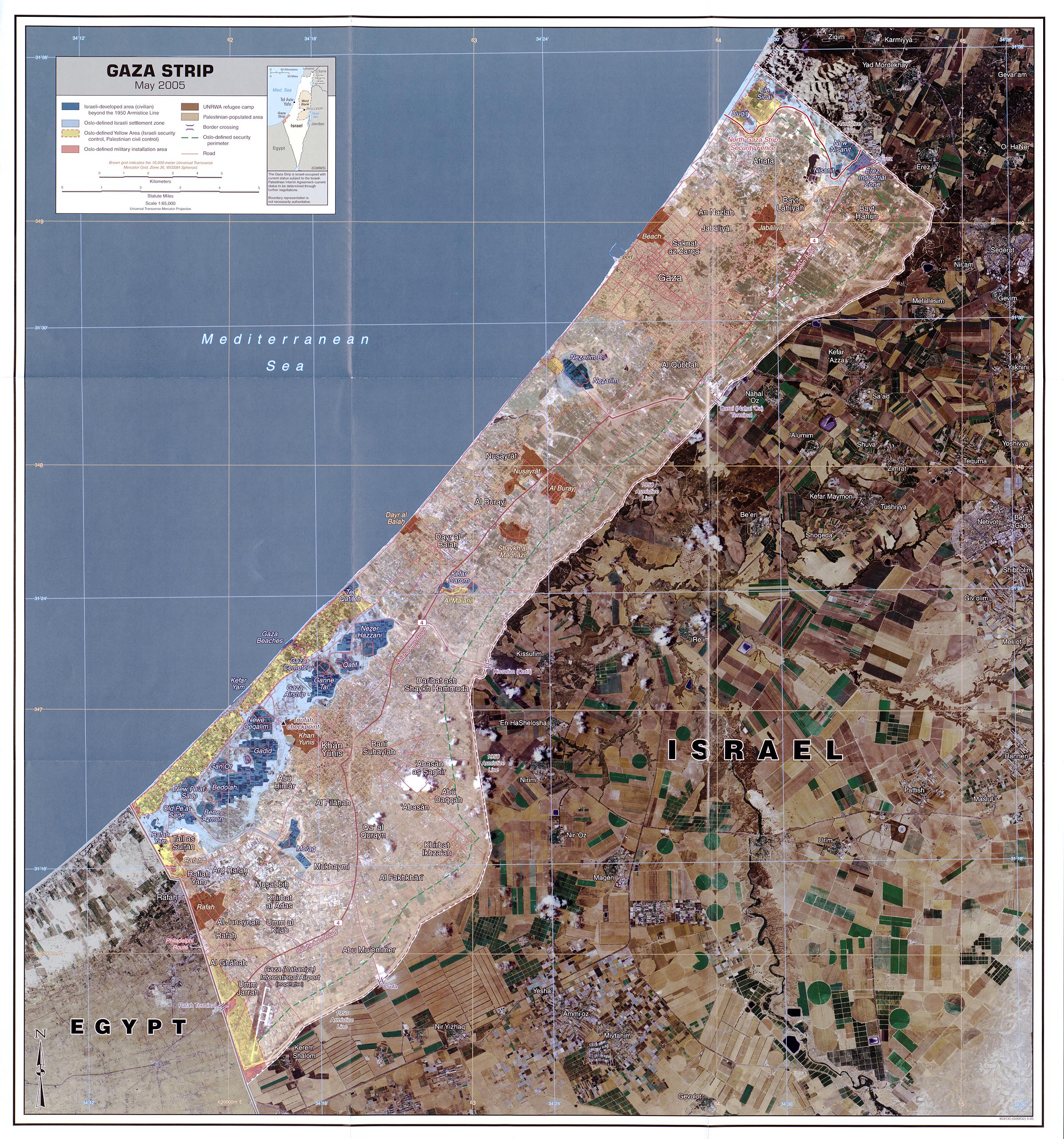
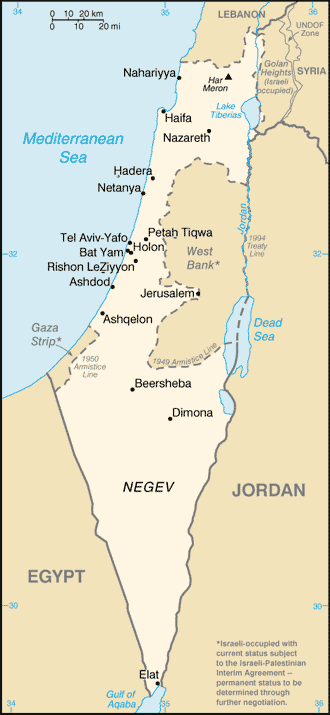

In other words, the Hamas government cannot be expected to act like a rational state. This government thrives on the state of siege and tension that it prolongs with every qassam launch. Its domestic and international support rests on the misery of its population, which is attributed entirely to Israel - despite the fact that the occupation ended two years ago. The obvious parallel to the situation which the Hamas government is aiming for is that of post-withdrawal southern Lebanon. How one deals with such an entity - on the military, economic, and diplomatic fronts - is still an open question.
Friday, January 18, 2008
INS Hanit
 The Israeli Navy Ship Hanit ("Spear")
There is an excellent article by the ever-dependable Amos Harel and Avi Issacharoff detailing, for the first time, the "intelligence failure" (it was more complicated than that), which led to the near-sinking of the INS Hanit by Hizbullah on the night of July 14, 2006. Readers will recall the discussion with Hazbani about this a few months ago.
The article also makes interesting points about the intense qassam firing of the past week.
Wednesday, January 09, 2008
Putting Sderot on the Map
 Map from Wikipedia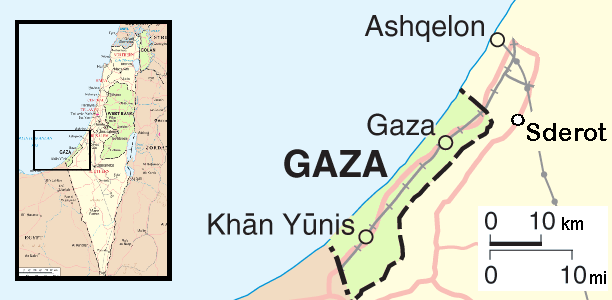
Steven Erlanger's story on the front page of today's New York Times (print edition) is, to my knowledge, the first time that the plight of the southern town's residents has made it there. The qassam attacks from Gaza began before the withdrawal of August 2005, but they have intensified greatly since. Erlanger's piece, accompanied by photographs of children peering at the destruction caused by the rockets, gives voice to the parents, sons, and daughters of the town, whose suffering has received relatively little attention until now.
There are some who try to relativize the qassam attacks, by pointing to the primitive construction of the rockets, their inaccuracy, and the low number of deaths that they have caused so far. They inevitably follow up with a comparison of the qassam to the F-15, with its deadly strikes on Gaza. This kind of comparison provides the relativizers with poetic justification, just like the image of rock throwers confronting tanks (in reality, they are more likely to face soldiers). We are entreated to view the struggle as one of heroic resistance fighters with limited resources confronting an awesome machine marshaling infinitely stronger state and military power. Or better yet, we are told that the rocket attacks resist "the occupation."
Such comparisons obscure the particularity of the terror that Sderot's residents experience every day. It is easy to remark, upon reading about one of Erlanger's teenage protagonists Razi, who "has seen 15 therapists" since seeing a rocket explode in front of his eyes, that Razi, unlike the children of Gaza at least has a therapist. This is a cynical and cruel game. The suffering experienced by Razi and all of Sderot's residents is not just and it is not unavoidable. It is the outcome of a deliberate strategy to terrorize civilians, which should be condemned as loudly as Israeli air strikes which kill innocent Palestinians.
The qassam attacks are all too often depicted as pin-point blows against the "powerful" by those sanctified as essential "victims." The reality of course is that they are aimed at one of Israel's poorest and most defenseless populations.
In this post, I have deliberately avoided the "causes" of the qassam problem and any discussion of its solution. I do not know whether the qassam attacks are being used for tactical or strategic purposes. These are issues I hope to address soon.
Saturday, June 09, 2007
"Lessons" from the Kisufim Attack
 The Kisufim ("Yearnings") Crossing, marked in orange
The thwarted attempt by Palestinian militants to capture an Israeli soldier near the Kisufim crossing has again raised questions about the government's "policy of no response" (Debka Hebrew).
In the incident, which occurred on Saturday afternoon, a team of four Islamic Jihad fighters broke through the security fence in a white jeep marked "TV." Lookouts immediately alerted nearby forces from the Givati Brigade. Meanwhile, the militants, who were dressed in military fatigues, stormed an empty outpost (a pillbox) and started firing. When they realized that the outpost was unoccupied and saw IDF jeeps arriving at the scene, three of the fighters returned to Gaza. Israeli troops began combing the area. A dog from the Oketz unit discovered the fourth terrorist, who had hidden in a pipe. After he revealed his location when he shot the dog, Israeli soldiers surrounded the man, who was killed in the two-hour long gun battle that ensued (Ynet Hebrew, New York Times).
 The vehicle used by the attackers (Reuters)
Soon after the initial news of the incident, army sources expressed concerns about "tactical shortcomings" in the response of the unit summoned to the scene (Ha'aretz Hebrew). "Why," they asked, "was there no pursuit of the [Islamic Jihad] crew at Kisufim?" To Lt. Colonel Bassam 'Alian, who commands the Rotem Battalion (one of the four battalions in the Givati Brigade) and was among the first to arrive on the scene, the answer is simple: the troops focused on securing the area first and making sure that the terrorists did not reach nearby residential areas. (A quick excursus: Bassam 'Alian made the headlines in August 2006, after he was injured in Lebanon, shortly after being promoted to Lt. Colonel.)
I will leave it to the military to investigate these alleged tactical deficiencies, but it strikes me that the criticism might not be entirely rational. I cannot help linking this disappointment that Israeli soldiers did not manage to arrest or kill the other attackers with a general sense of frustration about the government's defensive policy. This frustration is most palpable among reservists from Sderot and the south. In a recent article, "An Israeli defeat in Sderot," Ze'ev Schiff argues that despite the organization's military weakness, Hamas has achieved deterrence vis-a-vis Israel, just as Hizbullah has in the north. He calls this a "national failure" more serious than the outcome of the Lebanon war. Schiff concludes by bemoaning
the almost total disappearance of the strategic principle set by David Ben-Gurion, to the effect that upon the outbreak of a military confrontation, Israel must quickly transfer the fighting to enemy territory. At present, it is the enemy who is immediately transferring the fighting to Israeli territory (Ha'aretz).In recent days, IDF Chief of Staff Gabi Ashkenazi has also called for an expansion of offensive action in Gaza by the army, though he still rules out a major ground operation comparable to Defensive Shield. Israel's National Security Council, on the other hand, believes that the current policy should be continued (Ha'aretz English).
The government's reluctance to authorize a large-scale operation in Gaza, however, is not based on the acceptance of a draw with Hamas alone. Israel is trying to avoid the inevitable civilian casualties that would accompany a return to the policies of June 2006, which included heavy artillery fire, and bombardment from the sea and air in response to qassam launches. Perhaps the government is hoping for a further deterioration of the Palestinians' diplomatic position, as well as the attrition of its fighting power in internecine conflict.
As we occupy ourselves with the management of this conflict, the future looks bleaker than ever. Because the Palestinian factions cannot guarantee Israelis' security, Israel will not give up the land the parties and the Palestinian people demand as a requirement for the cessation of attacks. To be sure, the armed struggle - at least of the sort carried out since the mid-1990s - especially the suicide bombings have only brought disaster to the Palestinians. Furthermore, the qassams and their more lethal future successors will bestow mere temporary gains upon the Palestinians (a cease fire here, a partial lifting of restrictions), until the next terrorist attack. Then, it will be two steps backward again.
I think the optimism of the "anti-Zionists," that Israel will disappear is misplaced. They believe that the world only has to be convinced of the suffering of the Palestinians. It is true that a great number of people today believe that Israel is the manifestation of evil and wholly responsible for the hardships experienced by Palestinian civilians. They bank on what they see as the inevitable triumph of justice, and the defeat of the wicked. In the words of Angry Arab:
Zionists miscalculated: the deep seated racism that characterized the minds of Zionist pioneers, and the contempt through which they looked at the Arabs, did not prepare them for an unexpected variable: the persistence of Palestinian struggle. That the Palestinians will not succumb to Zionist diktats. And that the Arabs will not let bygone's be bygone's.I think the inverse of what As'ad AbuKhalil is saying rings just as true. The Arabs, especially the Palestinian Arabs, were not prepared for the persistence of the Jews' belief that they belong there, and that they need their own state. What the anti-Zionists don't understand is that Israeli Jews have nowhere to go. They do not intend to "return" anywhere - certainly not to the precariousness of life without national self-determination. Perhaps it is time to admit that the interests of Israelis and Palestinians are simply irreconcilable. For both sides, national self-determination seems to have requirements that the other side will not accept. But the loser of this kind of "draw" is surely the person without a state.
 Getting along is easier in San Francisco (May 2007)
In a very serious interview conducted by Sayed Kashua, best known for his hilarious satirical columns in Ha'aretz [the link happens not to be his funniest piece but it's still good], Hillel Cohen, the author of four fine works on the relationship between the state (or pre-state institutions) and the local Arab population, put it this way:
-"One could also say that the tragedy of the Palestinians from the start is that they found themselves on land that the Jews claim, and say is their historic homeland - rightly so apparently, unlike what some of the Palestinians think. The Jews have roots here and they've managed to stake a claim in this land. This is where the tragedy begins. If the Jews hadn't come here, nothing would have developed the way it has. But they did come here and they are also stronger. This is the root of the tragedy. The question within this equation is what you do about it. The tragedy within this equation is that if you're quiet and don't protest it doesn't help you, and if you protest gently it also doesn't help you, and if you move to an armed struggle, then it also hurts you. Whatever you do, you're screwed."
So what should be done?
-"I don't have a proposal for what the Palestinians should do. But let's say, theoretically, if the Palestinians were to take up a non-violent struggle en masse, maybe something would happen."
Then what? That would bring them back to an Oslo-type process.
-"Perhaps. Listen, I don't know what to say to the Palestinians. If someone were to land here from Mars and ask me which nation is worth joining, I probably wouldn't recommend he join the Palestinian people."
And the Jewish people? The Israeli people?
-"No comment."
Sunday, May 27, 2007
Gaza or Bust?
 Bitkhonists stirring the Helba
Pressure is mounting among the type of "bitkhonists," mentioned previously by Jeha, for the army to pursue a more aggressive policy in the Gaza Strip. Moshe "Boogie" Ya'alon, the chief of staff who preceded Dan Halutz, last week called on Israel to launch a major ground invasion into the strip, in order to eliminate the rocket threat. Ya'alon, who still opposes the 2005 unilateral disengagement from Gaza, and who has been sharply critical of former chief of staff Dan Halutz's handling of the Lebanon war, argued that
The problem in Gaza will not solve itself and no one will solve it for us. It requires us to reach the terrorists and the areas in which they operate, and strike at the industry of terror. We did this during Operation Defensive Shield, and before that operation we were unsure about whether to proceed. Today, you must be blind not to realize the necessity of entering Gaza.Defensive Shield (חומת מגן) was a massive military operation conducted by Israel in response to a month of suicide bombings, including the infamous attack at a hotel in Netanya, which killed 30 Israeli civilians, on the eve of Passover on March 27, 2002. Under Halutz's direction, the IDF mounted a major campaign in the West Bank, targeting Ramallah, Nablus, Betlehem, and, especially, Jenin. Ya'alon seems to be suggesting that the operation "finished" the suicide bombing squads. It is true that, as far as I can recall, Israel did not experience anything close to the level of violence that it faced in March 2002. But were the tactics of the duo of former Defense Minister Shaul Mofaz and Chief of Staff Ya'alon throughout the al-Aqsa intifadah really the reason for eventual defeat of the suicide bombers? During their administration, it did not look that way at all.
Ze'ev Schiff, Ha'aretz's military correspondent, is more cautious than Ya'alon. In a recent piece on the qassams and the situation in Gaza, he suggests that "A temporary incursion by the IDF deep into certain parts of the Gaza Strip is also a possibility." However, his assessment of the situation in Gaza is equally pessimistic, and he offers no diplomatic solutions at all, arguing pretty much for purely unilateral measures.
The thrust of the piece is that the Palestinians cannot be trusted to abide by agreements with Israel or any other state (the argument is in the title: "If that's how they act in Gaza"):
the Palestinians do not want to, or are not capable of, keeping agreements. They'll always find an excuse or a pretext, even if it ends up hurting them. Some say this happens because the Palestinians have no national entity. But Yasser Arafat had such an entity and controlled a majority of his organizations, and he continuously violated agreements (Ha'aretz ).I am not entirely convinced that this is true (though I'm certainly leaning this way), and Schiff, too, believes that "Israel has no choice but to continue to seek agreements with the Palestinians." What measures then does Schiff think Israel should take? Rather vaguely, he speaks of "maintaining broader margins of security," which translates into isolating the West Bank from Gaza, to prevent the spread of qassams (as well as internecine fighting) there. This means that Israel must oppose the Dayton recommendations. He also insists that Israel must keep striking at the sources of qassam fire (before or after rockets are launched). In this respect, the logic is again very familiar from the Lebanon war:
Hamas and the other Palestinian organizations, which seek mainly to strike civilian targets in Israel, are now complaining about Palestinian civilians being harmed. Israel mustn't punish Palestinian civilians for the attacks on its communities, but it must return fire immediately to the sources of fire, even if civilians nearby are hurt. This is the most basic and natural right to defense. The fact that Russia was the first one to criticize Israel on this is utterly ridiculous.And, according to Schiff, Hamas has scored a victory against Sderot and Israel as a whole, perhaps the same kind of "victory" claimed by Nasrallah's katyushas. The other big problem for Schiff is Egypt, which he accuses of turning a blind eye to weapons and cash smuggling into Gaza, and thereby of playing a "two-faced game in the war on terror."
I still think that a ground operation would be a huge mistake. Throughout the al-Aqsa intifadah, Mofaz and Ya'alon kept arguing for permission to carry out some decisive operation that would "wipe out" the terrorists. The same kind of logic led to the utterly fantastic war aims of eradicating Hizbullah that were articulated by Olmert, Peretz, and Halutz during the Lebanon war. We must resist the temptation of a "dramatic solution."
A combination of more subtle defensive as well as "surgical," small-scale measures offensive measures, not the mammoth campaigns like Operation Defensive Shield, have been the key to managing the conflict - i.e., to dramatically decreasing Israeli civilian as well as military casualties. Among these measures I include the security fence, checkpoints, and the diplomatic isolation of the Hamas government. The problem is that this strategy also precludes a dramatic negotiated solution of the type that so many of us keep yearning for.
Thursday, May 17, 2007
"God Saved Us"
 Sderot synagogue hit by a qassam. The photograph of R. Ovadia Yosef (right)
and the painting of the youthful Baba Sali [I think] (left) were unharmed (Photo: Ynet)
The photographs and the press reports from Sderot this week are eerily reminiscent of scenes from the north in last summer's war. Of course, the residents of the western Negev have been living with the qassam strikes since before the disengagement from Gaza. But the media spotlight is now back on Sderot, and the pressure on the government is mounting to "do something" about it.
On the airwaves and in the print media, the inhabitants of the Negev town seem unanimous that they have been abandoned by the politicians. I am not sure that Prime Minister Ehud Olmert's visit assuaged their fears - some Sderot residents took this as an opportunity to lash out at Olmert as well as Defense Minister Amir Peretz, whose house in the city is apparently a target for the qassam crews.
Shortly after Olmert finished his tea with Peretz and left the town, a rocket struck a synagogue. This strike could very well have resulted in casualties; shortly before the qassam hit, community members had celebrated the dedication of a new Torah scroll. "God saved us," said one of the people on the scene. Ynet's coverage (Hebrew) gives voice to the anger and fear of Sderot residents. These are the words of Aryeh Cohen, who came to Peretz's house to "talk" to the PM:
ראש הממשלה פחדן, באת כמו גנב בלילה עם כל השומרים שלך. זו לא פרובוקציה מה שאני עושה, אני רוצה לדבר איתו. רק אתמול בלילה עברו מעלי טילים. אני רוצה לשמוע את ראש הממשלה נותן לי תשובות. כל הזמן אנחנו שומעים אותך ואתה לא מאפשר לנו להשמיע את קולנו. נכנס לבית של פרץ, פרץ גם עוד יותר פחדן ממך - גר בבית ממוגן ואנחנו - אין לנו מקלטיםThe truth is that while the IDF may be able to reduce the rocket strikes to a certain degree with some of its current actions, qassams will continue landing on Sderot without a renewal of some kind of hudnah with Hamas. Even that, however, will only reduce the number of rockets, as the Islamic Jihad and wild Fath crews will continue their activities. As the latest eruption of internecine fighting in Gaza made all too clear, no one has a monopoly on violence in the Strip.
The Prime Minister is a coward, you came like a thief in the night with all your guards. What I am doing is not a provocation, I want to talk to you. Only last night missiles passed over me. I want to hear the Prime Minister give me answers. We hear you all the time and you don't allow us to make our voices heard. He went into Peretz's house, Peretz is even more of a coward than you - he lives in a protected house - we don't have shelters.
Aluf Benn lists four different alternatives, faulting Israel's leaders for not having learned from Winograd and ignoring "diplomatic" alternatives. The options he lists are:
- Offering a cease-fire in the West Bank in exchange for a cessation of qassam firing
- Allowing the U.S. to implement the "Dayton Plan" - i.e., training and arming forces loyal to Abu Mazen to fight the qassam crews and weapons smugglers
- Engage in direct talks with Hamas and offer to lift the economic embargo against the PA in exchange for a long-term hudnah
- Meet with Abu Mazen
The first and third options, which involve dealing with Hamas, seem more promising. However, these days it is not at all clear that Hamas can deliver the goods (i.e., no more qassams) any more effectively than Abbas. In any case, both of these scenarios would allow Hamas to build up its forces for a future confrontation; one has to weigh the costs very carefully.
Given that none of the "diplomatic" alternatives above are truly viable, it seems that Israel can only hope to reduce the rocket fire at this point by targeted air force and artillery strikes, and work on reinforcing buildings and bunkers in Sderot. This is pretty much in line with previous escalations in the south. Sooner or later, an errant Israeli artillery shell or air strike will hit a residential building in Gaza, kill a large number of Palestinian civilians, and occasion an international outcry, and put a stop to the operation. Then, things will return to the status quo ante of 10 instead of 30 qassams a day ... until the next round.
The worst thing Israel could do is to embark on a full-scale invasion of Gaza now. It will bring only marginal gains over air strikes, in terms of preventing qassam launches. Let's face it. There is no real solution to the problem of the rockets - at least not one that Israel by itself could achieve.
Wednesday, May 16, 2007
The Qassam Front
 Exodus to Be'er Sheva
As I said last week, it was only a matter of time before one of the qassam rockets among the barrage fired at the western Negev and the city of Sderot would occasion a more far-reaching response from the army. The direct hit on a Sderot apartment complex today broke the camel's back, though it remains to be seen just how "comprehensive" the military response will be. The air force's bombing of a Hamas "operations center" in Rafah, which killed 4 and wounded 20, combined with a resumption of "targeted killings" of Hamas leaders probably represent the limits of the "severe and harsh" measures promised by Olmert will take.
The increased qassam activity is taking place against the backdrop of renewed intra-Palestinian fighting between Hamas and Fatah, which has led to more than 40 deaths over the past four days. Perhaps partly in a bid to make some sort of appeal for Palestinian unity, Hamas is openly taking part in the qassam firing, which explains the increased activity on this front (50 rockets since Tuesday). Fatah militants are probably also participating to some extent, as they too seek to appeal to the street. But the residents of Gaza know how disingenuous this rhetoric is. The call for Palestinian unity against Israel and the qassam attacks obscure the serious tensions between the factions and criminal gangs in Gaza, and the lethal violence inter-factional violence enveloping the Strip.
It is amusing to watch As'ad AbuKhalil try to deny that we are in fact seeing the beginnings of a civil war in Gaza. It reminds me of his praise for the Iraqi "insurgency" and his pathetic efforts to manipulate the statistics from that theater - all in order to claim that these criminals are fighting "illegal occupation" rather than butchering innocent civilians.
This latest eruption in intra-Palestinian fighting should dispel any doubts about the viability of the Mecca accords (if anyone remembers it) as well as other cease fires. All of these cease fires are unlikely to last without the complete victory of one faction over another. The U.S. has been pressuring Israel to rush arms to Abu Mazen to support Fatah fighters and to ensure that Hamas does not score a complete rout over its opponents. I think that Olmert will continue resisting these calls - both for domestic political (one of the slogans of the right after the outbreak of the second intifadah, aimed at the Oslo process backers, was "you gave them rifles" - and they were right that these guns were indeed turned against Israeli soldiers and civilians ), as well as strategic reasons.
Even if Fatah were to acquire additional equipment, it is not at all clear that its failures in the field against Hamas are due to a material disadvantage. In any case, Fatah is unlikely to defeat Hamas militarily; certainly, such a victory bestowed upon it by American or Israeli backing would profoundly hurt its chances in the political sphere. It makes much more sense for Israel to step back and intervene with pinpoint operations against Hamas fighters and infrastructure (or Fatah militants) as it sees fit.
Meanwhile, Gaydamak has paid for 800 Sderot residents to be put up in hotels in Tel Aviv and Be'er Sheva. An exodus of sorts has gripped the town since the latest strike. In the Israeli media, photographs have been published of residents trying desperately to board Gaydamak's buses and flee the city.
Olmert has responded angrily (Hebrew) to this evacuation operation. It is clear that Gaydamak is amassing an arsenal of public support in pursuit of his political ambitions; in the meantime he is performing some very good deeds. The residents of Sderot have been let down again by the Israeli government. Nobody has previously discussed the deplorable "lethargy" exhibited by the country's politicians with regard to putting in place at least a preliminary defense system against the rockets. The public bomb shelters have only been opened now in Sderot.
Expect the qassam fire to continue increasing over the next few days, as Hamas and Fatah try to fight a two-front war - against each other and Israel. The biggest losers will of course be the residents of Gaza.
Subscribe to:
Posts (Atom)