Thursday, July 13, 2006
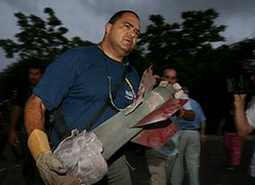
Barak Getting Grilled


Setting Realistic Goals
I think it is fair, at this point, to call Lebanon a failed state. Is it really possible for Lebanon to disarm Hizbullah? Perhaps the military force exists to do this, but the problem is political. It seems very unlikely that such an operation could take place under the current political constellation. Thus, I don't think it's realistic to see the de-militarization of Hizbullah as an operational goal. However, we should not forget that not too long ago a much more formidable political and military force operated in Lebanon - the Syrian army, and its intelligence network. Unless I am badly misinformed, it was widespread popular opposition to the Syrian presence, which erupted in mass demonstrations after the assassination of Hariri, combined with international pressure, which ultimately forced the Syrians out. It seems highly doubtful to me, however, that Israeli air strikes will convince the majority of Lebanese to kick Hizbullah out. The Shia and the Palestinians feel as triumphant as ever and are rejoicing at Nasrallah's latest coup. The remaining groups are either too fanatical in their hatred of Israel or too divided to act against the terrorist group, despite all the suffering it has brought upon their country. Nevertheless, I don't think Israel has a choice - the current strikes against Hizbullah and Lebanese targets must continue if Israel wants to protect its citizens. However, the goal of the current operation should be clarified and the bar should not be set too high. The IDF should focus on removing Hizbullah from the border. Israel has waited far too long since its withdrawal from Lebanon to do this. And if forcing the Lebanese government to disarm Hizbullah is an unrealistic goal, it is perhaps slightly more realistic to push back Hizbullah so that its rockets are (at least for now) unable to strike Israeli targets. Once this is accomplished, the Lebanese government must be made responsible for preventing Hizbullah from assuming its previous positions. This is an achievable goal - politically and militarily - even if it does not accomplish the complete disarmament stipulated by the UN resolution. I think that the Lebanese people grasp far better than the Palestinians that their real interests do not lie in supporting terrorist acts against Israeli civilians.
17:00: More than 90 Israelis Wounded in Katyusha Attacks, 1 Dead
Lebanese Political Dysfunctionality is to Blame
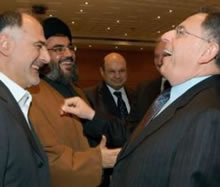
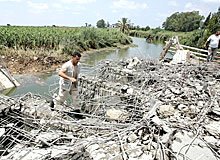
The damage done by the Israeli Air Force, Naval and artillery strikes against Lebanon appears to be formidable. Targets struck include numerous bridges, a power station and the runways of the Beirut International Airport. Civilians have also been hit. I've surveyed some of the Lebanese blogs that I read frequently, and many people were venting their anger at Hizbullah and Nasrallah, especially for the timing. It is not only Maronite Christians who are upset. The tourist season in Lebanon is in full swing and many Lebanese have been expecting to reap the dividends of the recovering tourist industry, which has been buoyed by Arab tourists from the Gulf and Saudi Arabia as well as westerners. Of course, the strikes are not endearing Israel to the Lebanese public, either. On his blog From Beirut to the Beltway, Abu Kais, a Lebanese American, who is, incidentally, a Shi'a, expresses his frustration with Hizbullah and Israel. His biggest complaint against Israel is that it is cowardly to beat up on Lebanon instead of attacking Syria or Iran.
From the perspective of Israeli decision-makers, however, the raids against Lebanon make perfect sense. Israel is sick of having to deal with non-state actors that are not beholden to the limits and types of calculations that usually restrain states. The Lebanese government has to be held responsible for its dilly-dallying on Hizbullah. Lebanese politicians have been engaged in a "National Dialogue" for months now and many hoped that this talk-shop would somehow result in the disbandment of Hizbullah. Nothing of that sort has happened. Instead, Lebanon's domestic political scene seemed totally paralyzed. Nothing was done to capitalize on the Syrian withdrawal in order to pressure Hizbullah, in the same way that nothing has been done since the Israeli withdrawal from Lebanon in 2000. Lebanese politicians have to wake up and start acting like leaders. The big fear among Lebanese was that provoking or cracking down on Hizbullah would result in renewal of a civil war. But is that an excuse for wasting time and not addressing the continued operation of a foreign-backed militia on your sovereign territory?! Is it better to allow Hizbullah to continue operating with impunity, to bring more missiles to southern Lebanon and to continue arming itself? The longer Lebanon waits, the more difficult it will become to pressure Hizbullah to do anything. Nasrallah knows this very well. The attack on Israel and the kidnapping of Israeli soldiers was a move to make his movement more popular among Lebanese Shi'a and perhaps among the Palestinians. Every time Hizbullah succeeds, its position vis-a-vis the state of Lebanon is strengthened.
Perhaps the Lebanese military and its leaders lack the material wherewithal and the political will to take on Hizbullah. In that case, they do not really deserve to be in charge of their country. If you cannot maintain a monopoly of force, if you cannot exercise your sovereign control over your territory, then you're not really a state and you need someone else to take care of business on your own territory, and that really sucks.
What is most unfortunate about all of this is that the Middle East has been through it all. Israel went to war against Egypt in 1956 partly because of the support that Egypt provided to Palestinian "fedayeen" irregulars who attacked civilians in Israel from the Gaza Strip. Israeli retaliations against Egyptian targets arguably led Egyptian leader Gamal 'abd al-Nasir to rein in the Palestinian militias. In Jordan, the Palestinians acted with more impunity and Israel also retaliated against Jordanian targets in the West Bank and not just the Palestinian guerillas. King Hussein also had to juggle his fears of domestic unrest (from Jordan's Palestinian population) and fear of Fatah with the need to forestall Israeli retaliation attacks. Hussein, to his credit, acted in September 1970 to save the Hashemite Kingdom of Jordan from overthrow at the hands of Fatah/the PLO. The comparison only goes so far, because Hizbullah is Lebanese and is therefore not considered an outside force, but the fact that it is backed by Syria and Lebanon makes it no less of a foreign agent.
Wednesday, July 12, 2006
Katyushas Rain Down on Nahariya
 Many Israelis in the North will be spending
 As usual, the Lebanese government declined to take responsibility for the terrorist groups operating comfortably from within its borders. Israel has finally decided to take the country to task by establishing a new strategic framework, in which Lebanese as well as Hizbullah infrastructure is targeted in response to attacks on Israeli civilians and soldiers. This morning, Hizbullah flexed its muscle, firing over fifty Katyusha rockets (of the type "Grad"), some of which hit the northern city of Nahariyah. Train service to the town has been halted. One woman was killed, and 8 people were injured in the strike which hit a house. More to follow. See the coverage in Ha'aretz.
Arab Hypocrisy vis-à-vis the Palestinians
Palestinians march for right to work in all professions
By Mohammed Zaatari
Daily Star staff
Wednesday, July 12, 2006
SIDON: More than 500 Palestinians demonstrated Tuesday at the Ain-al Hilweh refugee camp, calling on the Lebanese government and international community to allow refugees the right to work in any profession they choose. While praising Labor Minister Tarrad Hamade's partial lifting of a ban on some 70 specific professions for Palestinians born in Lebanon, protesters urged the minister to allow Palestinians to work in all fields, specifically pharmacy, engineering, law and medicine.
The government prohibits Palestinians from working in dozens of professions, most of which are in traditionally well-paying fields such as medicine, law, engineering, academia, etc.
[...]
The official reason? To prevent the permanent settlement of Palestinians in Lebanon.
Two-Front War
Hizbullah has plunged Israel into a two-front war. This morning, around 9:05, the Lebanon-based Shia militia launched a coordinated cross-border raid that began with an ambush on two IDF Hummer jeeps on patrol inside Israel near the border. Hizbullah infiltrators lying in wait, fired anti-tank missiles at the jeeps. Three soldiers were killed and 2 captured in this initial attack, which coincided with Katyusha rockets, mortar shelling, and gunfire raining down on army outposts and the border. Five Israeli civilians were lightly injured by this shelling of northern settlements. An Israeli tank that tried to pursue the attackers was blown up by a massive, remotely-operated roadside bomb inside Lebanon, killing 4 more soldiers. In ensuing attempts to rescue troops stuck in the completely-destroyed tank, a number of soldiers were injured, one seriously.The operation had been planned for six months, Hizbullah sources revealed.
One of the captured soldiers is a 24-year-old from a Druze village in the Western Galilee. The other soldier, who is 26, is from Kiryat Motzkin in the north.
So far, the IDF response has consisted of bombing bridges inside Lebanon to prevent the conveyance of the captured soldiers away from the border. Israel has mobilized a reserve division of 6,000 men. There are also reports that special forces are operating inside Lebanon. Furthermore, the Israeli navy is operating in Lebanese waters. The IDF claims that dozens of Hizbullah outposts have been destroyed, primarily by the air force.
At a press conference that concluded at 18:30, the Major-General Udi Adam of the IDF's Northern Command emphasized that Israel holds the state of Lebanon responsible for the attack and for the well-being of the soldiers. Hizbullah, he reiterated, operates freely from Lebanese territory. Thus, the IDF response will not be limited to the south of the country. The military has permission to operate deep inside Lebanese territory. Although he acknowledged that Hizbullah is supported by Iran, he rejected suggestions about a possible retaliation against Syria, emphasizing that
This is an issue between Israel and Lebanon. We hope Syria is mature enough to recognize this, and to stay out of the fighting.Earlier, I watched Hizbullah head Nasrallah delivering a defiant speech to his supporters; he was, as usual, all grins and smiles. Nasrallah reassured his audience, smirking all the while, that the two captured soldiers are "safe and far, far away." He warned Israel that any "escalation" would lead to a harsh response from the terrorist organization. Implicitly, he threatened that the organization would resort to its extensive system of Katyushas and Iranian Fajr missiles positioned across the border. The rockets are believed to be capable of hitting targets deep inside Israel, including such towns as Nahariya and Hadera, not to mention Qiryat Shmoneh in the north.
Israeli PM Ehud Olmert called the attacks a declaration of war.
Tuesday, July 11, 2006
"Envie de lui péter la gueule"
The Italian newspaper, Corriere della Sera, reports that FIFA, world soccer's governing body, bowing to pressure from the likes of SOS Racisme and Zizou's cousin Mokhtar Haddad, will launch a probe into the circumstances surrounding the headbutt.
The SOS call didn't alarm me as much as this comment from Mr. Haddad: "We think he either called him a terrorist or a son of Harkis [Algerians who fought on the side of France during the Algerian war of independence]."
Meanwhile, French defender William Gallas has declared his support for Zizou. The Frenchman says there is only one thing to do with these Italians: "crack their faces open."

I'm confused. Materazzi says he isn't cultivated enough to know what an Islamic terrorist is, but he knows what a Harki is? Rather than try to solve this puzzle, Jennie has suggested that we perform some tests to see how bad a headbutt to the thoracic zone hurts in an attempt to establish whether Materazzi is as good an actor as the French coach Raymond Domenech.
Monday, July 10, 2006
Palestinian-Americans Denied Entry
Amira Hass reports in Ha’aretz that
For the first time since 1967,
As the US Embassy has been careful to point out – to its own citizens as well as to the press – “
Sunday, July 09, 2006
It's Over
 The Tragic Fall of Zinedine Zidane
The world's greatest sporting event came to an end today, as Italy defeated France on penalty shots. It is an understatement to say that France has an image-problem in Israel. Thus, it was no big surprise that many Israelis were cheering for Italy. Nevertheless, the French team's hard work and especially the leadership of Zinedine Zidane had earned les bleues the grudging respect of many football fans here. All this admiration, however stinting, was erased at the end of tonight's game, when "some dark force," as the Israeli commentator put it, took over the retiring 34-year-old. After an exchange of words with Marco Materazzi, Zidane knocked the Italian player to the ground with a brutal head-butt to the chest, and then went on playing as if nothing had happened (though half a minute later he began to take off his arm band). I think it is not an exaggeration to call Zidane's head-butt and his red card in the second overtime period a tragedy - in the Shakespearean sense. It was painful to see this hero fall so low. From that point on, I could not watch the game without a deep sense of disappointment.
To be fair, even in Israel, and even after Zidane's self-destructive antics, there were a few voices that continued to support France - perhaps davka this tortured outburst of rage enamored the player to a few. One fan at the cafe where I was watching the game, on Ben Yehuda Street in Tel Aviv, kept repeating that Zidane was no frayer - the popular and infamous Israeli expression for a "sucker." One fan added the old adage that "you can take the boy out of the 'hood, but you can't take the 'hood out of the boy." But most of the cafes and bars on the street erupted in controlled applause and cheering when Italy clinched the cup.
Other local reactions: one fan, who seems to have been an immigrant from South America, kept insisting that the French team was not "French" - pointing at players like Makalele, Thierry, and, of course, Zidane. His neighbor seemed genuinely perturbed at this, and a small argument broke out. Strangely enough, the South American also repeated several times that he was "for the blacks," and that he liked them much more than the French. It was nevertheless a perverse observation. For all of France's social and ethnic tensions, the composition of its team seems much more "normal" than that of Italy or Germany, for example. I wonder what the South American thinks about Abbas Suan, the Israeli Arab who was one of the national team's star players during the World Cup qualifying stages.
Saturday, July 08, 2006
Post-Colonialist Fantasies about the "Arab Jew"
It's always sad to me that anything written about Middle Eastern Jewry in English has to be prefaced by some obligatory background about the fact that there were once vibrant Jewish communities throughout the Middle East and North Africa. The great majority of these Jews fled/emigrated/were expelled after the establishment of the state of Israel in 1948, and the rise of Arab nationalist regimes.
To this day, discussions about the circumstances that caused the massive exodus of Jews from their homelands in the Middle East are highly politicized. There are many people who argue that the Jews who fled Syria, Egypt and Iraq, for example, are no less deserving of the sympathy that has been shown to Palestinian refugees. Scholars and pseudo-scholars of the post-colonialist, anti-Zionist persuasion, on the other hand, have adopted Mizrahi (Hebrew for "Eastern" as in "Oriental") Jews as honourary (but generally reluctant) members of the "victims-of-Zionist-Ashkenazi-imperialist-oppression" club. Generally, the highly politicized claim of these academics is that the Jews who immigrated to Israel were "Arab Jews", whose identity and language was Arab. The post-colonialists argue further that these "Arab Jews,", after being conned into coming to Israel, were forced to abandon their heritage and their true identity, along with their alleged sympathies for their "fellow Arabs", the Palestinians. In the writings of these people, some of whom are Israeli scholars and others foreigners, "Mizrahi" Jews are depicted as the good Jews who were somehow perverted by the white/Ashkenazi/colonialist/Zionist establishment.
I have no problem with critical scholarship that challenges dominant social narratives and examines the problematic relationship of Israeli society to everything "Oriental". Many Middle Eastern Jews were indeed victims of discrimination, and there is no denying that immigrants who came to Israel in the 1950s and 1960s were pressured to conform to what was then an Ashkenazi-dominated Israeli identity. Among other things, this meant that people were made to feel ashamed of speaking Arabic, of having particular "Oriental" customs and of wearing certain clothes. Eastern European Jews, by the way, came under the same pressure to conform to "Israeliness" and to speak Hebrew rather than their native Yiddish, German, Polish, Russian, Hungarian or Romanian. In any case, to insist, today, as some radical, weirdo NGOs (Ahoti-Sista) and pro-Palestinian scholars (e.g. Joseph Massad, who has probably never been to Israel) do, that Israel is some kind of "internal apartheid" country composed of a dominant Ashkenazi elite and a downtrodden mass of "Arab Jews", is to be completely detached from reality. Today, Israelis of Middle Eastern origin are part of the establishment. Ethnicity and cultural backgrounds (and it's not exactly in the North American sense of the word) are celebrated proudly in public – witness the popularity of weddings in which bride and groom dress in traditional Moroccan Jewish attire or the number of people who still choose to have a Henna ceremony before the wedding. Furthermore, no one would even think of suggesting that the people who carry out these ceremonies are any less Israeli because of them.
So, basically, the only people who still hold on to the myth that Israeli Jewish society is about to errupt in ethnic conflict are those who have an interest in discrediting Israel. Usually, these people tend to be rather out of touch with what is going on in Israel. That is the reason why I was not surprised to read what Sasson Somekh had to say about a recent translation and review of an Israeli short story that appeared in the Egyptian literary magazine al-Hilal. Somekh grew up reading al-Hilal as a teenager in Baghdad, wrote Arab poetry and published masterful studies of Nagib Mahfuz's work. He has no problem calling himself an "Arab Jew" and does so frequently, but he is well aware that hardly anyone in Israel defines him or herself that way. That is why Somekh, the Israeli academic reading an Arabic translation of a Hebrew short story, is also quite critical of the translator's review.
The review and translation in question appeared in the June 2006 edition of al-Hilal and are the work of Muhammad 'Abud who translated the Ha'aretz prize-winning short story "Ana min al-yahud" written by Almog Bahar (although its title is in Arabic, the story itself was originally in Hebrew). Somekh starts out praising 'Abud, as he should. After all, it's not every day that Israeli literature is translated into Arabic in the Arab world and published so prominently. From Somekhs critique of 'Abud's review, however, it soon becomes clear that he takes issue with the claims that the Egyptian translator makes in his critique. 'Abud, who has also never visited Israel, characterizes Almog Bahar's story as a "Protest against Cultural Oppression". According to 'Abud, the hidden message that Bahar is trying to convey can be summed up as follows:"אני יהודי-ערבי ואני מדוכא ומקופח בשל ההגמוניה האשכנזית" [I'm an Arab Jew and I am oppressed by the Ashkenazi hegemony]. As Somekh reveals, however, the story is much more subtle and complex than that. It appears, above all, to be a humorous take on ethnic-linguistic tensions in Israeli society. I'll try to read the story before I comment more fully on it. To me it seems clear that even some of the more open-minded Egyptian intellectuals who take a genuine interest in Israel still suffer from a tendency to politicize their study of Israeli literature. For them, Israeli literature is to be read only as a means of understanding Israeli society, but not on its own artistic merits. Of course, that is a charge that can also be levelled at Middle Eastern studies scholars in Israel, although not at Somekh, whose works of criticism really do make an effort to treat their subject - Modern Arabic Literature - on its own merits, rather than as socio-political manifestos.
Source:
ששון סומך, המספר הישראלי - שטן או בעל ברית July 7, 2006 Ha'aretz
Thursday, July 06, 2006
The Elephant in the Room
I'm afraid the march to war is on and that the timetable will not be very convenient for Israel as Olmert and Peretz attempt to "change the rules of the game" with Hamas. I don't know what the best predictions are on a timetable for the Convergence Plan of withdrawal from large parts of the West Bank, perhaps the schedule is less and less fixed as the current crisis heats up. But Iran certainly won't be given until the August date it has set for itself to respond to the IAEA report. The G8 summit in St. Petersburg in 10 days time is bound to witness further escalation.
Wednesday, July 05, 2006
Olmert Announces Harsh Response to Ashqelon Attack
 Olmert Speaking at Independence Day
Celebrations at the US Embassy in Tel Aviv
Israeli Prime Minister Ehud Olmert must have surprised the consular staffers and select group of VIPs celebrating July 4th at the American Embassy in Tel Aviv. Instead of addressing them in English, as he had probably planned to do, he delivered a speech in Hebrew that focused on an event about which many of the guest had probably not yet been briefed. Olmert referred to the event as being of unparalleled gravity. Here is a a translation of an excerpt from the speech he delivered at the embassy. The translation is based on digital video footage of the event provided by a source:
The rocket that landed today in the heart of Ashqelon is an unprecedented escalation in the terrorist war directed by the Hamas organization, which today rules the Palestinian Authority. Here and now we will say only that to this attack, to this failed attempt to hurt civilians living in the borders of the sovereign state of Israel, there will be a wide-ranging and yet-unseen response. Hamas will the first to notice this.Olmert also mentioned the soldier Gilad Shalit, who is still in the hands of Palestinian militants. He vowed that Israel would do everything it could to bring Shalit home safely, to which the audience responded with loud applause. It seems clear, however, that the IDF mission in Gaza, originally launched to free the captured soldier, has been turned into a ground operation against the Qassams. The Ashqelon attack has provided Olmert with further evidence to convince the court of world opinion about the necessity of serious measures against the rockets. (That the firing on Sderot was not enough seems profoundly unjust; it is true that Ashqelon has more strategic sites and a larger population, but the people of Sderot are worth no less than the residents of Ashqelon). Olmert also implicitly emphasized the city's presence within the 1967 borders - something which, of course, also applies to Sderot. In so doing, the Israeli PM has tried to persuade the world that Israel is acting as any other sovereign state would and must - something which the Europeans especially, not to mention the Jewish State's numerous enemies, have been slow to grasp. The American line continues to be one of implicit approval.