Sunday, July 16, 2006
Sirens Go Off
At 13:55 the sirens went off here again, but thank God, it was a false alarm. Many people are already in bunkers.


More Katyushot Land
 11:15: We heard 3 booms, very loud. The last one sounded very close to us. Right now on the TV we are seeing an area that is 7 minutes walking from our house, but I don't think that's where they hit. This time the sirens went off BEFORE the rockets. We were wondering what they meant - a minute later we heard two quick booms, and then another louder one.
BTW, the cat in the apartment here is just chilling like nothing happened. I bet people's dogs are freaking out.
I'm posting a picture of an English map of Haifa. We're in [REMOVED]. There were hits in [REMOVED] and some other places it seems. I didn't have time to edit, so excuse the poor quality.
The Speedo Commando
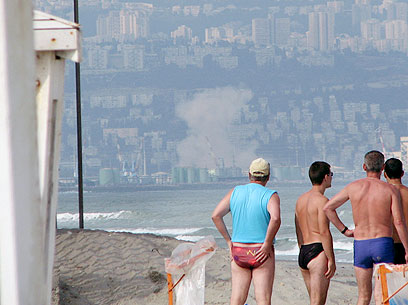
This is definitely the saddest day so far in this war. At least 8 people just lost their lives. I couldn't help smiling though when I saw this picture. A bunch of speedo-wearing Israeli swimmers look on as rockets fall in the background.
I'm a little concerned by the fact that the radio stations are being rather indiscreet about reporting where the rockets are falling. Hizbullah is definitely listening in to Israeli radio. Hopefully, this won't help them improve their aim.
Saturday, July 15, 2006
Live from Haifa
After the first boom, we weren't 100% sure what it was. But it became very obvious when we heard them all in succession. We both jumped out of bed. The booms were unlike anything I've heard. They weren't super-loud but really powerful-sounding, and it wouldn't stop. Boom boom boom boom. There was a five minute pause, and then we heard the next round. We counted a total of 13. There were bomb shelter sirens after the first booms. It took a while for the news to come on; we were watching Dr. Seuss for like a minute and still hearing booms. On another channel they were reporting about tonight's quiet, then suddenly, השקט הזה כרגע נגמר, "this quiet has just ended." There are six dead and and twenty wounded I am just seeing on the TV. We heard ambulances go by, but right now, it's 9:35 and relatively quiet. Oops, I spoke too soon, it's 9:40 and sirens are going off. I don't know if it's to go those nasty bunkers or just "protected rooms." We just heard another boom, that makes it 14 katyushot.
The number of dead has gone up to 9. Apparently the railway station has been hit, but have to confirm that. The neighborhoods that have been hit are [removed] and possibly [removed], which is very close, but we might have misheard the latter. [ADDED 10:10: it was not the railway station, but a garage - I think this is where the injuries were].
It's 10 am. We are watching some grainy images, maybe they're using their cell phones to film this. 10:02: we just heard 3 more booms. We are really absorbing some hits. The sirens are going off, and we are thinking more and more that the bunker might be a good idea. It would be nice to shower first but the bathroom faces north (that's bad, not because of the feng shui). Hizbullah just announced that they have fired Raad-2 and Raad-3 rockets. We are hearing some stuff on loudspeakers outside. I'm going to listen. Couldn't make it out.
10:10 the sirens are to stay inside, if possible in protected rooms.
The number of dead has gone up to 9. Apparently the railway station has been hit, but have to confirm that. The neighborhoods that have been hit are [removed] and possibly [removed], which is very close, but we might have misheard the latter. [ADDED 10:10: it was not the railway station, but a garage - I think this is where the injuries were].
It's 10 am. We are watching some grainy images, maybe they're using their cell phones to film this. 10:02: we just heard 3 more booms. We are really absorbing some hits. The sirens are going off, and we are thinking more and more that the bunker might be a good idea. It would be nice to shower first but the bathroom faces north (that's bad, not because of the feng shui). Hizbullah just announced that they have fired Raad-2 and Raad-3 rockets. We are hearing some stuff on loudspeakers outside. I'm going to listen. Couldn't make it out.
10:10 the sirens are to stay inside, if possible in protected rooms.
More Rockets Hit Haifa - Local Reports
My siblings Amos and Carmia who are currently in Haifa just reported that they heard approximately six loud explosions, followed later by another six or so. This was around 9:12 AM. When they turned on the TV news, they heard that a barrage of katyushot had struck Haifa or near Haifa. They appear to have missed, though, and landed in the Gulf. More details to follow, I'm sure...
What was Nasrallah thinking? Part Two
There has been a lot of commentary in the past few days on how to interpret the Hizbullah's decision to provoke Israel by launching its raid into Israeli territory. Nasrallah himself explained his decision as a bid to increase pressure on Israel to release the Palestinian, Lebanese and other Arab prisoners that it holds. Nasrallah also said that he wanted to help the Palestinian cause and that his attack came in solidarity with Hamas. We cannot dismiss these rationales as mere pretexts. Hizbullah is an organization with an ideology, and its followers may indeed view this operation as a way to "support" the Palestinians by coming to their need at a time of crisis. However, even if Nasrallah does not genuinely care about the Palestinians or other prisoners held in Israel and is using them only as a pretext to attack, he may have decided to carry out the raid in order to appeal to Lebanese Shi'a and to Arab public opinion as a whole.
Interpretations that ascribe this motive to Nasrallah tend to focus on the Lebanese domestic political context and regional public opinion to explain Hizbullah's attack. Lebanon's current Prime Minister, Fuad Siniora, is a member of the “Future Movement” – the anti-Syrian coalition led by Sa‘ad Hariri, the son of the assassinated former Prime Minister Rafiq Hariri. He’s perceived as pro-Western and pro-American. According to some commentators, Nasrallah’s aim was to embarrass Siniora and to expose him as a weakling. Hizbullah is making it very clear that it controls what will happen on the ground, while Lebanon’s Prime Minister is being forced to look on. The Lebanese army can’t intervene now, nor can the Prime Minister and other opponents afford to criticize Hizbullah directly, especially as Lebanon is under attack. Hizbullah supporters are probably gleefully pointing to the refusal of the United States to intervene and telling the Lebanese and all Arabs that Siniora and his American friends are useless. They’re trying to position themselves as fighters and heroes and the only ones who can uphold Arab honour. These claims are of course ludicrous – Hizbullah is the reason for the attacks and the reason why America is not standing by Lebanon. There’s not a chance that a terrorist group implicated in the death of 220 marines (killed by an attack on the American peacekeeping force stationed in Beirut in 1983) is going to get a break from the United States. A propos, Jordan and Saudi Arabia, both allies of the United States, have come out strongly attacking Hizbullah’s foolishness and brazenness.
On the other hand, Hizbullah is being backed by two states that are trying to send a message to America. It’s clear that Hizbullah is a proxy of Iran and Syria, although it is not clear whether instructions were issued for these attacks. Even in a Ha’aretz article by Yoav Stern published today (July 16), a senior Israeli military intelligence officer is quoted as saying that, although Syria has played a “negative role” in the recent events, it is not believed to be “directly involved in the escalation.” The Israelis are also denying that they intend to attack Syria. Instead, Israeli military commentators such as Ze’ev Shiff are saying that Iran is the country that is leading the way in supporting Hizbullah. Many of the rockets, including the advanced missile used to strike at the Israeli frigate, are of Iranian make, apparently. Iran’s Revolutionary Guards are also present on the ground in Lebanon and advising Hizbullah. This is obviously a very useful opportunity for Iran to get a look at Israeli capabilities and weaknesses. Hizbullah is indeed an incredibly useful proxy for Iran. However, there’s also a larger picture, one that is well-explained on SyriaComment.com, a blog run by Joshua Landis, an academic who knows Syria, but has been fiercely attacked by a number Lebanese-American academics for acting as a mouth-piece for the Syrian regime. According to Landis, Syria is mad that it has been sidelined by the US ever since 9-11. America has made it harder for Syria to get international financing, has accused Syria of assisting rebels in Iraq, locked Syria out of trade deals with Iraq, pressured it to withdraw from Lebanon and dissed Bashar al-Asad on numerous occasions. Syria wants the Americans to understand that it is a regional power to be reckoned with. In other words, Bashar al-Asad does not want to be considered irrelevant to stability in the Middle East. According to Shiff and others, Iran’s interest is to divert attention from the nuclear issue and to prevent it from being brought to the Security Council. I don’t fully understand how a momentary conflagration could have achieved that, but I do see how, if this turns into a big regional crisis, there might be less unity among Security Council members on the Iran issue. Maybe the Iranians are stirring up trouble between Lebanon, Israel and the Palestinians, to signal that Europe and the US cannot push Iran too far in the nuclear negotiations.
Interpretations that ascribe this motive to Nasrallah tend to focus on the Lebanese domestic political context and regional public opinion to explain Hizbullah's attack. Lebanon's current Prime Minister, Fuad Siniora, is a member of the “Future Movement” – the anti-Syrian coalition led by Sa‘ad Hariri, the son of the assassinated former Prime Minister Rafiq Hariri. He’s perceived as pro-Western and pro-American. According to some commentators, Nasrallah’s aim was to embarrass Siniora and to expose him as a weakling. Hizbullah is making it very clear that it controls what will happen on the ground, while Lebanon’s Prime Minister is being forced to look on. The Lebanese army can’t intervene now, nor can the Prime Minister and other opponents afford to criticize Hizbullah directly, especially as Lebanon is under attack. Hizbullah supporters are probably gleefully pointing to the refusal of the United States to intervene and telling the Lebanese and all Arabs that Siniora and his American friends are useless. They’re trying to position themselves as fighters and heroes and the only ones who can uphold Arab honour. These claims are of course ludicrous – Hizbullah is the reason for the attacks and the reason why America is not standing by Lebanon. There’s not a chance that a terrorist group implicated in the death of 220 marines (killed by an attack on the American peacekeeping force stationed in Beirut in 1983) is going to get a break from the United States. A propos, Jordan and Saudi Arabia, both allies of the United States, have come out strongly attacking Hizbullah’s foolishness and brazenness.
On the other hand, Hizbullah is being backed by two states that are trying to send a message to America. It’s clear that Hizbullah is a proxy of Iran and Syria, although it is not clear whether instructions were issued for these attacks. Even in a Ha’aretz article by Yoav Stern published today (July 16), a senior Israeli military intelligence officer is quoted as saying that, although Syria has played a “negative role” in the recent events, it is not believed to be “directly involved in the escalation.” The Israelis are also denying that they intend to attack Syria. Instead, Israeli military commentators such as Ze’ev Shiff are saying that Iran is the country that is leading the way in supporting Hizbullah. Many of the rockets, including the advanced missile used to strike at the Israeli frigate, are of Iranian make, apparently. Iran’s Revolutionary Guards are also present on the ground in Lebanon and advising Hizbullah. This is obviously a very useful opportunity for Iran to get a look at Israeli capabilities and weaknesses. Hizbullah is indeed an incredibly useful proxy for Iran. However, there’s also a larger picture, one that is well-explained on SyriaComment.com, a blog run by Joshua Landis, an academic who knows Syria, but has been fiercely attacked by a number Lebanese-American academics for acting as a mouth-piece for the Syrian regime. According to Landis, Syria is mad that it has been sidelined by the US ever since 9-11. America has made it harder for Syria to get international financing, has accused Syria of assisting rebels in Iraq, locked Syria out of trade deals with Iraq, pressured it to withdraw from Lebanon and dissed Bashar al-Asad on numerous occasions. Syria wants the Americans to understand that it is a regional power to be reckoned with. In other words, Bashar al-Asad does not want to be considered irrelevant to stability in the Middle East. According to Shiff and others, Iran’s interest is to divert attention from the nuclear issue and to prevent it from being brought to the Security Council. I don’t fully understand how a momentary conflagration could have achieved that, but I do see how, if this turns into a big regional crisis, there might be less unity among Security Council members on the Iran issue. Maybe the Iranians are stirring up trouble between Lebanon, Israel and the Palestinians, to signal that Europe and the US cannot push Iran too far in the nuclear negotiations.
Life Goes On in Haifa
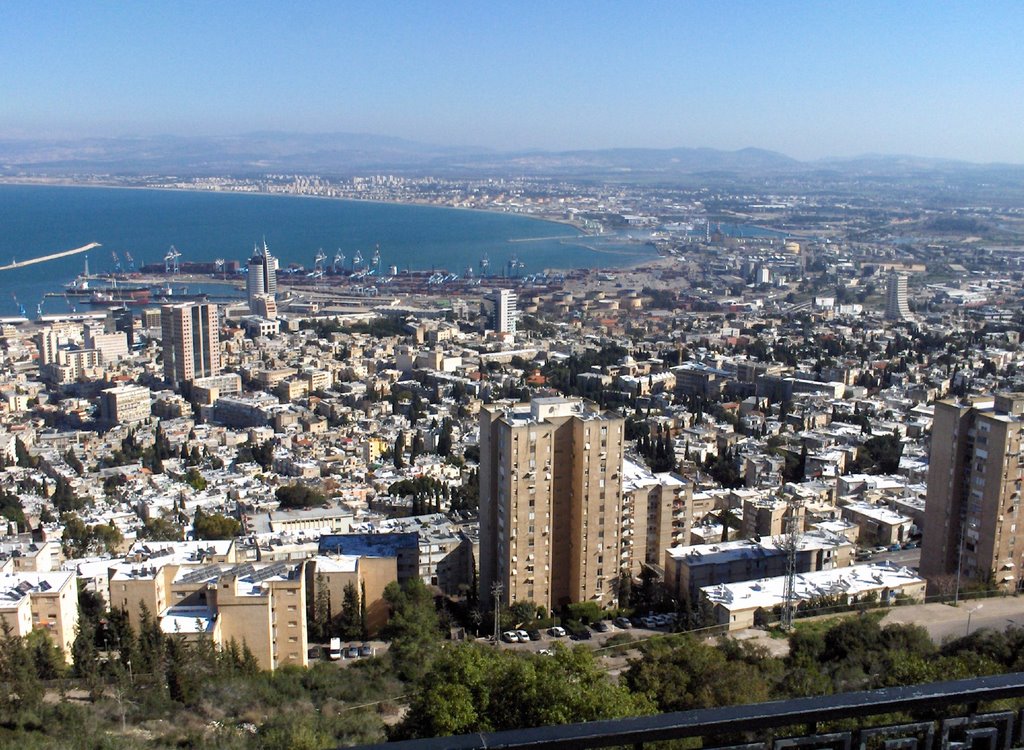
Although Haifa is still under the threat of attack, life, at first glance, seems to be continuing as normal. It's Saturday night and the cafes are full. During the day, Wadi Nisnas, the bustling Arab neighbourhood of Haifa, did not seem noticeably emptier than usual. However, while apartment-hunting, it became clear that a lot of little people had evacuated the city. Many of the landlords were unable to show us their apartments because they had left for Tel Aviv or other places for the weekend. One even thought that Tiberius would be a nice escape and instead found herself in a bunker with the family after the katyushas hit the town.
What was Nasrallah Thinking?
I am not sure what the consensus on this is. Perhaps we won't know until many years from now. But I am curious what the motivations for the Hizbullah attack on Israel were. Could it be that Nasrallah simply miscalculated, or did Hizbullah in fact hope to provoke a response of the scale that we are currently witnessing? If Hizbullah's primary motivation was to free prisoners in Israeli jails, then the organization seems to have made a serious mistake. On the other hand, if the goal was to start a war that has potential to turn into a regional conflagration, we have to ask whose interests this would serve. Hizbullah has very little to gain in the long run. Sure, its occasional military successes, such as the kidnapping action, blowing up an IDF tank, the hit scored on the Israeli missile boat, and of course the barrage of rockets that have terrorized Israeli civilians, might boost the organization's approval ratings in the Muslim world. Furthermore, the tragic deaths of innocent Lebanese civilians, killed by F-16 missile strikes, as well as the population's suffering might galvanize Arabs and Muslims further against Israel. But these aims have rather high costs attached to them. In the long run, Israel will probably be able to destroy a significant part of Hizbullah's infrastructure and personnel. Furthermore, as I've said before, without Hizbullah's attack on Israel, these deaths would not have taken place. Perhaps the Lebanese and others will make Hizbullah responsible. A revision of the border is out of the question - here, Hizbullah has no legitimacy whatsoever. So what can Hizbullah actually gain?
I have left out the Syrian and Iranian factors until now. It is true that the Syrians have territorial ambitions - to regain the Golan Heights and the Sheba farms. But they also have a lot to lose in an international climate that is heavily tilted against them. What about the Iranians? Here, one possibility might have been an attempt to divert attention from their nuclear efforts. On the other hand, it is possible to ask whether for them too the motivation is ultimately ideological.
I have left out the Syrian and Iranian factors until now. It is true that the Syrians have territorial ambitions - to regain the Golan Heights and the Sheba farms. But they also have a lot to lose in an international climate that is heavily tilted against them. What about the Iranians? Here, one possibility might have been an attempt to divert attention from their nuclear efforts. On the other hand, it is possible to ask whether for them too the motivation is ultimately ideological.
IDF Press Conference - ha-Qirya, Tel Aviv
I'm listening to a press conference being given by the Chiefs of Staff of the different branches of the IDF right now. It's being broadcast live on Israel Army radio (Galey Tsahal) from Israeli Defence Headquarters in Tel Aviv. Here are some noteworthy remarks:
Asked about the IDF's targeting of a bus carrying 18 Lebanese civilians, a senior officer from the Air Force expressed regret for any civilian deaths.
- The missile that hit an Israeli Frigate 16 km off the coast of Lebanon was struck by an Iranian-made radar guided missile (C-802). Two such missiles were fired. One hit the Israeli frigate, inflicting heavy damage and resulting in the death of one soldier and three missing. Another missile hit a Cambodian ship and sank it. Its Egyptian crew was rescued by a passing boat. An Israeli navy representative noted that the IDF did not anticipate that Hizbullah would use the missile in the naval theater. They said that it was a surprise that the Iranians had granted Hizbullah use of advanced weaponry of this sort. It was also stated that the Lebanese Army allowed Hizbullah use of its radar facilities to fire the missile and that Lebanese Army radar facilities have been hit as a result.
- Israel has no intention to invade Lebanon using ground forces
- The IDF intends to refrain from striking at Lebanese Army forces unless they become involved in the fighting. Only Hizbullah-linked targets are being attacked.
- The patriot missile batteries that have been positioned in the Haifa area are not intended for use against Hizbullah fire. They are intended as a defensive measure against a potential Syrian attack.
Asked about the IDF's targeting of a bus carrying 18 Lebanese civilians, a senior officer from the Air Force expressed regret for any civilian deaths.
Friday, July 14, 2006
Local Reactions in Haifa
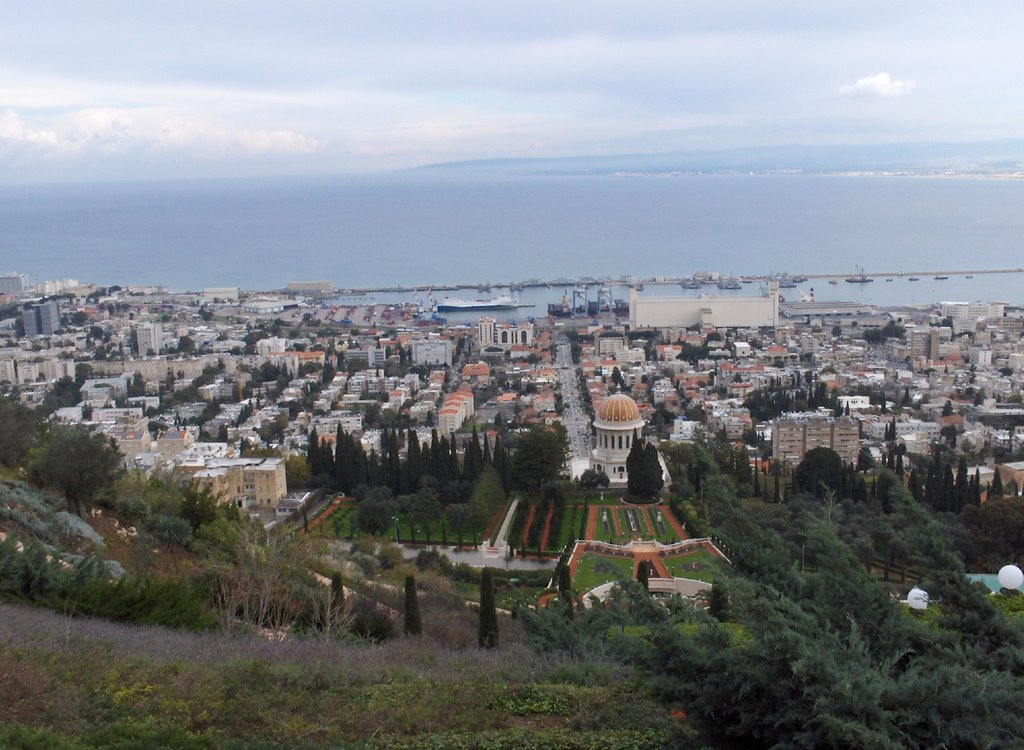 A picture of the beautiful Bahai Gardens in Haifa taken last winter.
My brother and I had made plans to tour it again on Shabbat.
Ghaleb Abu Zaineb, a Hizbullah official, today threatened that the terrorist organization would fire more rockets on Haifa "at any time." Reactions here in Haifa to the attacks and new threats vary. Yesterday, before the first rocket landed in Haifa, many people expressed doubt that Hizbullah would pull through with their threat. Following the attack, people on the street reacted in different ways. There were some nervous tears, and I noticed more hugging than usual; some of the young men voiced fears that they might soon be called up. Everyone is glued to radio and television news, wondering what their next step should be: staying put, locating nearby bunkers, or preparing to stay with friends and family further south. Our family members are also urging us to come to the centre of Israel. For now though, most people are staying put. However, daily life has been interrupted or at least modified. People have changed their weekend plans, and are going to spend less time outside. Work has also been affected for some.
More Europeans who don't get it
The Sueddeutsche Zeitung has a story (it's more like an opinion piece) on human rights and international law experts' evaluations of the Israeli response. Of course, all of the "experts" cited in the article deny that Israel has a right to act as it has in the past few days. This excerpt sums up the overall tenor:
I think what the Europeans expect Israel to do is to wait until it loses 20 civilians in a missile attack on Tel Aviv. They don't understand that if Israel wants to maintain any sort of deterrence to prevent something terrible like that from happening, it has to react with "disproportionate" force.
Auch Völkerrechtler kritisieren das Ausmaß der israelischen Vergeltungsschläge. Unumstritten ist freilich, dass sich Israel nach Artikel 51 der UN-Charta gegen „bewaffnete Angriffe“ verteidigen darf.
Ob die vereinzelten Überfälle libanesischer Hisbollah-Kämpfer auf israelische Grenzposten bereits Angriffe in diesem Sinne sind, ist strittig. Ebenso die Frage, ob der libanesische Staat überhaupt für die Aktionen der Hisbollah verantwortlich ist.Entering another country's territory to kidnap soldiers, shelling civilian settlements and military outposts, and, to top it all off, firing rockets at its cities - all these do not qualify as "attacks"?
International law specialists, too, criticize the extent of the Israeli retaliation strikes. Certainly, the right of Israel to defend itself against "armed attacks," according to Article 51 of the UN Charter, is undisputed.
But whether isolated ambushes of Israeli border outposts by Lebanese Hizbullah fighters already qualify as attacks in this sense is debatable. Similarly questionable is whether the Lebanese state is responsible for the actions of Hizbullah at all.
I think what the Europeans expect Israel to do is to wait until it loses 20 civilians in a missile attack on Tel Aviv. They don't understand that if Israel wants to maintain any sort of deterrence to prevent something terrible like that from happening, it has to react with "disproportionate" force.
Disproportionality
Reading through the major world newspapers, one finds the overwhelming opinion from Spain to India to be that Israel's reaction to the capture of its soldiers is "disproportionate" to the provocations of Hamas and Hizbullah. The EU came out last week with its condemnation of the offensive in Gaza, and now the French, Russian, and Italian foreign ministers as well as the EU presidency have all gone on record as saying that Israel's use of force in Lebanon is similarly disproportionate. In today's Süddeutsche Zeitung, Germany's left-center paper, an otherwise sympathetic commentator calls Israel's reaction "überproportional" and a recipe for further violence. If only European opinion makers could suggest some POSITIVE, concrete alternatives for Israel aside from simply calling for a "measured response."
All of these world leaders recognize Israel's right to react with force to the recent attacks on its sovereignty, but it seems to this observer as well that the "shock and awe" of military strength is simply not the most effective means of halting the violence, returning the soldiers safely, or winning international support. The importance of the latter, especially, it seems to me, should not be underestimated over the long run. As Ha'aretz suggests, negotiations with Hizbullah should not be rejected out of hand.
Perhaps the broader implication of my comment is that the mouth-watering temptation to smugly reject all European opinion on Israel as self-righteous, hypocritical, and/or antisemitic - which it often is - should not lead us to lose our critical stance vis-a-vis the Israeli military.
All of these world leaders recognize Israel's right to react with force to the recent attacks on its sovereignty, but it seems to this observer as well that the "shock and awe" of military strength is simply not the most effective means of halting the violence, returning the soldiers safely, or winning international support. The importance of the latter, especially, it seems to me, should not be underestimated over the long run. As Ha'aretz suggests, negotiations with Hizbullah should not be rejected out of hand.
Perhaps the broader implication of my comment is that the mouth-watering temptation to smugly reject all European opinion on Israel as self-righteous, hypocritical, and/or antisemitic - which it often is - should not lead us to lose our critical stance vis-a-vis the Israeli military.
Thursday, July 13, 2006
Taking Stock of Air Force Operations
Hizbullah threatened to bomb Haifa yesterday afternoon IN RESPONSE to IAF strikes on its headquarters in Beirut. But Hizbullah ended up preempting the IDF, firing a number of Katyushas at Israel's third-largest city that, B"H, did not lead to any deaths (as far as I know). All along, Hizbullah is trying to present itself as the defender of Lebanon, even though it was the terrorist organization that precipitated the attacks on the country in the first place. Without Hizbullah's unprovoked attack across the internationally-recognized border, Lebanese citizens would be carrying on with their lives as usual today. They would be dancing in the clubs of Beirut and enjoying the rewards of a growing economy bolstered by a recovering tourism industry. Of course, the air strikes are not exactly endearing Israel to ordinary Lebanese, but before the attack on Haifa - an unbelievable escalation - the air force focused mostly on Hizbullah bases, missile silos, and bunkers, as well as strategic sites such as bridges, roads, and airports that could be used to convey troops. Ze'ev Schiff has a good analysis of the sites that the air force has targeted so far. He writes that:
The vast majority of the 100 targets that the IAF have hit are in southern Lebanon. On Friday, the air force is likely to expand its operations to include other parts of the country. The operations are guided by an effort to indicate to the Lebanese government those areas for which Israel considers it responsible. Therefore, it is important to note not only the nature of the targets the air force is attacking, but also those that it is not. The air force, for example, attacked Hezbollah offices, but none in Beirut.Of course, now that Haifa has been attacked, all this is likely to change.
Haifa Hit
Haifa, one of the major population centres of Israel and the city I live in, has been hit. Although the New York Times claims that two rockets have hit the Haifa port, I have not come across this information elsewhere.
We know that the area of the famous Stella Maris Cathedrale (about two kilometres from my home) was hit. The information we are getting is rather confusing: stay at home, don't go outside; on the other hand, my friend says there are clear instructions to go down to the neighbourhood bunkers. The mall I work at was shut down some time after the rocket hit, before regular closing time. All the coffee shops and restaurants, usually bustling in the evening hours, are also dark and empty.
We know that the area of the famous Stella Maris Cathedrale (about two kilometres from my home) was hit. The information we are getting is rather confusing: stay at home, don't go outside; on the other hand, my friend says there are clear instructions to go down to the neighbourhood bunkers. The mall I work at was shut down some time after the rocket hit, before regular closing time. All the coffee shops and restaurants, usually bustling in the evening hours, are also dark and empty.
Subscribe to:
Posts (Atom)