Showing posts with label Oil. Show all posts

Thursday, November 06, 2008

Wishful Thinking

I'm curious what exactly Amr Hamzaway is talking about:
US policies in the region are in the grip of a severe credibility crisis. I am not talking about the campaign to spread democracy, to which the Bush administration had hardly adhered before the Hamas victory in the Palestinian legislative elections in 2006 and that it abandoned entirely afterwards. Rather, I am speaking of the conventional role that Washington has played since the end of World War II, which is to protect its allies -- Israel above all -- and to steer the collective security arrangements in the Gulf in order to safeguard the flow of oil. Many of America's allies have begun to question the efficacy of Washington's polices and, in some cases, now believe these policies cause more problems than they solve.
What kind of role does he expect Washington to play? Is he really so delusional as to think that anything meaningful will come of Arab flirtations with other (rather mysterious) powers? The "allies" to whom he is referring may believe what they like. They have long been free to do so. The more important question is, what are they going to do about it?

Obama will pursue a different kind of foreign policy in the region than Bush. But he will certainly not stop protecting Washington's allies or the flow of oil.

Sunday, August 10, 2008

The Destruction in South Ossetia

Ethnic diversity in the Caucasus (Source)

The Russian devastation of Georgian positions in the break-away region of South Ossetia, Abkhazia, and, now, the Caucasian country's heartland signal a new reality not only in this part of the world but in Russia's role elsewhere.

As so many commentators have pointed out, this was the first time that we have seen Russia's military confront regular armed forces, as part of an international conflict, since its 1979 invasion of Afghanistan. One could nitpick and point to the fighting in Chechnya, but here Russia faced a separatist insurgency carried out by irregular though effective bands of fighters. Russia's performance in that earlier conflict, however, was interpreted by many as a symptom of its military's disintegration.

Now, Russia has asserted its supremacy, before its doorstep - in the air, sea, and on (the rather treacherous) land. It faced down a modern fighting force by a small but rising power, whose army has been supplied by Ukraine, the US, and Israel (until recently). Interestingly enough, although the news showed up only on a few tickers several weeks ago, Israel suspended its arms shipments (primarily UAVs) to Georgia - probably after Russian pressure.

After the diplomatic defeat in Kosovo, which the Russians have always argued should also mean a green light for Abkhazian and Ossetian independence from Georgia, Putin and Medvedev have upped the ante - they are talking about an outright annexation of these regions to Russia. The South Caucasus, in retrospect, was a red line for Russia, beyond which it would not allow any more encroachments. With Georgia's foolish decision to launch a preemptive attack on the separatist positions in South Ossetia, Russia has seized the opportunity to take an even larger bite.

The implications for the former Soviet republics are clear - states from Turkmenistan to Ukraine (and their would-be allies in the West or elsewhere) must now own up to the fact that whatever support is delivered to them from afar better be significant if they are to assert themselves against Russia. For the weaker states among these republics, this will mean toeing a more neutral line between Russia and the West. The belligerent factions in Azerbaijan pressing for a renewal of hot war with Armenia, over control of Nagorno-Karabakh, may have been served notice. This would be a dramatic reconfiguration of the South Caucasus, with the the "TBC pipeline powers" folding their cards to Gazprom - though it remains to be seen how Turkey, another state whose current military capabilities in international conflict are still untested will react this state of affairs. To be sure, the reduction of Georgia to a rump state around Tblisi would be good news for the other resource-poor state in the region - the Republic of Armenia.

For larger former Soviet republics, such as Ukraine, Russia's actions will accelerate coalition-building with the West and investment in their armed forces. Apparently, the Ukrainian navy is not standing idly by as Russia attempts to blockade the Georgian coast, to prevent Ukrainian arms dealers from shipping weapons there. But it remains to be seen how much force, if any, Ukraine will be able to wield against Russia in this round.

Beyond its immediate sphere of influence on its frontiers, Russia has made explicit its rejection of an international system that it perceives as stacked in the West's favor. It has also made the Western European powers preaching to it look like paper tigers. Although much of Russia's rhetoric in this conflict has been directed at the US, which it blames for inciting Georgia's attack in the first place, it has become clear that the Americans decided early on that Georgia was not worth an overt confrontation with Russia. No doubt, this will bring joy to many Russian analysts and to others riding the bandwagon of America's decline. They should be careful not to overstep the new borders demarcated for them.

Thursday, October 11, 2007

Troubles in Turkey

Two issues are currently occupying a great deal of public attention in Turkey: the Armenian genocide resolution in the US Congress, and PKK activity in southeastern Turkey and northern Iraq. While the former has also received significant press coverage in the US, there seems to be very little awareness in the American and European media about the latter. For the Turks, the lack of concern shown by the Europeans and the Americans for the dangers posed to the country by PKK attacks is a source of deep frustration and a sense of abandonment. People in the government and the press are openly questioning the value of Turkey's partnership with America and the West. Indeed, many are implicating the US in the terrorist attacks by the PKK, referring repeatedly to the alleged discovery of American weapons in PKK hands. The Armenian genocide resolution seems to these critics of the US yet another indication of America's evil intentions (or, at best, indifference) with respect to Turkey. Rather than interpreting the genocide resolution as a product of America's democratic culture, the Turks seem to be reading it as another example of Western hypocrisy and imperialist interference in Turkish affairs. Furthermore, it is hard to ignore the thinly-veiled expressions of anger at "the Jewish lobby," which some Turkish commentators are now depicting as part of an anti-Turkish alliance with "the Armenians."

There is very little that the Turks can do to directly influence Congress at this stage. The White House's furious diplomatic activity against passage of the House resolution to recognize the Armenian genocide seems doomed to failure. Likewise, Turkey's power to take direct action against either the Iraqi Kurdish government or the PKK is also somewhat limited. This does not mean that the Turks will be able to hold off indefinitely public opinion calling for some kind of response. But it seems that the Turkish military and government realize the risks and difficulties of a more extended cross-border operation. Economic sanctions against the Iraqi Kurds are also a possibility - but they may also hurt Turkish interests in the area.

This leaves Turkey with a more indirect option. While the Turks have been thwarted in their attempts to project direct military force in the region (mainly because of the presence of the Americans), they do have the ability to disrupt significantly American strategic aims with respect to Iran and Russia. Turkey is the key to two planks of American energy policy: 1) to isolate Iran, and 2) to provide an alternative to Europe-bound Russian oil and gas pipelines.

The Americans have been watching Turco-Iranian energy cooperation with a great deal of concern. But the lack of American concern for Turkish interests in Iraq, has pushed the country to drop its inhibitions about upsetting the Americans on this front. Indeed, some Turkish politicians seem to be advocating cooperation with the Iranians on the Kurdish issue as well. As for Russia, despite Turkey's investment in American-backed infrastructure projects in the South Caucasus, the Turks have no qualms about serving as another gate for Gazprom energy to Europe and the Levant. The more the merrier.

Saturday, June 16, 2007

Iraqi Oil Trivia of the Day

Iraq Oil Infrastructure (source)

From Lieutenant General Martin Dempsey's testimony (watch it on CSPAN) at the House Armed Services Subcommittee hearing on Tuesday, June 12:

Nearly 90% of Iraq's total revenue depends on two offshore oil terminals in the Persian Gulf. The Al-Basra Oil Terminal (ABOT) pumps oil worth 83% of that revenue, while Khor al-Amaya's output (KAAOT) makes up 5-6%. They are protected by a "ring of steel" about which you can read more in one of Michael Yon's older dispatches.

Sunday, June 10, 2007

Historical Note on Turkish-American Relations

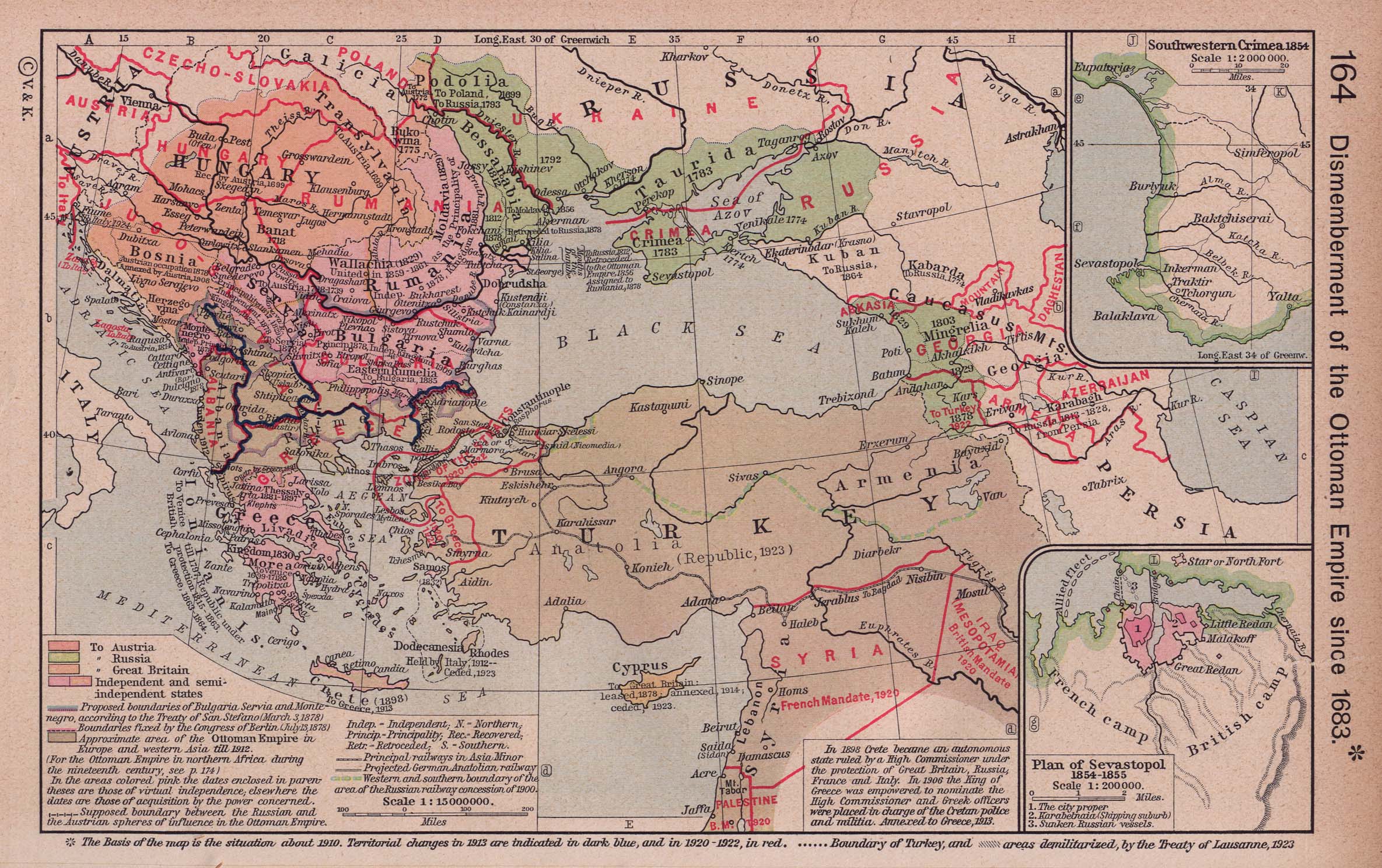
The dismemberment of the Ottoman Empire
(Perry Castaneda, click to magnify)

Hazbani's questions about U.S. policy toward the Ottoman empire and the Turkish republic after WWI sparked my interest in the history of Turco-American relations.

As Hazbani noted, the U.S. did not declare war on the Ottoman empire in 1917 - a decision in line with the non-interventionist policy it had pursued since the late 19th century. The U.S.'s main concerns then were protecting the investments that American missionaries had made in educational institutions, as part of efforts to convert Ottoman Christian minorities. But the American also had an eye to future economic opportunities. The latter motivations became preeminent after 1918, when most of the Ottoman Christian populations had either left or been killed or deported.

It is interesting that Hazbani mentioned a US Navy paper, on "USN relations with Turkey from 1914-1940," as the person whom many associate with redefinition of American relations with Turkey after the war was Admiral Mark Bristol, the U.S. High Commissioner to Turkey from 1919-1927. Bristol saw economic and investment opportunities for the U.S. in Turkey, and he was not blind to the navy's need for oil (Donald Bloxham, The Great Game of Genocide, pp. 185-187).

Another point that Hazbani made was about the relatively benign stance of the U.S. toward the defeated Ottoman empire, especially when compared to the rapacious aims of the British, French, Italians, and Greeks.

Under the Treaty of Sèvres, signed in August 10, 1920, the Ottoman empire was not only stripped of all its non-Turkish territories (in the Balkans and in North Africa), but also of some of its Anatolian possessions. The oil-rich town of Mosul, one of those former Ottoman empire possessions that Melih Can was talking about, was seized by the British as part of the Iraq mandate. The French took Cilisia as part of their Syrian mandate. In Eastern Anatolia, the Allies recognized the Armenian and Kurdish claims to independence. Finally, in May 1919, the Allies approved of the Greek occupation of Smyrna (or Izmir in Turkish) in the west, also on the grounds of national self-determination (Greek statisticians claimed a Greek majority in the city). However, the Italians were allowed to occupy Antalya in SW Anatolia (Norman Rich, Great Power Diplomacy since 1914, p. 61).

The U.S. did not participate in this, partly because it had not been party to the irresponsible promises of territorial spoils made by the Allies to each other. However, American businessmen were happy to go along with the British in looking for oil in tapping the Mosul oil fields. There actually was a certain convergence of US and British interests here, but the U.S. came to differ with Britain and the other European powers on the future of Turkey. The British, under Lloyd George, hoped to persuade America to guarantee Armenian independence and thereby put in place a check against both Bolshevik and possible Turkish pan-Islamist (or pan-Turkic?) ambitions. The Americans refused, and eventually came to see a strong, nationalist Turkey as a preferred alternative (Bloxham, Ibid., pp. 192-193).

Atatürk (Wikipedia)

In the meantime, Mustafa Kemal had risen to the top of the Turkish nationalist movement. In October 1920, the Bolsheviks had overthrown the Armenian Republic and turned it into a Soviet Republic. But with the Red Army embroiled in a war with Poland, Kemal attacked the Armenian Soviet Republic and regained all the lost Turkish territory, including Batum, Kars, and Ardahan; Batum was later returned, and became part of the Georgian Soviet. Kemal also signed a treaty with France, which returned Cilicia in southern Anatolia as well as arms, in exchange for Tureky's recognition of the French mandate over Syria. Lastly, the Italians surrender their Anatolian claims in return for certain economic stipulations and Turkish acceptance of their possession of Tripoli, the Dodecanese islands, and Rhodes. In August 1922, the Turks took back Smyrna from the Greeks. Finally, the nationalist forces headed north to Constantinople, where the British were still defending the sultan and the Treaty of Sèvres. Soon thereafter, Kemal led the domestic revolution that deposed Sultan Mehmed VI on November 17. The net result: Anatolia had been secured under the leadership of a modern, Western-oriented Turkish Republic.

These Turkish gains were consolidated under the November 20, 1922 Treaty of Lausanne. Armenian and Kurdish independence in eastern Anatolia had been quashed, as had Greek claims in the west (eastern Thrace); only Mosul was lost to the Mesopotamian mandate, and Alexandretta (İskenderun) to France (the latter became part of Turkey again in 1939) (Rich, Ibid., pp. 85-87).

(Map source: Wikipedia)

From 1922 to 1989, American policy viewed a strong, undivided Turkey as a bulwark against the Soviet Union and as a force for stability in the region. Although Turkey's pursuit of an autarkic economic policy and its trade relations with the Weimar Republic and then the Hitler regime during the interwar period and into the 1930s meant that many of America's economic hopes were not realized then, the military and economic aid that poured into Turkey in the 1940s cemented the American role in the country.

Turkey, it seems clear, now wants some of the oil spoils of which it had been deprived by the British after WWI. In addition to protecting its population from terrorist attacks, the country also wants to safeguard its territorial integrity, which it sees threatened by the rise of a Kurdish state on its southern border, and Kurdish control over oil revenues from Kirkuk and elsewhere. The trick for the U.S. will be to determine how to keep the Turks in line with its own interests, at the lowest price possible.

Thursday, June 07, 2007

Has Turkey Crossed the Rubicon?

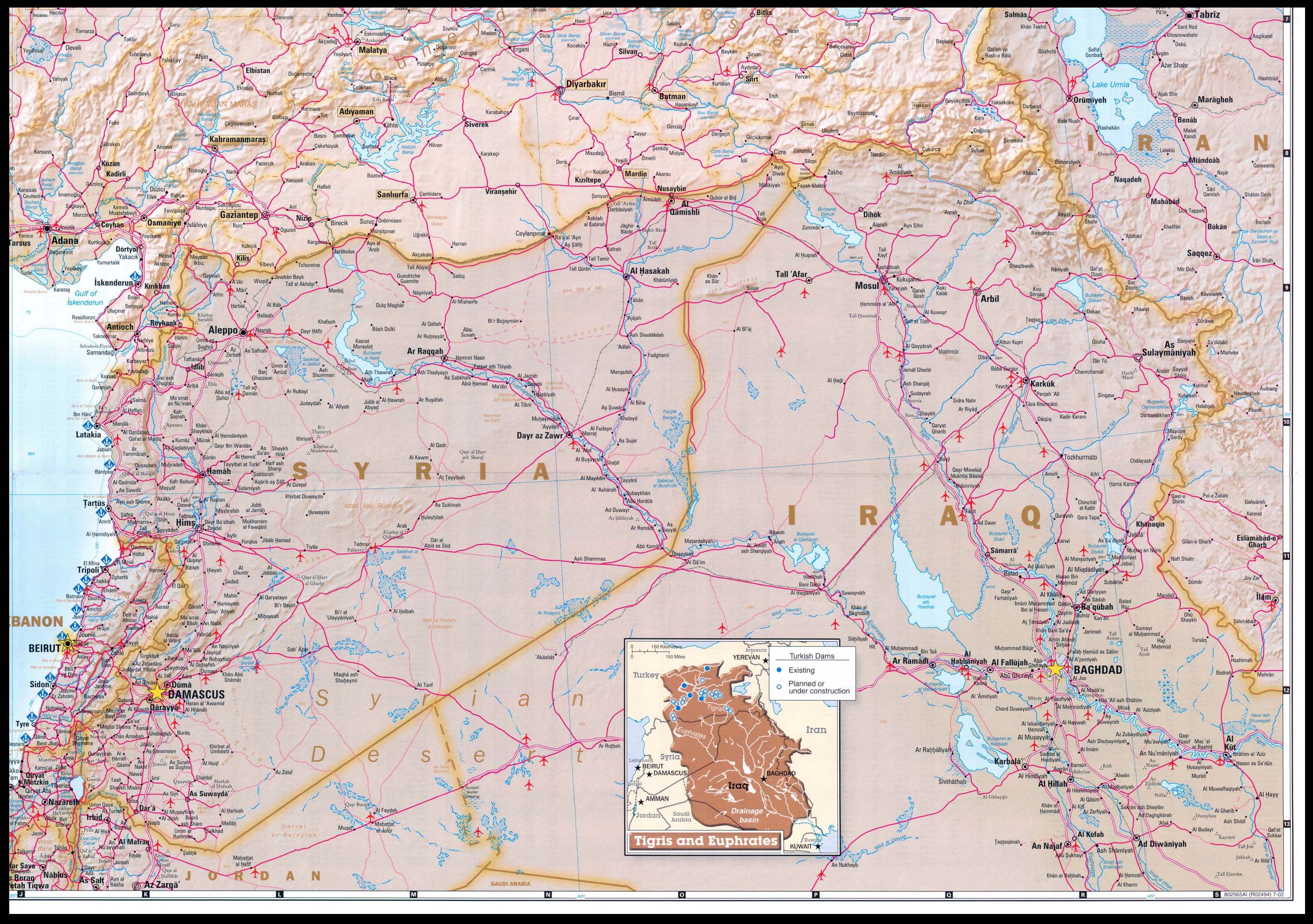
Southeastern Turkey, Syria, and northern Iraq (Perry-Castaneda)

There is currently a media blackout on Turkey's military operation in the south of the country and in northern Iraq. The American as well as the European press have hardly covered it. Initial reports in the international media, which cited Turkish "security circles," spoke of several thousand Turkish soldiers having entered Iraq in a "very limited" operation. These reports, however, were later denied by the Turkish foreign ministry, Iraqi border officials, as well as by the White House.

At this point, we can only speculate about what is truly transpiring. Clearly, the Turkish military is engaging in a large-scale operation against the PKK within its own borders; most likely, it has also carried the fight into Iraq. The Kurdish separatist group has stepped up its terror campaign inside Turkey in the past few months, providing the Turks with plenty of reasons for a response in southern Turkey as well as against hide-outs and camps across the border.

Turkey has conducted many cross-border raids in the past, and aside from denying that Turkish troops are in Iraq, both the U.S. and the Turks are publicly playing down the scope of this operation. However, there are people in Turkey who are hoping and/or expecting this to be a far more significant move than that. Dr. Melih Can, an "international relations expert," has a long article in Today's Zaman, which I think expresses some of the foreign policy aspirations and grievances of members of the Turkish elite, as they have developed since the U.S. invasion of Iraq.

I previously encountered Can's name last August, when he published a piece on Russian policy in the Middle East. The article, "Did Russia have a hand in stopping Israel?" was a mixture of analysis and wishful (though not entirely unrealistic) thinking that resembles his more recent piece about Turkish ambitions in the region. Writing in the wake of the Lebanon war, Can seemed to me a bit too convinced that Israel had suffered a devastating defeat at the hands of Hizbullah:
The war Israel waged against the Hezbollah will go down in history for destroying the Israeli army’s image of invincibility as much as for the massacres of civilians (Zaman, August 17, 2006).
Can attributed special significance to Hizbullah's supposed successes against Israeli tanks:
Known as the source of Israeli military might and named the “mountain steel,” the Israeli-made Merkava tanks, destroyed one by one by the Hezbollah became a symbol for this crushing defeat.
This, of course, is nothing but hyperbole. Hizbullah actually did not destroy Israeli tanks "one by one." It is true that one older Merkava model was blown up by a massive mine in the initial pursuit across the border, after Hizbullah's kidnapping action. It is also correct that, after the war, Israel complained that Russia had armed Hizbullah with advanced anti-tank missiles (of the type Metis), and that a few of these put some older Merkava tanks out of commission. However, the main damage that Israeli troops incurred at the hand of this weaponry was not to
tanks but to soldiers sleeping in houses.

The main point that Can was trying to make in that piece, however, was about Russia's moves to thwart American and Israeli power in the region in order "to continue in its traditional role of selling arms, directly or indirectly, to Middle Eastern governments and organizations," and to "rectify[...] the role of Russian businessmen in the region’s energy sector" (Zaman). Interestingly enough, the article does not mention Turkey's role in these moves at all. In his latest contribution to the debate, Can lets the cat out of the bag.

While Can's more recent article is not explicitly pro-Russian, it brims with resentment about American limitations on Turkish ambitions in the region. The sense of wounded pride is especially palpable in the penultimate paragraph of the article, in which Can gives the US two choices:
either to pull new “canvas sacks” over Turkey’s head or to enter into a fresh compromise with Turkey in the near future (Zaman, June 7, 2007).
The "canvas sacks," I believe, are a reference to the "hood event" in July 2003, when U.S. troops arrested Turkish special forces operating in northern Iraq, and put hoods or canvas bags over their heads. That incident provoked an uproar in Turkey and was apparently the basis of a 2006 feature film based on the television show "Valley of the Wolves" (whose distribution was blocked in the US, in part due to accusations of antisemitism and anti-Americanism)

According to Can, an over-the-border military operation by Turkey would be about much more than a response to PKK terrorist attacks. Rather, he argues, it would be about "Turkey's new role within the Middle East," and whether the country is to follow a "
mission appropriate to its own history or a more independent set of policies" (Zaman). By "appropriate to its own history," Can seems to mean a policy in line with its Cold War pro-American alignment - not one that accords with Turkey's "historical destiny." The trans-border operation, in Can's mind, thus figures as a crucible for Turkey - it will clarify both the country's willingness to pursue its real interests, as well as America's stance vis-à-vis a more independent Turkey. In that sense, an "over-the-border operation" marks a crossing of the Rubicon, and seems very much bound up with Turkey's destiny in the region.

Kirkuk (Source: Perry-Castaneda)

Can's claim that "there is an extremely pressing need for a breaking point right now, with this need emerging as an over-the-border military operation," is full of expectation of some change, and the sense that aggressive action is necessary for Turkey to break free from the force containing it. That force, it becomes clear, is the U.S., which has pushed Turkey into a difficult predicament. Can distinguishes 7 sub-forces, almost all of which are closely linked to American involvement in the region:
1. the beginning of America's withdrawal, and its alleged "encouragement of various ethnic and sectarian clashes within the framework of its 'New Middle East Strategy.'"

2. increased awareness of threats to Turkey from northern Iraq, and the "provocation of Turkey by the PKK-Barzani relationship"

3. the danger facing Iraqi Turkmens and Kirkuk

4. "the irresponsible and one-sided stance of the US administration"

5. an "i
ncrease in activities aimed at shaking the prestige of Turkey and the Turkish Armed Forces"

6. the involvement of other countries in Iraq, most notably Iran

7. Turkey's domestic political situation
I may be misinterpreting Can, but it seems to me that he even accuses the U.S. of being behind #7. He argues that to prevent Turkey's entry into northern Iraq, "the US is using all possible tools and national dynamics possible in Turkey ... [and that] this is how the current domestic political crisis, blockages and lack of stability in Turkey need to be understood." I am not sure whether Can is implying that the U.S. is supporting Erdogan in his recent show-down with the military and secularists or the latter. It is also possible that he is alluding to U.S. support for the Kurds in Turkey (unlikely), or perhaps even the Armenian Genocide resolution in the American Congress (also unlikely).

Can argues that the Americans aim primarily to have Ankara coordinate its activities with Washington, according to the latter's interests. But Turkey's post-Cold War foreign policy has increasingly diverged from America's, and the U.S.
has become uncomfortable with Turkey's displays of a more independent stance, the attempts to define the agenda, moves to forge new alliances and, as a result, entrance into a new period in the "Turkish-Islamic" world through a venture involving Russia and Iran (Zaman).
Both Turkey's increasingly eastern orientation in the region - Can speaks of shifts in the Ankara-Damascus-Cairo-Riyadh-Tehran-Islamabad line - and its refusal to subordinate itself to America's stance on Russia (the Turks are not cooperating with the U.S. strategic aim of building a gas pipeline network that provides a viable alternative to Russia's Gazprom) testify to a clash of interests. Of particular concern to the U.S., is the possibility that Turkey will go for an even more independent policy vis-à-vis Iran.

Source: Wikipedia

On the other hand, in the Caucasus, American and Turkish interests seem so far to coincide, as both countries have invested a great deal in strengthening Georgia and Azerbaijan (see our post on some of the pipelines). Still, in the Middle East, or as Can says, "in the former Ottoman Empire areas," the Turks are clearly flexing their muscles. Turkey has emerged as a respected (by the Arabs) "mediator" in the region who might undermine American pre-eminence as a broker, and the
respect and esteem achieved by Turkey in the former Ottoman Empire areas following March 1, 2003 have only served to underscore its capacity for changing current regional balances in the future (Zaman).
March 1, 2003, of course, was the date on which the Turkish parliament ended up rejecting U.S. troop deployment in the country ahead of the invasion of Iraq. Turkey, in other words, Can says, is no longer content to play the "memorized roles" that it performed during the Cold War.

It is true, of course, that the PKK's terrorism in Turkish cities is also an important motivating factor for action in northern Iraq. Turkey's patience with U.S. declarations about the problem of attacks carried out from bases in Iraqi Kurdistan has run out. Furthermore, according to Can, the Turkish Army does not take seriously "veiled threats" against the Kurds as well as against Turkish incursions (on the latter, see my January post on former Pentagon Undersecretary Dov Zakheim's op-ed). Turkey's Chief of Staff, General Yaşar Buyukanit has apparently not ruled out a confrontation with American troops, and there is a pro-Russian tendency in the military.

Can's hope - and hence the sense of expectation - is that an "over-the-border operation" will finally address a complicated set of policy problems that require resolution. In particular, he believes that it could clarify
1.Turkish-Western relations (Turkey-US as well as Turkey-EU)

2. Turkish-Russian, Turkish-Iranians, and Turkish-Iranian-Russian relations

3. the future of Iraq and a Kurdish state, and thereby, "the partnership and friendship of Turkey-Syria-Iran"

4. role of the Kurds in the region, especially Kurdish nationalism around the PKK and Barzani

5. Turkey's new regional and global position, especially the question of whether Turkey will be a global player

6. the terror problem in Turkey and "theoretical 'civil war scenarios'"

7. leadership processes in Turkey.
This seems to me a very tall order that will probably be disappointed and thus lead to further frustration. But very much will depend on the American response. It is possible that the U.S. has been denying that anything unusual is taking place precisely because it does not want the "over-the-border operation" to extend beyond the immediate problem of the PKK. News of a large Turkish invasion, with designs on Kirkuk, would be an untenable provocation and force the U.S.'s hand. However, in the meantime, it appears that the Americans have left the Kurds to confront the threat by themselves (a May 30 agreement handed security in three provinces over to the Kurdistan Northern Regional Government), and are waiting things out on the sidelines.

Thursday, December 28, 2006

Watching the Caspian Sea Basin

A view of the region (Source: Perry Castaneda)

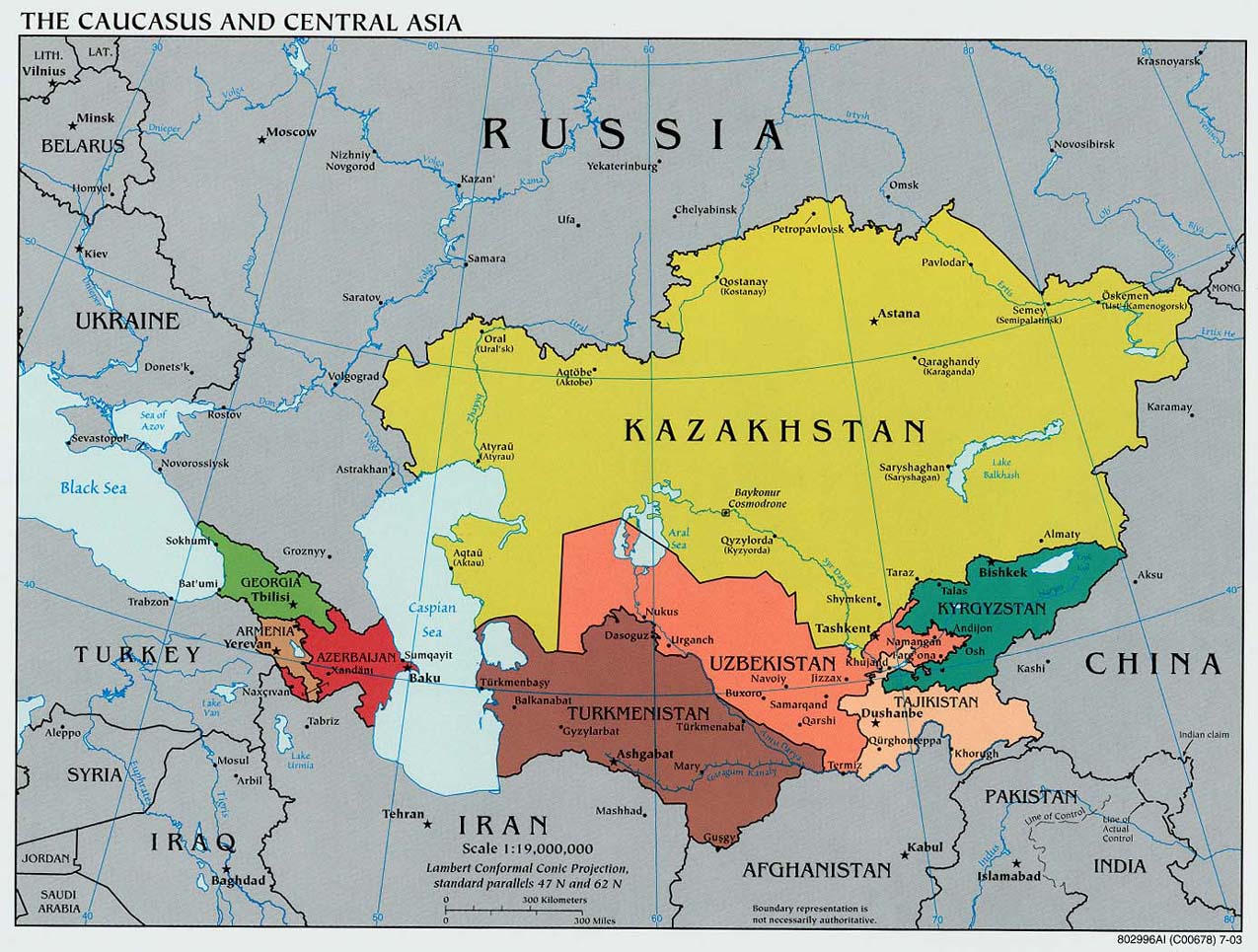
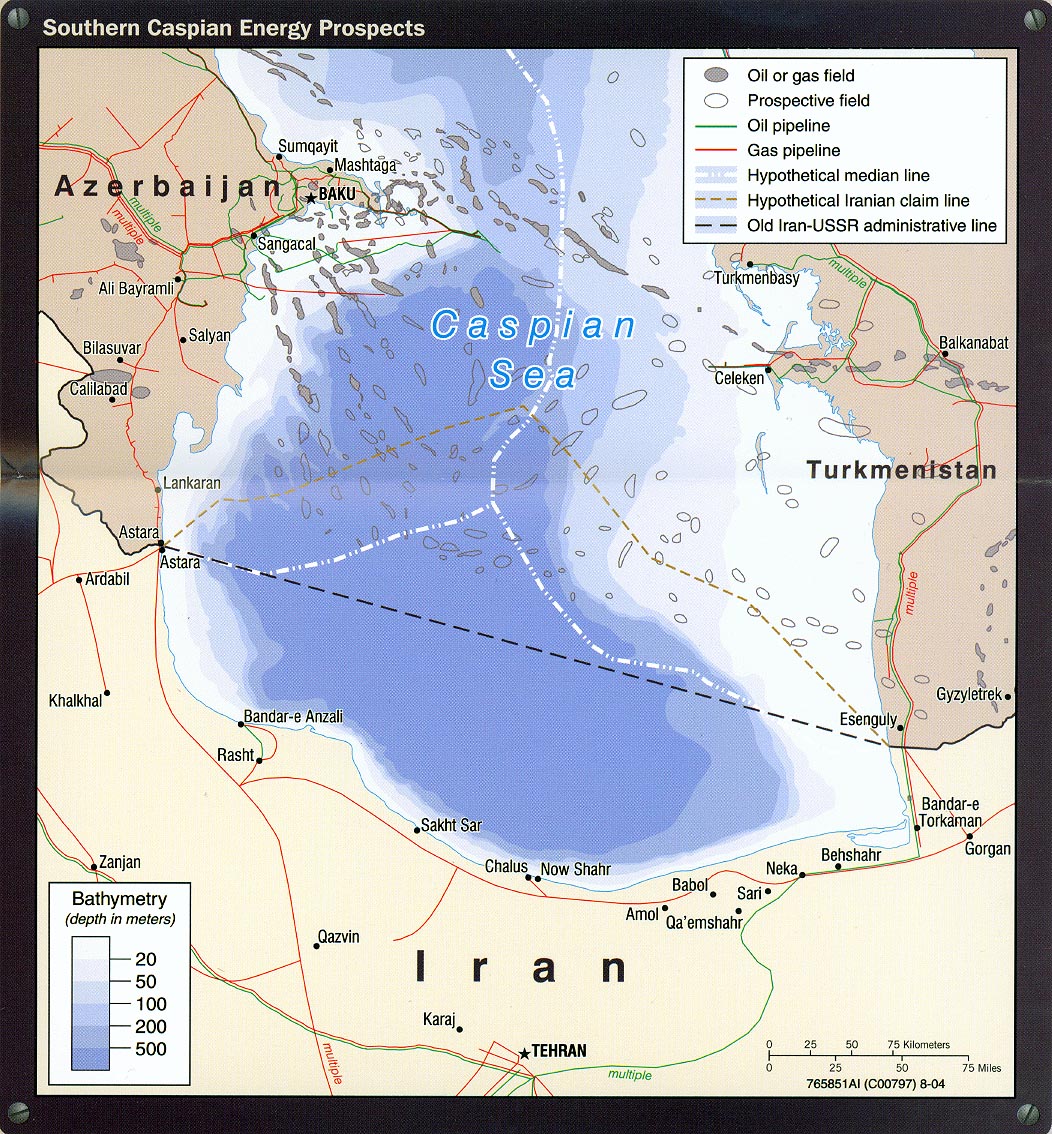
Most observers of the Middle East would agree that Iran has been making a successful run at establishing itself as a regional hegemon. So far, attention has been focused on its moves in Iraq, the Levant, and to a lesser extent, in Afghanistan. The elimination of Iraq as a threat on its western frontier has been the biggest boost to Iranian ambitions. Iran's successes in challenging the pro-Western government in Lebanon via its proxy Hizbullah and its ally Syria have further extended its westward reach all the way to the Mediterranean. Reports of Iranian activity in Afghanistan have also surfaced, especially recently. But Afghanistan offers little in the way of resources. A much more lucrative catch for Iran is the Caspian Sea basin to its north - an area with significant oil and natural gas reserves. Iran shares borders with the countries on both the Caucasian and Central Asian sides of the Caspian Sea - Azerbaijan in the west and Turkmenistan in the east.

Turkmenistan recently made the headlines when its eccentric post-Soviet dictator, Turkmenbashi Saparmurat Niyazov died. Like its other post-Soviet Central Asian neighbors, with the exception of Kazakhstan perhaps, Turkmenistan has little in the way of modern state institutions to ensure stability following the death of its revered leader. Peter Zeihan of Stratfor (you have to sign up to read it and pay, unless someone forwards it to you) is predicting that the Iranians will be hard-pressed not to make some sort of move on Turkmenistan - in order to control key oil and gas pipelines and to secure itself against an attack from the northeast. In so doing, however, Iran risks a showdown with Russia, which has been intent to monopolize Central Asian energy distribution networks through Gazprom. ADDENDUM: Josh and Nathan over at Registan are merciless in their criticism of Zeihan. The titles of their posts, "Piecing It Together, Sort Of" and "Dumb Things Written about Turkmenistan," respectively, give an indication of their critiques. I guess we'll see who's right 5 years from now.

Oil and gas fields in the southern Caspian (Perry Castaneda, 2003)

Azerbaijan has been in the news mostly due to its increasingly aggressive posturing vis-a-vis Russia. While its enemy Armenia has been moving ever closer to Russia, Azerbaijan has been seen as a Western ally, together with Georgia. Both Georgia and Azerbaijan are aiming for greater energy independence from Russia. Together with Turkey, the two Caucasian states are also trying to build an energy supply network that will bypass Russia and Iran as it delivers oil and gas to Europe and other markets (see our earlier post, "Pipe Dreams"). Iran is wary of Azerbaijan's ties to the U.S., and perhaps even more nervous about the country's potential to incite the large Azeri minority in Iran, especially in its northern provinces. A recent New York Times article suggests that the Iranians may be playing a similar kind of game they have pursued with such success in Lebanon and Afghanistan. Azerbaijan is overwhelmingly Shi'a, and although it is often represented as quintessentially secular and frequently compared to Turkey, there is a large market for Iranian-style Shi'a Islamism. Especially in the poor rural areas, Iran is investing in social programs and religious centers. According to local observers, the Iranian investment is paying off. As evidence, they cite reactions to a recent article by two Baku secularists who criticized Islam's negative impact on Azerbaijani's economic development. Provincial imams denounced the pair and an Iranian ayatollah called for their execution. It doesn't help that the regime has made no moves toward democratization (contra U.S. President Bush's statement in May 2006 after a meeting with President Ilhalm Aliyev that Azerbaijan "understands that democracy is the wave of the future"). Sooner or later, the current Azerbaijani government will face opposition from both conservative Shi'a in the provinces cut out of the oil and gas spoils as well as the secular urban elite in Baku demanding liberalization. But Iran might not have to be subversive in its activities for much longer. Although Azerbaijan has traditionally been very careful not to antagonize its southern neighbor, Aliyev has recently come out against sanctions being placed on Iran and announced that he would look to replace Russia with Iran as the country's electricity supplier.

Needless to say, Turkey, Russia, and the U.S. will not look on passively at Iranian moves northward. But who will join whom?

Friday, December 15, 2006

Pipe Dreams: Samsun-Ceyhan-Ashqelon-Eilat

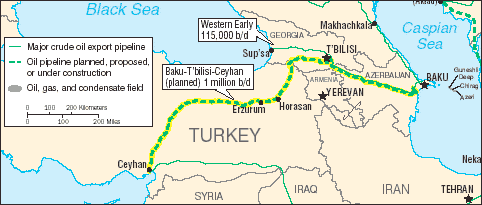
A map showing the B-T-C Pipeline (Source: Wikipedia)

A number of new oil and natural gas pipelines have made the news in the past year. The most high-profile one was the recently completed Baku-Tbilisi-Ceyhan pipeline, which transports oil from Azerbaijan to the Turkish Mediterranean port of Ceyhan and is quickly becoming a major energy hub. This week, a 690 km natural gas pipeline running parallel to it began feeding gas from the Shah Deniz field in the Caspian Sea off Azerbaijan to Georgia and Turkey (Financial Times, December 14, 2006, p. 3).

The new pipeline, built by British Petrol and several partners, connects Baku to Erzurum in eastern Turkey, from where the gas will be fed to the port city of Ceyhan. The pipeline will eventually be able to carry gas to Europe. U.S. policymakers hope that it will challenge Russia's near-monopoly over gas export pipelines out of the Caspian Sea and Central Asia. Gazprom, Russia's largest company and Central and Eastern Europe's main supplier of gas, has recently raised its prices (even to allies such as Belarus), threatening the economies of U.S. allies Georgia and Ukraine. Notice also that the pipelines draw a big circle around Iran as well as Armenia.

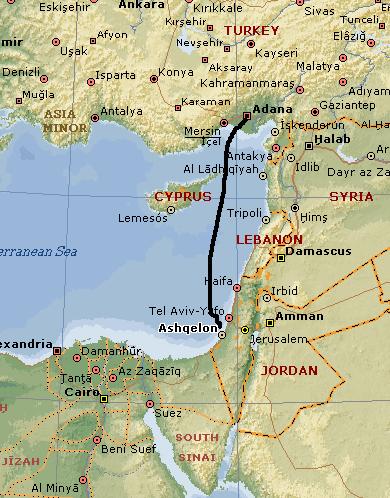
While the Baku-Tbilisi-Ceyhan oil pipeline and this new Baku-Erzurum gas corridor aim to provide an alternative to Russian energy with an eye to Europe, a different project announced this week will feed gas, oil, and water from Russia to the Levant and possibly beyond it. Turkey and Israel are cooperating to build an underwater pipeline from Ceyhun to Ashqelon (see Ha'aretz, the Washington Times, and Zaman). Feeders will also provide water and energy to Lebanon, Jordan, and the Palestinian Authority. Gazprom is planning to increase gas delivery across the Black Sea to the Turkish city of Samsun from where it will continue to Ceyhan. Check out Encarta's World Atlas for regional maps showing Ceyhan (in the Turkish province of Adana) and Ashqelon.


The Israelis, for their part, will make use of a pipeline from Ashqelon to Eilat. Until now, crude oil has been pumped from Eilat northward to Ashqelon and Haifa. The recently-completed "Reverse Flow Project" will allow oil and gas to be pumped in the opposite direction, from Ashqelon to Eilat (Eilat-Ashkelon Pipeline Company). From the port in Eilat, oil can be shipped further east via the Red Sea - at competitive prices (so argue the backers of the plan). The project has excited India, which is hoping to diversify its energy sources as its economy grows. China and South Korea could also benefit (People's Daily Online).

Israel currently imports most of its oil from Russia by oil tankers, which ship the crude from the Black Sea through the Bosphorus to Haifa, where Israel's refineries are located (Washington Times). Congestion on this waterway has driven up the price of shipping, which was the main reason for the recent cancellation of a deal with Turkey to provide Israel with fresh water (it turned out that the increase in shipping costs made the water more expensive than fresh water produced in Israel by its desalination refineries).

With all these pipelines, the Maccabees probably wouldn't have had to worry about making the oil last. Happy Hanukah - חנוכה שמח!

Addendum: The website of the Eilat-Ashkelon Pipeline Company mentioned above has two interactive, animated maps, giving you a very good sense of the movement of oil and gas within Israel, and from Russia, the Caucasus, and Central Asia to east Asia via Israel.