Prime Minister Recep Tayyip Erdogan called the leaked documents “suspicious,” but refused to comment on their substance. According to the semi-official Anatolian News Agency, Mr. Erdogan said that Turkey will “wait until WikiLeaks spill all the beans,” before evaluating the seriousness of the revelations, “because the seriousness of Wikipedia is doubtful” (NYT).WikiLeaks contains a number of very negative assessments of Erdogan and the Turkish government by the U.S.
Showing posts with label Turkey. Show all posts
Showing posts with label Turkey. Show all posts
Monday, November 29, 2010
Erdogan - More to Laugh About
This is almost as funny as Prince Andrew's analysis of anorexia and his paean to British geography teachers


Sunday, June 06, 2010
Report by Turkish Newspaper Hurriyet Strengthens IDF Account
An article published today in Hurriyet, one of Turkey's biggest newspapers, strengthens some of the accounts provided by IDF soldiers of what happened after they landed on board the ship. The article has a link to a collection of photos restored from memory cards that belonged to activists on board the ship. It shows three bloodied soldiers being dragged below deck by activists. It also documents the activists holding knives and iron bars. According to the Hurriyet article, which was summarized by Haaretz, the IDF seized cameras and deleted photos from their memory cards, but the files were later restored using standard memory card software. Some activists also concealed their cameras or dimmed them.
Saturday, June 05, 2010

I've mapped out the home provinces of each of the activists who were killed and placed a marker in each province's capital. The data are based on a Zaman article (Turkish English-language newspaper) that appeared last weekend.
Those who died appear to have been from all over Turkey. They may well have met up before and prepared/trained together in the months that preceded the flotilla, but they're not all from the same approximate area (other than most of them being from Anatolia). We probably cannot derive too much meaning from geographical plot, but it does help rule out the hypothesis that I had considered according which the people who attacked the soldiers were a bunch of young people from the same small town. TO the contrary, the median and mean age of those killed was about 31.
My assumption is that most of those killed were directly engaged in fighting with the soldiers, but it's possible that some people were in the wrong place at the wrong time. What's clear is that the actions of a small group of hot heads completely changed the mind state of the boarding party and increased the threat perception they had, compelling the soldiers to use lethal force.
Friday, June 04, 2010
Preliminary Results from Navy Investigation
Here is the timeline of events that the Israeli navy arrived at in its investigation, as reported by Ha'aretz:
Monday, 4:30 AM operation on Mavi Marmara begins. It was targeted because "of the presence of hard-core activists including members of the IHH." Operation was supervised by Navy chief Eliezer Marom and the head of naval commandos, Lt. Col. A., who were on vessels next to the Marmara.
First four commandos who rappelled onto the ship were attacked with bars, axes, and knives. Team leader had his personal weapon taken away and activists were pointing it at his head. After jumping off the rope, the fourth commando shot the activist holding the gun. This took place 20 seconds after the first commando had landed. The commanders of this first unit to land were among those to land first.
10 more soldiers were able to land, after the original rope was fixed by one of those who had already landed. 10 more soldiers rappelled onto the ship. They cared for the wounded and took over the upper deck of the ship.
4:32 AM Lt. Col. A. gives orders by radio to use live fire (in the article, this event appears after other incidents, but the narrative explains that the order was given "two minutes after the incident had begun")
4:36 AM: a second force landed from another helicopter, led by a major. Commandos on board the ship realize that 3 soldiers are missing; they begin a search for them. Naval commando chief Lt. Col. A. boards the ship along with dozen other soldiers who climbed aboard from boats or landed from a 3rd helicopter.
During the search for the missing soldiers, there is "limited shooting" on the bridge and in the lower deck, until the 3 missing soldiers are recovered.
Soldiers reported that they were fired upon (time not mentioned in summary of report). At least two commandos suffered gunshot wounds. 9mm casings were found - this is ammunition not used by the commandos, so the conclusion was that these were fired by people on the ship. The captain of the Marmara told the naval commando chief Lt. Col. A. that guns used by activists were thrown overboard before the complete takeover of the ship by the commandos. Several handguns and an M-4 rifle were taken from soldiers.
Altogether between 60-100 activists were involved in the fighting. They were apparently well-trained, judging from the weapons they had and code books which were found containing orders passed from group leaders. The rioters included Turks, Yemenis, Afghans and one Eritrean; all were experienced in hand-to-hand fighting. Even after shots were fired, some of them did not retreat.
The security forces had trained extensively for the operation, with a ship at sea holding 50 soldiers playing the role of activists. The scenario envisioned was more like a demonstration at Bil'in - a village on the seams of Israel's security fence ("wall").
Commandos were not prepared for the possibility of dozens of rioters attacking them as they landed.
The report does not explain at which points exactly the 8 other activists were killed. It claims that all of these casualties were of the hardcore, trained fighters.
Monday, 4:30 AM operation on Mavi Marmara begins. It was targeted because "of the presence of hard-core activists including members of the IHH." Operation was supervised by Navy chief Eliezer Marom and the head of naval commandos, Lt. Col. A., who were on vessels next to the Marmara.
First four commandos who rappelled onto the ship were attacked with bars, axes, and knives. Team leader had his personal weapon taken away and activists were pointing it at his head. After jumping off the rope, the fourth commando shot the activist holding the gun. This took place 20 seconds after the first commando had landed. The commanders of this first unit to land were among those to land first.
10 more soldiers were able to land, after the original rope was fixed by one of those who had already landed. 10 more soldiers rappelled onto the ship. They cared for the wounded and took over the upper deck of the ship.
4:32 AM Lt. Col. A. gives orders by radio to use live fire (in the article, this event appears after other incidents, but the narrative explains that the order was given "two minutes after the incident had begun")
4:36 AM: a second force landed from another helicopter, led by a major. Commandos on board the ship realize that 3 soldiers are missing; they begin a search for them. Naval commando chief Lt. Col. A. boards the ship along with dozen other soldiers who climbed aboard from boats or landed from a 3rd helicopter.
During the search for the missing soldiers, there is "limited shooting" on the bridge and in the lower deck, until the 3 missing soldiers are recovered.
Soldiers reported that they were fired upon (time not mentioned in summary of report). At least two commandos suffered gunshot wounds. 9mm casings were found - this is ammunition not used by the commandos, so the conclusion was that these were fired by people on the ship. The captain of the Marmara told the naval commando chief Lt. Col. A. that guns used by activists were thrown overboard before the complete takeover of the ship by the commandos. Several handguns and an M-4 rifle were taken from soldiers.
Altogether between 60-100 activists were involved in the fighting. They were apparently well-trained, judging from the weapons they had and code books which were found containing orders passed from group leaders. The rioters included Turks, Yemenis, Afghans and one Eritrean; all were experienced in hand-to-hand fighting. Even after shots were fired, some of them did not retreat.
The security forces had trained extensively for the operation, with a ship at sea holding 50 soldiers playing the role of activists. The scenario envisioned was more like a demonstration at Bil'in - a village on the seams of Israel's security fence ("wall").
Commandos were not prepared for the possibility of dozens of rioters attacking them as they landed.
The report does not explain at which points exactly the 8 other activists were killed. It claims that all of these casualties were of the hardcore, trained fighters.
Wednesday, June 02, 2010
Imagine Israelis Protesting in Lebanon or Yemen...
An article published today in Ha'aretz (no English version available yet) by Fadi Ayadat indicates that almost all of the hundreds of activists from the Gaza Flotilla were deported today, save for seven individuals whose injuries did not permit their transport. The majority of activists (450), including, apparently, Europeans, were flown to Turkey, but another 100 from different parts of the Arab world, were sent off to the Allenby Bridge, which is generally used by Palestinians to enter Jordan. Previous news reports indicated that there were even individuals from Yemen among the activists. Most interesting to me was the fact that 5 activists were Lebanese and deported back to Lebanon via the Rosh ha-Niqra crossing between Lebanon and Israel.
One female representative of the Turkish Red Crescent who came to oversee the deportation of Turkish citizens was quoted as saying that the injured activists had been treated well in Israeli hospitals and that they did not face any overt hostility from the local population while treated.
Can anyone imagine Israeli civilians going to Turkey or a country in the Arab world to participate in a major act of civil disobedience, or to clash with the local authorities? It would be absolutely unthinkable.
One female representative of the Turkish Red Crescent who came to oversee the deportation of Turkish citizens was quoted as saying that the injured activists had been treated well in Israeli hospitals and that they did not face any overt hostility from the local population while treated.
Can anyone imagine Israeli civilians going to Turkey or a country in the Arab world to participate in a major act of civil disobedience, or to clash with the local authorities? It would be absolutely unthinkable.
Analysis of Flotilla Video
Highlights use of paintball guns and speculates about tactics used by commandos boarding the Marmara.
Breakdown of Flotilla Activists' Countries of Origin
From Ha'aretz:
Israel gave the following breakdown of countries and numbers of those activists ordered expelled, excluding the nine killed and the seriously wounded in Monday's raid:
Australia 3; Azerbaijan 2; Italy 6; Indonesia 12; Ireland 9; Algeria 28; United States 11; Bulgaria 2; Bosnia 1; Bahrain 4; Belgium 5; Germany 11; South Africa 1; Holland 2; United Kingdom 31; Greece 38; Jordan 30; Kuwait 15; Lebanon 3; Mauritania 3; Malaysia 11; Egypt 3; Macedonia 3; Morocco 7; Norway 3; New Zealand 1; Syria 3; Serbia 1; Oman 1; Pakistan 3; Czech Republic 4; France 9; Kosovo 1; Canada 1; Sweden 11; Turkey 380; Yemen 4.
Monday, May 31, 2010
The Marmara Incident - Preliminary Notes
Everyone involved in this blog probably had the same initial reaction of disbelief, shock and sadness when they heard about the deaths (so far, 9 confirmed) that resulted from Monday morning's IDF raid on the Marmara. Now that more information has become available, however, this incident has become somewhat less unfathomable to me.
It is now clear that the IDF troops who boarded the Marmara encountered very violent and determined resistance that caught them completely off-guard. News reports indicate that they were not armed with lethal rifles (only paint ball rifles??) and that they carried hand guns as a last resort. Looking at the way in which they boarded the ship, it's almost certain that the boarding commandos did not expect to use their weapons and did not expect to engage in truly violent confrontations. As a result, as they touched down on the deck of the ship, they were overpowered and separated from each other. The most definitive video clip, shown only by Israeli media so far, to my knowledge, shows soldiers being bludgeoned and one of them being tossed over the deck. On Ynet, that video clip provided by the IDF spokesperson is followed up with testimony from a soldier with a broken arm who recounts how he and his comrades landed on deck the Marmara with their paint ball rifles strapped on their backs, not in their hands, and how the activists started beating them to a pulp with metal clubs. The soldier goes on to describe how his paint ball rifle was destroyed, and how he tried to reach for his handgun but found out that his arm was broken. Throughout this, he saw other soldiers down on the ground, still receiving beatings. The Ynet-supplied video stops there. I have yet to see video evidence that shows what happened next, but my assumption is that a few soldiers opened fire at that point.
Comments by ministers and senior officers to the Israeli press reveal that they had no idea that this scenario - definitely the worst case scenario - was more than a remote possibility. Previous incidents of this sort were resolved with minimal violence, resulting either in the granting of passage to the Gaza Strip in one case or in vessels being towed to Israel.
Clearly, there was an intelligence failure in this particular case. The decision to use naval commandos also seems quite ludicrous in hindsight. This was a policing operation on the high seas that should have been handled by units with crowd control experience.
Some readers of this post may disagree with the blockade of the Gaza Strip and with the rationale behind the boarding, but I am quite convinced that few will dispute that it seems highly likely, based on the evidence we've seen so far, that the IDF soldiers involved in the raid resorted to lethal force as a last-resort measure and in self-defence. Whether they should have been sent on this kind of a mission is the bigger question.
Note: The IDF video footage is now available on the BBC News website.
Note: The IDF video footage is now available on the BBC News website.
The IDF spokesperson's YouTube channel now has a clip up from the naval commandos' radio communications in which a soldier reports hearing live fire from the activists "down below".
Friday, May 07, 2010
Growth of Islamic Banking in Turkey
On Wednesday, FT contained a special insert called "Istanbul as a Financial Centre." The headline read, "Ambition yet to be matched by reality," a state of affairs which is then explained in articles about lack of political and social consensus, a conservative business oligarchy that offers little power and protection to equity holders, and competition from Moscow to be the regional hub both for multinationals and financial services. All this is set across the backdrop of a city that is potentially very attractive to highly skilled migrants. As for the Turkish economy, as George Bush used to say, "The fundamentals are strong."
What caught my eye was the article by Delphine Strauss on the growing stake of Islamic banks in Turkey's financial sector. These banks have grown at almost double the rate of commercial banks over the last three years. In Turkey's case in particular, we could chalk this up to a political climate that is increasingly friendly to these institutions, as the Islamic AKP has entrenched its power. Yet it appears that these banks are increasingly competitive across the Islamic world. In a very interesting article in October's Anthropology News, BU PhD candidate Sarah Tobin, analyzes the gains made by Islamic banks during the global financial crisis (UC Berkeley, sadly, doesn't give me access to the article online; as for the performance of Islamic banks, it should be noted, that the Dubai credit crisis damaged them considerably). Tobin, whose work is in Jordan, sees the rise of these institutions as more than just the result of their cautious investments in a volatile market. Islamic banks are providing all kinds of non-pecuniary services, from giving customers a daily feeling of religious authenticity, to "Islamicizing" certain transactions that the Koran on some readings would seem to disallow, to scoring brownie points with an Islamic regime -- which is where Turkey might come in, though it sounds like many of the banks' biggest customers are religiously conservative Anatolian businessman, the new elite of the AKP world.
One gets the sense from Strauss's report on Turkey that the Turks lag behind the rest of the Islamic world on this score both because of the secular Kemalist legacy and because participation in Islamic finance is more "political" -- or less "authentic" than elsewhere. On this account, if the AKP loses power tomorrow, the sector shrinks precipitously. Here, Tobin's article is a helpful companion. She underscores that with each bank maintaining its own Shari'ah board charged with interpreting a great diversity of financial instruments, practices, and markets ultimately, as I understand it, in light of the Koranic injunction against taking and receiving interest, no clear standard of "Islamic banking" exists. The local diversity of Islamic law surely plays a role too. And though Jordanian banks may be more conservative than those in Dubai, it seems the charge of "un-Islamic" might be leveled against anyone at anytime. This is not to say that particular forms of investment, types of enterprise, and grand strategy do not pattern the Islamic banking sector. They do, and that's what I find so interesting. The FT piece, for example, describes "sukuk-style bonds," which are offered but twice a year, and are indexed to the revenues of government agencies. Whatever Islamic banking is, it's certainly not a simple reaction against modernity. Standard & Poor's just started rating a Shari'ah-compliant fund from Qatar last Tuesday.
Sunday, November 08, 2009
Erdogan Again
BY AMOS
In the past two years, we have seen repeated crises in Turkish-Israeli relations. Most of these were set off by Turkish condemnations of Israeli policies and military operations. A few of these spats involved warnings issued by the Turks to both Israelis and American Jews that recognition of the Armenian Genocide by either Israel or American Jewish organizations would lead to irreparable harm to the Turkish-Israeli relationship. Time and again, Israeli commentators and politicians have tried to assuage the Turks as well as the Israeli public. "Everything is okay," and "military relations continue to be excellent and are immune from these political disturbance. Those sounding this line, however, are running out of credibility very quickly. Turkey's prime minister, Tayyip Erdogan , seems intent on destroying ties between the two countries. Until now, the highlight was his angry outburst at Davos (see clip below). The recent cancellation by Turkey of an air force drill that was supposed to have included Israel also caused a stir. But Erdogan's remarks (Ha'aretz) today, ahead of the Organization of the Islamic Conference's meeting in Istanbul, take the cake.
Erdogan's statements included a defense of Sudan's President Omar al-Bashir and the incredible assertion that Muslims are incapable of carrying out genocide (I will not mention the obvious here; suffice to say that millions of Armenians feel very differently about this matter). Erdogan also charged that Israel had committed worse crimes in Gaza than Sudanese paramilitary forces had in Darfur. All this comes on the heels of the General Assembly's endorsement of of the Goldstone report. It is clear that the current Turkish government does not believe that Israel is an important ally. However important the ties between the armed forces of the two states might be, Erdogan's attacks on Israel since 2007 make him an enemy rather than a friend of the Jewish state.
In the past two years, we have seen repeated crises in Turkish-Israeli relations. Most of these were set off by Turkish condemnations of Israeli policies and military operations. A few of these spats involved warnings issued by the Turks to both Israelis and American Jews that recognition of the Armenian Genocide by either Israel or American Jewish organizations would lead to irreparable harm to the Turkish-Israeli relationship. Time and again, Israeli commentators and politicians have tried to assuage the Turks as well as the Israeli public. "Everything is okay," and "military relations continue to be excellent and are immune from these political disturbance. Those sounding this line, however, are running out of credibility very quickly. Turkey's prime minister, Tayyip Erdogan , seems intent on destroying ties between the two countries. Until now, the highlight was his angry outburst at Davos (see clip below). The recent cancellation by Turkey of an air force drill that was supposed to have included Israel also caused a stir. But Erdogan's remarks (Ha'aretz) today, ahead of the Organization of the Islamic Conference's meeting in Istanbul, take the cake.
Erdogan's statements included a defense of Sudan's President Omar al-Bashir and the incredible assertion that Muslims are incapable of carrying out genocide (I will not mention the obvious here; suffice to say that millions of Armenians feel very differently about this matter). Erdogan also charged that Israel had committed worse crimes in Gaza than Sudanese paramilitary forces had in Darfur. All this comes on the heels of the General Assembly's endorsement of of the Goldstone report. It is clear that the current Turkish government does not believe that Israel is an important ally. However important the ties between the armed forces of the two states might be, Erdogan's attacks on Israel since 2007 make him an enemy rather than a friend of the Jewish state.
Tuesday, September 01, 2009
Historic Development in Turkey-Armenia Relations
Turkey and Armenia announced today that they would establish diplomatic relations. If the protocols are formally ratified by the two countries before the deadline, it would spell the end of Turkey's sixteen-year blockade of Armenia. Turkey closed its border with its Caucasian neighbor in 1993, during the Armenian-Azerbaijani war over Nagorno-Karabakh. I do not know enough about domestic politics in Armenia at the moment to speculate on whether serious political obstacles exist in the country to prevent ratification. Many Armenians in Armenia, Nagorno-Karabakh, and the large Diaspora will certainly protest any change in relations with Turkey that does not address the issue of genocide recognition. In Turkey, there are also likely to be voices, especially among opponents of Erdogan, against opening the border with Armenia.
More interesting for watchers of the region will be the fallout among Turkey's and Armenia's neighbors: especially Azerbaijan, Georgia, Russia, and Iran. For Azerbaijan, the Turkish move is a serious a blow, as the blockade was one of Azerbaijan's major instruments in pressuring Armenia during negotiations over Nagorno-Karabakh. For Georgia, the opening of the Turkish-Armenian border means increased competition and the end of profits from shipping Turkish goods to Armenia via Georgia. Both will likely become even more dependent on the U.S. for aid and protection.
For Russia, which has emerged as Armenia's main backer in recent years, the deal means both an improvement in relations with Turkey and new opportunities for energy development. Turkey perhaps stands to gain the most - on the ground and in international diplomacy.
More interesting for watchers of the region will be the fallout among Turkey's and Armenia's neighbors: especially Azerbaijan, Georgia, Russia, and Iran. For Azerbaijan, the Turkish move is a serious a blow, as the blockade was one of Azerbaijan's major instruments in pressuring Armenia during negotiations over Nagorno-Karabakh. For Georgia, the opening of the Turkish-Armenian border means increased competition and the end of profits from shipping Turkish goods to Armenia via Georgia. Both will likely become even more dependent on the U.S. for aid and protection.
For Russia, which has emerged as Armenia's main backer in recent years, the deal means both an improvement in relations with Turkey and new opportunities for energy development. Turkey perhaps stands to gain the most - on the ground and in international diplomacy.
Tuesday, January 06, 2009
The Diplomatic Circus

Turkish PM Erdogan
Most remarkable have been Egypt's repeated pronouncements that Hamas itself is to blame for the crisis. The regime feels confident enought to withstand both foreign and domestic pressure, even as Nasrallah has castigated Mubarak for his alleged support of Israel. It is clear that Egypt wants Hamas weakened and is willing to tolerate large numbers of Palestinian casualties for this to happen. Egypt is asserting itself as the power broker in the Israeli-Gazan conflict, and making both the Iranians and Syrians look like idle talkers. The message to Hamas: we are your only road to salvation.
The Jordanians are looking on quietly, hoping that the Israelis finish the job quickly, with as few Palestinian casualties as possible. They seem more antsy than the Egyptians about the operation's implications for them.
Among the Europeans, the French have played the most visible role in efforts to achieve a cease fire. Until now, their efforts have not achieved very much on the ground. Although Sarkozy has blamed Hamas for the eruption of violence, he has also tried to push for a quick end to the fighting. I am not sure what exactly France is up to. My sense is that Sarkozy is trying to seize an opportunity for France to establish another foothold in the Israeli-Arab conflict. Unlike the Egyptians, the French do not seem to place as high a priority on weakening Hamas. It is possible that they may even support a partial legitimization of the Hamas government in Gaza, which would be achieved through an insertion of French monitors at the Philadelphi corridor, to guard against the militarization of the Strip via underground tunnels.
I am not sure how the Egyptians are responding to these moves. However it may be packaged, such international monitors on the Egyptian side of the border represent an affront to Egyptian sovereignty. Furthermore, Egypt may well want to keep some weapons against Israel in its arsenal, by preserving the option of turning a blind eye to Hamas or other Palestinian smuggling.
One can be sure that the Germans are watching France's high-profile diplomacy very carefully. Meanwhile, Angela Merkel is probably pursuing German objectives with a little more tact and efficacy than Sarkozy.
The other regional power that has made headlines since the Gaza operation began is Turkey. Erdogan's condemnations of Israel have been especially damning. They seem to reflect Turkish public opinion but they are also, likely, connected to Turkey's efforts to mediate between Syria and Israel. Turkey has invested significantly in the Syrian track and sees the current conflict as a blow against its efforts and its standing in the Arab world. The Turks have also long sought a normalization of Hamas's rule over Gaza - I am not sure why this has been important to them (ideological reasons?).
Qatar, as usual, is using the opportunity to strike blows at the Saudis, who are very quietly toeing the Egyptian-Jordanian-American line.
For the U.S. and Israel the priority is that Hamas emerge visibly weakened from "Operation Cast Lead." Whatever cease fire emerges must look quite different also from the Lebanese solution. Peace Now cannot mean War Tomorrow.
More on that in a future post.
Thursday, October 11, 2007
Troubles in Turkey
Two issues are currently occupying a great deal of public attention in Turkey: the Armenian genocide resolution in the US Congress, and PKK activity in southeastern Turkey and northern Iraq. While the former has also received significant press coverage in the US, there seems to be very little awareness in the American and European media about the latter. For the Turks, the lack of concern shown by the Europeans and the Americans for the dangers posed to the country by PKK attacks is a source of deep frustration and a sense of abandonment. People in the government and the press are openly questioning the value of Turkey's partnership with America and the West. Indeed, many are implicating the US in the terrorist attacks by the PKK, referring repeatedly to the alleged discovery of American weapons in PKK hands. The Armenian genocide resolution seems to these critics of the US yet another indication of America's evil intentions (or, at best, indifference) with respect to Turkey. Rather than interpreting the genocide resolution as a product of America's democratic culture, the Turks seem to be reading it as another example of Western hypocrisy and imperialist interference in Turkish affairs. Furthermore, it is hard to ignore the thinly-veiled expressions of anger at "the Jewish lobby," which some Turkish commentators are now depicting as part of an anti-Turkish alliance with "the Armenians."
There is very little that the Turks can do to directly influence Congress at this stage. The White House's furious diplomatic activity against passage of the House resolution to recognize the Armenian genocide seems doomed to failure. Likewise, Turkey's power to take direct action against either the Iraqi Kurdish government or the PKK is also somewhat limited. This does not mean that the Turks will be able to hold off indefinitely public opinion calling for some kind of response. But it seems that the Turkish military and government realize the risks and difficulties of a more extended cross-border operation. Economic sanctions against the Iraqi Kurds are also a possibility - but they may also hurt Turkish interests in the area.
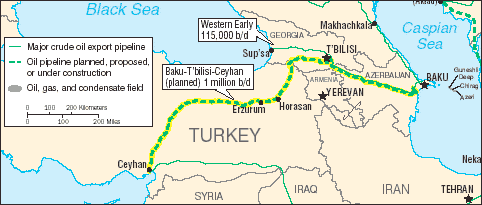
This leaves Turkey with a more indirect option. While the Turks have been thwarted in their attempts to project direct military force in the region (mainly because of the presence of the Americans), they do have the ability to disrupt significantly American strategic aims with respect to Iran and Russia. Turkey is the key to two planks of American energy policy: 1) to isolate Iran, and 2) to provide an alternative to Europe-bound Russian oil and gas pipelines.
The Americans have been watching Turco-Iranian energy cooperation with a great deal of concern. But the lack of American concern for Turkish interests in Iraq, has pushed the country to drop its inhibitions about upsetting the Americans on this front. Indeed, some Turkish politicians seem to be advocating cooperation with the Iranians on the Kurdish issue as well. As for Russia, despite Turkey's investment in American-backed infrastructure projects in the South Caucasus, the Turks have no qualms about serving as another gate for Gazprom energy to Europe and the Levant. The more the merrier.
There is very little that the Turks can do to directly influence Congress at this stage. The White House's furious diplomatic activity against passage of the House resolution to recognize the Armenian genocide seems doomed to failure. Likewise, Turkey's power to take direct action against either the Iraqi Kurdish government or the PKK is also somewhat limited. This does not mean that the Turks will be able to hold off indefinitely public opinion calling for some kind of response. But it seems that the Turkish military and government realize the risks and difficulties of a more extended cross-border operation. Economic sanctions against the Iraqi Kurds are also a possibility - but they may also hurt Turkish interests in the area.
This leaves Turkey with a more indirect option. While the Turks have been thwarted in their attempts to project direct military force in the region (mainly because of the presence of the Americans), they do have the ability to disrupt significantly American strategic aims with respect to Iran and Russia. Turkey is the key to two planks of American energy policy: 1) to isolate Iran, and 2) to provide an alternative to Europe-bound Russian oil and gas pipelines.
The Americans have been watching Turco-Iranian energy cooperation with a great deal of concern. But the lack of American concern for Turkish interests in Iraq, has pushed the country to drop its inhibitions about upsetting the Americans on this front. Indeed, some Turkish politicians seem to be advocating cooperation with the Iranians on the Kurdish issue as well. As for Russia, despite Turkey's investment in American-backed infrastructure projects in the South Caucasus, the Turks have no qualms about serving as another gate for Gazprom energy to Europe and the Levant. The more the merrier.
Saturday, September 08, 2007
Recent Israeli Air Force Action
I am fairly confident that the recent incident on the Turkish-Syrian border, where Syria alleges it repulsed an Israeli fighter jet from its air space, will not result in military retaliation by Damascus. However, this latest incident might very well be used as a pretext by Syrian proxies in Lebanon and in the territories to attempt some kind of "counter-attack." If successful, such an attack might very well lead to an escalation of Syrian-Israeli tensions.
The incident took place on Thursday at dawn. Only the Turks and Syrians so far have released information based on first-hand observation as well as their own agendas. So far, the Syrians have alleged that the plane dropped munitions on a deserted area, while the Turks have displayed a jettisoned F-15 fuel-tank. Israeli sources have remained silent about the news, and the U.S. has not commented either.
What is the meaning of this report? I think we can safely discard the preposterous web of conjectures spun by Joshua Landis to allege a neo-con, North Korea connection. This is obviously about issues much closer to home. In an earlier post on Thursday, Landis asked, with faux exasperation, "What is this about?" and answered that "One has to believe it is an intentional provocation." This again seems to me off the mark.
I think there are two possible explanations for this incident. The IAF pilot was either engaging in a routine reconnaissance flight over Syria and due to an operational failure strayed into territory covered by the country's anti-aircraft installations, or, more likely, this was an operation designed specifically to test the current state of Syrian anti-air defense. In the latter case, we have to ask whether the IAF's performance can be judged a success. The pilot involved (so far, we know of only one plane, but there were probably others) escaped without harm or damage to the plane but was forced to jettison cargo and munitions, probably to speed up the getaway. On the other hand, given the expectation before the summer that there might be a war between Damascus and Jerusalem, it might have been preferable to avoid detection entirely, or at least to avoid giving Syria concrete proof that an incursion had occurred.
With evidence in hand, Syria is likely to do the most it can in the diplomatic realm to force Arab states to take rhetorical "measures." This could be detrimental to Israeli and American efforts at the upcoming peace conference, and it might serve as a handy diversionary measure by Iran and Syria at the UN. Turkey, too, is in an awkward position, as the Israelis most likely did enter the country's air space. We can expect some grandstanding from them, as they try to appease the Syrians and the Arab states, who will seize the opportunity to condemn Turkey for its collaboration with Israel.
There are some who see this incident as related to American plans for an aerial raid on Iran, or a joint Israeli-American offensive against Syria. I don't think either of these conclusions apply, but there is no doubt that Israel, the U.S., Syria, and Iran are paying especially close attention both to the actual evidence being reported and to the gains they may harvest through the information war in the media and the diplomatic sphere. Turkey, too, is doubtlessly probing carefully what Israel and/or the Americans might be up to.
The incident took place on Thursday at dawn. Only the Turks and Syrians so far have released information based on first-hand observation as well as their own agendas. So far, the Syrians have alleged that the plane dropped munitions on a deserted area, while the Turks have displayed a jettisoned F-15 fuel-tank. Israeli sources have remained silent about the news, and the U.S. has not commented either.
What is the meaning of this report? I think we can safely discard the preposterous web of conjectures spun by Joshua Landis to allege a neo-con, North Korea connection. This is obviously about issues much closer to home. In an earlier post on Thursday, Landis asked, with faux exasperation, "What is this about?" and answered that "One has to believe it is an intentional provocation." This again seems to me off the mark.
I think there are two possible explanations for this incident. The IAF pilot was either engaging in a routine reconnaissance flight over Syria and due to an operational failure strayed into territory covered by the country's anti-aircraft installations, or, more likely, this was an operation designed specifically to test the current state of Syrian anti-air defense. In the latter case, we have to ask whether the IAF's performance can be judged a success. The pilot involved (so far, we know of only one plane, but there were probably others) escaped without harm or damage to the plane but was forced to jettison cargo and munitions, probably to speed up the getaway. On the other hand, given the expectation before the summer that there might be a war between Damascus and Jerusalem, it might have been preferable to avoid detection entirely, or at least to avoid giving Syria concrete proof that an incursion had occurred.
With evidence in hand, Syria is likely to do the most it can in the diplomatic realm to force Arab states to take rhetorical "measures." This could be detrimental to Israeli and American efforts at the upcoming peace conference, and it might serve as a handy diversionary measure by Iran and Syria at the UN. Turkey, too, is in an awkward position, as the Israelis most likely did enter the country's air space. We can expect some grandstanding from them, as they try to appease the Syrians and the Arab states, who will seize the opportunity to condemn Turkey for its collaboration with Israel.
There are some who see this incident as related to American plans for an aerial raid on Iran, or a joint Israeli-American offensive against Syria. I don't think either of these conclusions apply, but there is no doubt that Israel, the U.S., Syria, and Iran are paying especially close attention both to the actual evidence being reported and to the gains they may harvest through the information war in the media and the diplomatic sphere. Turkey, too, is doubtlessly probing carefully what Israel and/or the Americans might be up to.
Thursday, August 30, 2007
Outgoing Israeli Ambassador to Turkey Denies Genocide

Pinhas Avivi, the outgoing Israeli ambassador to Turkey, told the Turkish Daily News that while "a lot of people see what happened during the events of 1915 as a tragedy," "there is a great difference accepting it as genocide." According to Avivi, "genocide is a decision by a government to destroy a people" and “never ever has anybody proved that this was the situation in 1915.”
Given Israeli policy on the issue, there is nothing surprising about the substance of this proclamation. The frankness with which the ambassador distorts history, however, is rather embarrassing. American diplomats at least use circumlocutions (if they don't, they get fired) when they deny that "the events of 1915" constituted genocide.
It is clear that the Israelis are doing their utmost to reassure Ankara of their friendship. The Turks, on the other hand, continue to show signs of frustration and disappointment, blaming Israel for the momentous shift in policy on Armenian Genocide recognition by the ADL. At the same time, they are eager to hear some approval for their position. In the background loom the nearly $10 billion in bilateral trade and joint economic ventures between the countries, the entrenchment of the Islamist AKP in power with the recent election of Abdullah Gul to the presidency, and Israel's concerns about Turkey's Iran-policy. It is perhaps with these factors in mind, that we should read Avivi's responses to the Turkish journalist's query about the ADL controversy.
Clearly, Israeli diplomats are playing a complicated game with the Turks. While Ankara plays the rejected lover, the Israelis claim that they are being faithful. As part of this charade, Israeli officials up to President Shimon Peres are promising the Turks to "keep an eye on it" - in order to make sure that other Jewish organizations do not announce similar shifts in policy. Avivi even claims that "the impression we got from different Jewish organizations in Washington is that, the ADL's approach is not seen as the right approach." Given that the American Jewish Committee followed the ADL's shift in policy, I am not sure where this impression is coming from. Are the Turks buying the bull that Israel is feeding them?
I have to wonder, too, whether Avivi's efforts to kiss up to the Turkish public were entirely successful. Asked by Barçın YİNANÇ about antisemitism in Turkey, the ambassador says that he believes it is "weak" in Turkey:
On the governmental level, and as far as 90 percent of the newspapers are concerned, apart from the newspaper Vakit and one or two journalists, I never felt it (Turkish Daily News).Reassured, the journalist notes that, "For some countries, it's such an issue that it requires the Israeli government to step in. Avivi tells him that “Anti-Semitism has never been an issue for us to be taken up on official level." The journalist, however, reminds Avivi of "false news report that Israel was reportedly buying land in Turkey" and "that conspiracy theories based on Zionism are quiet widespread." Aviv acknowledges that the embassy could have done more to reach out to ordinary people.
I have a hard time believing that there is less antisemitism in Turkey than in France or Germany, where Israeli government officials do not shy away from expressing fears about resurgent anti-Jewish expressions by the public.
Thursday, August 23, 2007
Turkey Expresses "Anger and Disappointment"

Citing sources in the Israeli Foreign Ministry, Ha'aretz reports that Turkey is pressuring Israel to compel American Jewish organizations to reverse their recognition of the Armenian Genocide. So far, the Anti-Defamation League and the American Jewish Committee, perhaps the two most recognizable Jewish political organizations in the U.S., have publicly declared that the events of 1915 constituted genocide. Turkish Foreign Minister Abdullah Gül expressed disappointment that Israel had not done anything to prevent these declarations, and talks between the Pinhas Avivi, the Israeli ambassador in Ankara, and Gül escalated to "unpleasant tones" [טונים צורמים] (Ha'aretz Hebrew).
The report is rather incredible, and reveals the bizarre spell that the phenomenon of Jewish diplomacy continues to exert on supposedly rational actors in the international state system. It appears that the Turkish Foreign Ministry truly believes in the existence of a cabal that initiates and enforces policies for all of world Jewry. The State of Israel now plays the role once attributed to the Rothschilds. I have always thought of Turkish diplomacy with respect to the denial of the Armenian Genocide as rather clever. Now it turns out that one of its guiding assumptions seems to have been the belief that American Jewish organizations take their marching orders from Jerusalem. I know that this thesis is popular among certain groups in the U.S. and elsewhere as well; the believers will hardly be persuaded by evidence to the contrary. The Turkish Foreign Ministry would do well to study the role played by Jewish groups in the American political system as well as the views of U.S. Jews on foreign and domestic policy, without the blinders of stereotypes about Jewish conspiracies.
The impact that the recognition decision of the ADL as well as the (characteristically) quieter AJC has made is astounding. In Turkey, government officials apparently "admitted that the ADL's shift in position was a setback for Ankara" (Turkish Daily News). Somehow, vast powers have been attributed to these Jewish organizations in the fight for and against House resolution 106, which would have the U.S. officially recognize the Armenian Genocide.
Sunday, August 19, 2007
Anti-Defamation League in Hot Water over Armenian Genocide
 A Jewcy Banner in a petition that calls on the ADL to recognize the Armenian Genocide
UPDATE: There have been some very interesting new developments, on which I have posted over on Genats-Lehayim. First, the ADL published an "open letter" maintaining their previous position. Today, Foxman finally retracted.
The municipal council of Watertown, Massachusetts, which together with Glendale, California is one of the major Armenian centers in the U.S., last Tuesday voted unanimously to pull out of the "No Place for Hate" tolerance-education program. The reason? The program is funded by the Anti-Defamation League, whose national board, the council alleges, has not been forthright in recognizing the Armenian Genocide.
Among other developments, the controversy has led to the firing of the New England Regional Director of the ADL, Andrew Tarsy, after he defied the national leadership of the organization and called on it to refer to the killing of 1.5 million Ottoman Armenians in 1915 as genocide. Now, some people are hoping that the scandal will lead to the "implosion" of the Anti-Defamation League and the sacking of its controversial leader, Abe Foxman.
One of the people who has been leading the campaign against the ADL is Joey Kurtzman over at Jewcy, who in a July post, Fire Foxman, "broke the news" of a February 2007 meeting between Turkish foreign minister Abdullah Gul and American-Jewish organizations, at which the latter allegedly agreed to oppose a House bill that would recognize the Armenian Genocide. For some thoughts on this meeting, see my post, "Recognizing the Armenian Genocide: Another Round."
I have very little sympathy for some of Kurtzman's other aims, which apparently include "the end of the Jewish people." Unlike Kurtzman, I hardly think the ADL is redundant. And while I can imagine how gratifying it is for a spunky, young Heeb to bash someone like Abe Foxman, I wish Kurtzman could have spared us the self-righteous universalist moralizing. Furthermore, Kurtzman's polemics against the ADL's anti-Mel Gibson campaign are a scandal, as is his pooh-pooing of antisemitism.
Nevertheless, I say mabrouk to the man for his spirited coverage of the Watertown-ADL controversy. To me, the whole episode illustrates something that I have repeated like a broken record on this blog: the American Jewish grassroots overwhelmingly support U.S. recognition of the Armenian Genocide. It's too bad that an excellent program, the ADL's "No Place for Hate," ended up being cut to send a message.
It is clear that there is a split between the grassroots and local leaders on one hand and the diplomatic activity of the larger organizations on the other. The directors are thinking geopolitics. When the Turkish foreign minister invites them to make a pitch for action against an Armenian Genocide resolution by Congress, they are not going to tell him "no" to his face, especially when he joins his plea to the status of the Jewish community in Turkey and to Turkish-Israeli as well as Turkish-American relations. The foreign policy departments of the premier American Jewish diplomatic organizations, such as the American Jewish Committee, are focused on the Middle East today; they are doing everything they can to keep Turkey on America's side, and at least somewhat close to Israel.
The question is whether historical truth, moral integrity, and diaspora Armenians should all suffer for the pursuit of these interests. I say pursuit because I am not convinced that being "neutral" on the Genocide issue - i.e., basically supporting Turkey's denialist status quo - is really furthering concrete interests on the ground. I have talked off-the-record to someone in one of the major foreign-policy oriented Jewish organizations in the U.S. , who supports the traditional line toward Turkey (on Genocide recognition and other issues), and I was surprised by the lack of flexibility and what seems to me unawareness of the dynamic situation we are facing in the region. It reminded me a little bit of Israel's reluctance to seize opportunities in Iraqi Kurdistan, on which Zvi Bar'el had the following to say in Ha'aretz recently:
Israel now fears that renewing the ties with the Kurds will harm its strategic relations with Turkey, which, as a matter of fact, is doing very good business with Kurdistan: Hundreds of Turkish commercial firms have investments there.Note: this is an expanded version of my post on Genats-Lehayim.
Nor does Israel want to clash with American interests. Washington views the Kurds' ambitions for a federation as an effort to undermine Iraqi unity - Washington's great goal. This is the same Washington that doesn't yet know who is a friend and who an enemy in Iraq, but is conveniently ignoring the Kurds and even their request for an American military base to be built in Kurdistan.
Sunday, June 10, 2007
Historical Note on Turkish-American Relations
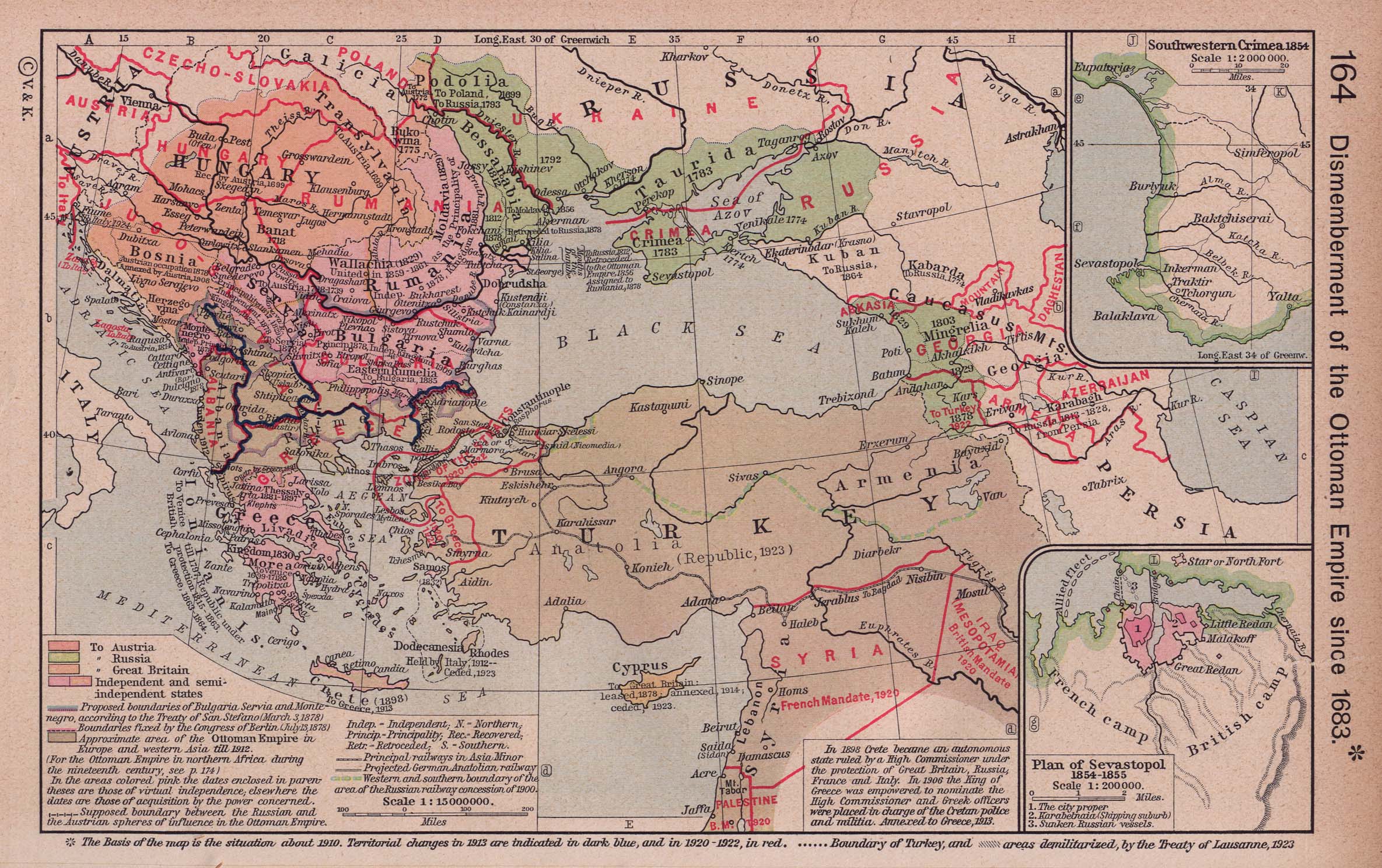
 The dismemberment of the Ottoman Empire
(Perry Castaneda, click to magnify)
Hazbani's questions about U.S. policy toward the Ottoman empire and the Turkish republic after WWI sparked my interest in the history of Turco-American relations.
As Hazbani noted, the U.S. did not declare war on the Ottoman empire in 1917 - a decision in line with the non-interventionist policy it had pursued since the late 19th century. The U.S.'s main concerns then were protecting the investments that American missionaries had made in educational institutions, as part of efforts to convert Ottoman Christian minorities. But the American also had an eye to future economic opportunities. The latter motivations became preeminent after 1918, when most of the Ottoman Christian populations had either left or been killed or deported.
It is interesting that Hazbani mentioned a US Navy paper, on "USN relations with Turkey from 1914-1940," as the person whom many associate with redefinition of American relations with Turkey after the war was Admiral Mark Bristol, the U.S. High Commissioner to Turkey from 1919-1927. Bristol saw economic and investment opportunities for the U.S. in Turkey, and he was not blind to the navy's need for oil (Donald Bloxham, The Great Game of Genocide, pp. 185-187).
Another point that Hazbani made was about the relatively benign stance of the U.S. toward the defeated Ottoman empire, especially when compared to the rapacious aims of the British, French, Italians, and Greeks.
Under the Treaty of Sèvres, signed in August 10, 1920, the Ottoman empire was not only stripped of all its non-Turkish territories (in the Balkans and in North Africa), but also of some of its Anatolian possessions. The oil-rich town of Mosul, one of those former Ottoman empire possessions that Melih Can was talking about, was seized by the British as part of the Iraq mandate. The French took Cilisia as part of their Syrian mandate. In Eastern Anatolia, the Allies recognized the Armenian and Kurdish claims to independence. Finally, in May 1919, the Allies approved of the Greek occupation of Smyrna (or Izmir in Turkish) in the west, also on the grounds of national self-determination (Greek statisticians claimed a Greek majority in the city). However, the Italians were allowed to occupy Antalya in SW Anatolia (Norman Rich, Great Power Diplomacy since 1914, p. 61).
The U.S. did not participate in this, partly because it had not been party to the irresponsible promises of territorial spoils made by the Allies to each other. However, American businessmen were happy to go along with the British in looking for oil in tapping the Mosul oil fields. There actually was a certain convergence of US and British interests here, but the U.S. came to differ with Britain and the other European powers on the future of Turkey. The British, under Lloyd George, hoped to persuade America to guarantee Armenian independence and thereby put in place a check against both Bolshevik and possible Turkish pan-Islamist (or pan-Turkic?) ambitions. The Americans refused, and eventually came to see a strong, nationalist Turkey as a preferred alternative (Bloxham, Ibid., pp. 192-193).
In the meantime, Mustafa Kemal had risen to the top of the Turkish nationalist movement. In October 1920, the Bolsheviks had overthrown the Armenian Republic and turned it into a Soviet Republic. But with the Red Army embroiled in a war with Poland, Kemal attacked the Armenian Soviet Republic and regained all the lost Turkish territory, including Batum, Kars, and Ardahan; Batum was later returned, and became part of the Georgian Soviet. Kemal also signed a treaty with France, which returned Cilicia in southern Anatolia as well as arms, in exchange for Tureky's recognition of the French mandate over Syria. Lastly, the Italians surrender their Anatolian claims in return for certain economic stipulations and Turkish acceptance of their possession of Tripoli, the Dodecanese islands, and Rhodes. In August 1922, the Turks took back Smyrna from the Greeks. Finally, the nationalist forces headed north to Constantinople, where the British were still defending the sultan and the Treaty of Sèvres. Soon thereafter, Kemal led the domestic revolution that deposed Sultan Mehmed VI on November 17. The net result: Anatolia had been secured under the leadership of a modern, Western-oriented Turkish Republic.

These Turkish gains were consolidated under the November 20, 1922 Treaty of Lausanne. Armenian and Kurdish independence in eastern Anatolia had been quashed, as had Greek claims in the west (eastern Thrace); only Mosul was lost to the Mesopotamian mandate, and Alexandretta (İskenderun) to France (the latter became part of Turkey again in 1939) (Rich, Ibid., pp. 85-87).

From 1922 to 1989, American policy viewed a strong, undivided Turkey as a bulwark against the Soviet Union and as a force for stability in the region. Although Turkey's pursuit of an autarkic economic policy and its trade relations with the Weimar Republic and then the Hitler regime during the interwar period and into the 1930s meant that many of America's economic hopes were not realized then, the military and economic aid that poured into Turkey in the 1940s cemented the American role in the country.
Turkey, it seems clear, now wants some of the oil spoils of which it had been deprived by the British after WWI. In addition to protecting its population from terrorist attacks, the country also wants to safeguard its territorial integrity, which it sees threatened by the rise of a Kurdish state on its southern border, and Kurdish control over oil revenues from Kirkuk and elsewhere. The trick for the U.S. will be to determine how to keep the Turks in line with its own interests, at the lowest price possible.
Thursday, June 07, 2007
Has Turkey Crossed the Rubicon?

There is currently a media blackout on Turkey's military operation in the south of the country and in northern Iraq. The American as well as the European press have hardly covered it. Initial reports in the international media, which cited Turkish "security circles," spoke of several thousand Turkish soldiers having entered Iraq in a "very limited" operation. These reports, however, were later denied by the Turkish foreign ministry, Iraqi border officials, as well as by the White House.
At this point, we can only speculate about what is truly transpiring. Clearly, the Turkish military is engaging in a large-scale operation against the PKK within its own borders; most likely, it has also carried the fight into Iraq. The Kurdish separatist group has stepped up its terror campaign inside Turkey in the past few months, providing the Turks with plenty of reasons for a response in southern Turkey as well as against hide-outs and camps across the border.
Turkey has conducted many cross-border raids in the past, and aside from denying that Turkish troops are in Iraq, both the U.S. and the Turks are publicly playing down the scope of this operation. However, there are people in Turkey who are hoping and/or expecting this to be a far more significant move than that. Dr. Melih Can, an "international relations expert," has a long article in Today's Zaman, which I think expresses some of the foreign policy aspirations and grievances of members of the Turkish elite, as they have developed since the U.S. invasion of Iraq.
I previously encountered Can's name last August, when he published a piece on Russian policy in the Middle East. The article, "Did Russia have a hand in stopping Israel?" was a mixture of analysis and wishful (though not entirely unrealistic) thinking that resembles his more recent piece about Turkish ambitions in the region. Writing in the wake of the Lebanon war, Can seemed to me a bit too convinced that Israel had suffered a devastating defeat at the hands of Hizbullah:
The war Israel waged against the Hezbollah will go down in history for destroying the Israeli army’s image of invincibility as much as for the massacres of civilians (Zaman, August 17, 2006).Can attributed special significance to Hizbullah's supposed successes against Israeli tanks:
Known as the source of Israeli military might and named the “mountain steel,” the Israeli-made Merkava tanks, destroyed one by one by the Hezbollah became a symbol for this crushing defeat.This, of course, is nothing but hyperbole. Hizbullah actually did not destroy Israeli tanks "one by one." It is true that one older Merkava model was blown up by a massive mine in the initial pursuit across the border, after Hizbullah's kidnapping action. It is also correct that, after the war, Israel complained that Russia had armed Hizbullah with advanced anti-tank missiles (of the type Metis), and that a few of these put some older Merkava tanks out of commission. However, the main damage that Israeli troops incurred at the hand of this weaponry was not to tanks but to soldiers sleeping in houses.
The main point that Can was trying to make in that piece, however, was about Russia's moves to thwart American and Israeli power in the region in order "to continue in its traditional role of selling arms, directly or indirectly, to Middle Eastern governments and organizations," and to "rectify[...] the role of Russian businessmen in the region’s energy sector" (Zaman). Interestingly enough, the article does not mention Turkey's role in these moves at all. In his latest contribution to the debate, Can lets the cat out of the bag.
While Can's more recent article is not explicitly pro-Russian, it brims with resentment about American limitations on Turkish ambitions in the region. The sense of wounded pride is especially palpable in the penultimate paragraph of the article, in which Can gives the US two choices:
either to pull new “canvas sacks” over Turkey’s head or to enter into a fresh compromise with Turkey in the near future (Zaman, June 7, 2007).The "canvas sacks," I believe, are a reference to the "hood event" in July 2003, when U.S. troops arrested Turkish special forces operating in northern Iraq, and put hoods or canvas bags over their heads. That incident provoked an uproar in Turkey and was apparently the basis of a 2006 feature film based on the television show "Valley of the Wolves" (whose distribution was blocked in the US, in part due to accusations of antisemitism and anti-Americanism)
According to Can, an over-the-border military operation by Turkey would be about much more than a response to PKK terrorist attacks. Rather, he argues, it would be about "Turkey's new role within the Middle East," and whether the country is to follow a "mission appropriate to its own history or a more independent set of policies" (Zaman). By "appropriate to its own history," Can seems to mean a policy in line with its Cold War pro-American alignment - not one that accords with Turkey's "historical destiny." The trans-border operation, in Can's mind, thus figures as a crucible for Turkey - it will clarify both the country's willingness to pursue its real interests, as well as America's stance vis-à-vis a more independent Turkey. In that sense, an "over-the-border operation" marks a crossing of the Rubicon, and seems very much bound up with Turkey's destiny in the region.

Can's claim that "there is an extremely pressing need for a breaking point right now, with this need emerging as an over-the-border military operation," is full of expectation of some change, and the sense that aggressive action is necessary for Turkey to break free from the force containing it. That force, it becomes clear, is the U.S., which has pushed Turkey into a difficult predicament. Can distinguishes 7 sub-forces, almost all of which are closely linked to American involvement in the region:
1. the beginning of America's withdrawal, and its alleged "encouragement of various ethnic and sectarian clashes within the framework of its 'New Middle East Strategy.'"I may be misinterpreting Can, but it seems to me that he even accuses the U.S. of being behind #7. He argues that to prevent Turkey's entry into northern Iraq, "the US is using all possible tools and national dynamics possible in Turkey ... [and that] this is how the current domestic political crisis, blockages and lack of stability in Turkey need to be understood." I am not sure whether Can is implying that the U.S. is supporting Erdogan in his recent show-down with the military and secularists or the latter. It is also possible that he is alluding to U.S. support for the Kurds in Turkey (unlikely), or perhaps even the Armenian Genocide resolution in the American Congress (also unlikely).
2. increased awareness of threats to Turkey from northern Iraq, and the "provocation of Turkey by the PKK-Barzani relationship"
3. the danger facing Iraqi Turkmens and Kirkuk
4. "the irresponsible and one-sided stance of the US administration"
5. an "increase in activities aimed at shaking the prestige of Turkey and the Turkish Armed Forces"
6. the involvement of other countries in Iraq, most notably Iran
7. Turkey's domestic political situation
Can argues that the Americans aim primarily to have Ankara coordinate its activities with Washington, according to the latter's interests. But Turkey's post-Cold War foreign policy has increasingly diverged from America's, and the U.S.
has become uncomfortable with Turkey's displays of a more independent stance, the attempts to define the agenda, moves to forge new alliances and, as a result, entrance into a new period in the "Turkish-Islamic" world through a venture involving Russia and Iran (Zaman).Both Turkey's increasingly eastern orientation in the region - Can speaks of shifts in the Ankara-Damascus-Cairo-Riyadh-Tehran-Islamabad line - and its refusal to subordinate itself to America's stance on Russia (the Turks are not cooperating with the U.S. strategic aim of building a gas pipeline network that provides a viable alternative to Russia's Gazprom) testify to a clash of interests. Of particular concern to the U.S., is the possibility that Turkey will go for an even more independent policy vis-à-vis Iran.
On the other hand, in the Caucasus, American and Turkish interests seem so far to coincide, as both countries have invested a great deal in strengthening Georgia and Azerbaijan (see our post on some of the pipelines). Still, in the Middle East, or as Can says, "in the former Ottoman Empire areas," the Turks are clearly flexing their muscles. Turkey has emerged as a respected (by the Arabs) "mediator" in the region who might undermine American pre-eminence as a broker, and the




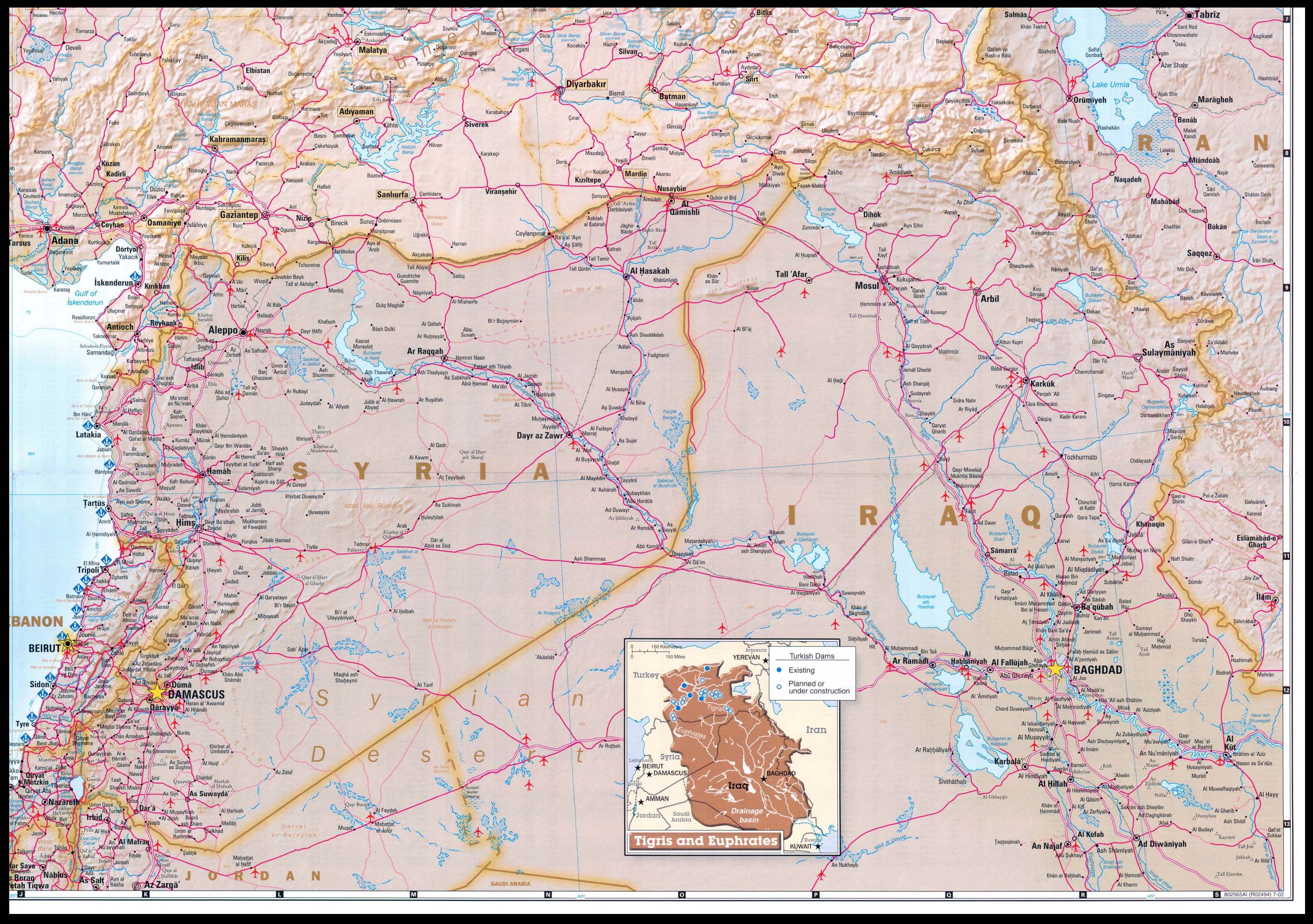

respect and esteem achieved by Turkey in the former Ottoman Empire areas following March 1, 2003 have only served to underscore its capacity for changing current regional balances in the future (Zaman).March 1, 2003, of course, was the date on which the Turkish parliament ended up rejecting U.S. troop deployment in the country ahead of the invasion of Iraq. Turkey, in other words, Can says, is no longer content to play the "memorized roles" that it performed during the Cold War.
It is true, of course, that the PKK's terrorism in Turkish cities is also an important motivating factor for action in northern Iraq. Turkey's patience with U.S. declarations about the problem of attacks carried out from bases in Iraqi Kurdistan has run out. Furthermore, according to Can, the Turkish Army does not take seriously "veiled threats" against the Kurds as well as against Turkish incursions (on the latter, see my January post on former Pentagon Undersecretary Dov Zakheim's op-ed). Turkey's Chief of Staff, General Yaşar Buyukanit has apparently not ruled out a confrontation with American troops, and there is a pro-Russian tendency in the military.
Can's hope - and hence the sense of expectation - is that an "over-the-border operation" will finally address a complicated set of policy problems that require resolution. In particular, he believes that it could clarify
1.Turkish-Western relations (Turkey-US as well as Turkey-EU)This seems to me a very tall order that will probably be disappointed and thus lead to further frustration. But very much will depend on the American response. It is possible that the U.S. has been denying that anything unusual is taking place precisely because it does not want the "over-the-border operation" to extend beyond the immediate problem of the PKK. News of a large Turkish invasion, with designs on Kirkuk, would be an untenable provocation and force the U.S.'s hand. However, in the meantime, it appears that the Americans have left the Kurds to confront the threat by themselves (a May 30 agreement handed security in three provinces over to the Kurdistan Northern Regional Government), and are waiting things out on the sidelines.
2. Turkish-Russian, Turkish-Iranians, and Turkish-Iranian-Russian relations
3. the future of Iraq and a Kurdish state, and thereby, "the partnership and friendship of Turkey-Syria-Iran"
4. role of the Kurds in the region, especially Kurdish nationalism around the PKK and Barzani
5. Turkey's new regional and global position, especially the question of whether Turkey will be a global player
6. the terror problem in Turkey and "theoretical 'civil war scenarios'"
7. leadership processes in Turkey.
Thursday, March 08, 2007
The Collapse of the Ottoman Era
 Allenby Park in Beer Sheva (June 2006)
Salim Tamari, a faculty member of Birzeit University and a visiting professor in the history department here, presented an interesting talk today at Berkeley's Center for Middle Eastern Studies. His talk, "Palestine 1915: The Collapse of the Ottoman Era in the Diaries of Soldiers from the Great War," sought to unsettle both the Turkish as well as the Arab nationalist historiography of World War One using the diaries of a lieutenant and a private serving in the Imperial Fourth Army commanded by Jamal Ahmad Pasha.
The Fourth Army fought in the Levant, at Suez, and in the Hijaz. The informants on whom Tamari relied were initially garrisoned in Jerusalem. Both of these diarists exemplified the complex, situational identities that were the norm in the Ottoman Middle East. According to Tamari, Lieutenant Muhammad al-Fasih, who hailed from Mersin (Iskandarun, which is now in Turkey, near the Syrian border), was a "Turkified Arab." Private Ihsan Hasan al-Turjman, on the other hand, was an "Arabized Turk" from the Old City of Jerusalem. As his last name indicates, members of his family were employed as translators. While the "Arabized Turk" died in 1917 (in murky circumstances on which more later), the "Turkified Arab" went on to become a decorated officer in the Kemalist army after the war. It was indeed only after WWI that their national identities crystallized. Tamari argued that this was the case for many Ottoman subjects in the Levant.
With his talk, Tamari hoped to undermine two dominant narratives in the historiography of the Great War. Both of these histories feature the motif of betrayal. On the one hand, Arab nationalist historians have represented the story as driven by the Turanian (pan-Turkic) betrayal of the Istanbul and Ottoman elite, which had allegedly abandoned the idea of an integrated constitutional regime of citizenship that would include Arabs and grant them a certain amount of cultural autonomy (such as Arab-language instruction in schools). These historians point to the aggressive Turkification campaign waged by the triumvirate of Enver, Tal'at, and Jamal Pasha. The Turkish side, on the other hand, believes that the Arabs betrayed the empire, pointing to the Hashemite alliance with the British and the fact that Egypt never rebelled.
Often occluded by these narratives is the fact that more Arabs fought in the Ottoman army than took part in the Arab Revolt on the side of the Husseinis and the Syrian nationalists. Indeed, alongside Albanians, Bulgarians, Kurds, and Turks, Arabs made up 1/3 of Ottoman forces. Tamari estimated that perhaps half of the 97,000 Ottoman troops who died at Gallipoli were from the Levant, Egypt, or the Hijaz. In the annual commemorations attended by ANZAC and Turkish veterans representatives nowadays, all of the fallen Ottoman soldiers have been retroactively Turkified.
 Another view of the memorial
In the Holy Land more specifically, pro-Ottoman affinities were and remained strong among the Arabs. It was hard for many inhabitants of the Jerusalem mutasarrifate to imagine themselves as cut off from a network that included Halab (Aleppo), Beirut, Damascus, and Anatolia. Many supported the idea of a federated Arab-Turkish Ottoman state, an idea that was also contemplated by parts of the leadership of the Committee of Union and Progress (Ittihad). Arab nationalists, on the other hand, favored either an independent Greater Syria to be ruled by Prince Faysal from Damascus. There was also the option of an independent Palestine, which has of course received a lot of prominence in the historiography.
One other option that Tamari unearthed using the diaries, which he claims was part of the discourse, was the "decentering of Palestine." Palestine, as he pointed out, of course, was not an Ottoman administrative unit at the time. It probably makes more sense to speak of the Jerusalem district, which the Ottomans imagined as stretching from Jaffa in the north, to the southern part of Nablus, and including all of the Sinai peninsula. Private Ihsan reports that based on this Ottoman conception of the area, many people between 1915-1916 were contemplating a union of this area ("Palestine") with Khedeval Egypt. The reasoning was that the British would not allow the Jerusalem district to unite with Syria, for fear of it falling under French control. The private, as Tamari noted, obviously could not have known that such a union would have contradicted British promises to the Jewish national movement, which became known with the Balfour declaration in 1917.
Obviously, this option became moot when the Egyptians did not rise up against the British, and when Allenby forced the Ottoman army northward as the British and their allies invaded from the south. Nevertheless, according to Tamari, pro-Ottoman forces remained strong in Nablus, Akko, and Haifa.
 Map at the Allenby memorial in Beer Sheva (June 2006)
The other part of Tamari's talk was devoted to the disintegrating effects of the Great War on Ottoman society in the Levant. The conscription of so many young men, combined with a locust attack in the spring of 1915 and the requisitioning of remaining crops by the Fourth Army, led to widespread starvation. The hunger and the breakdown of traditional society led to radical transformations, especially in urban centers. Adult men disappeared from the public sphere and an increasing number of women were forced to earn a living, though their options were extremely limited. Many turned to prostitution. Official bordellos for soldiers were established in Jaffa, Damascus, Beirut, and Jerusalem (which supposedly had 12 such institutions). Private Ihasan noted this collapse of his society with observations of prostitutes walking to the Damascus Gate.
The Great War also meant the end of a certain kind of localism. Tamari pointed to a declaration by Ihsan that he "will even go outside Jerusalem to get married." Such a statement would have been unthinkable before the war, the sociologist explained. But with so many soldiers being garrisoned far away in the empire (it was Ottoman policy to try to station soldiers far away from their homes; hence, Albanians and Bulgarians in Jerusalem, and so many Arabs at Gallipoli), and with the stablishment of railroad lines (aided by German military engineers) and the building of roads, local affinities began to break down. Ottomanist as well as nationalist identities competed to fill the void.
I will add two more notes of interest. Private Ihsan was killed in 1917, most likely by his commanding officer. This commanding officer, an Albanian, had apparently been harassing the private for months - "he had fallen deeply in love with Ihsan, who would have none of it." After Ishan complained to the commander, another Albanian, the would-be lover was demoted. Ihsan's C.O. then threatened him with death several times, coming to his house and seeking him out elsewhere. Until Tamari's discovery, the private's family had claimed that he was shot for deserting.
The actual finding of Ihsan's diary in the first place is also noteworthy. Tamari discovered the manuscript in the Hebrew University library. It did not have a name on it, and only through some sleuthing and a measure of good luck (which involved cross-referencing with another diary of a person who turned out to have been Ihsan's teacher) did Tamari discover the identity of the journal's author. In the Hebrew U. archive, the manuscript is filed under "absentee property." Tamari believes that it was probably found in an abandoned Arab home in East Jerusalem in 1967. He added that it was good that the Israelis found it, because if Ihsan's family members knew that it would come to light, they would probably have destroyed it.
Subscribe to:
Posts (Atom)