Showing posts with label Sderot. Show all posts

Wednesday, January 09, 2008

Putting Sderot on the Map

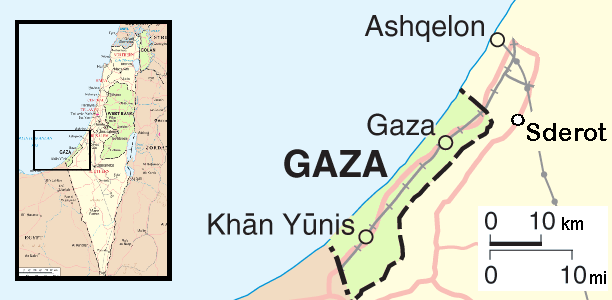
Map from Wikipedia

Steven Erlanger's story on the front page of today's New York Times (print edition) is, to my knowledge, the first time that the plight of the southern town's residents has made it there. The qassam attacks from Gaza began before the withdrawal of August 2005, but they have intensified greatly since. Erlanger's piece, accompanied by photographs of children peering at the destruction caused by the rockets, gives voice to the parents, sons, and daughters of the town, whose suffering has received relatively little attention until now.

There are some who try to relativize the qassam attacks, by pointing to the primitive construction of the rockets, their inaccuracy, and the low number of deaths that they have caused so far. They inevitably follow up with a comparison of the qassam to the F-15, with its deadly strikes on Gaza. This kind of comparison provides the relativizers with poetic justification, just like the image of rock throwers confronting tanks (in reality, they are more likely to face soldiers). We are entreated to view the struggle as one of heroic resistance fighters with limited resources confronting an awesome machine marshaling infinitely stronger state and military power. Or better yet, we are told that the rocket attacks resist "the occupation."

Such comparisons obscure the particularity of the terror that Sderot's residents experience every day. It is easy to remark, upon reading about one of Erlanger's teenage protagonists Razi, who "has seen 15 therapists" since seeing a rocket explode in front of his eyes, that Razi, unlike the children of Gaza at least has a therapist. This is a cynical and cruel game. The suffering experienced by Razi and all of Sderot's residents is not just and it is not unavoidable. It is the outcome of a deliberate strategy to terrorize civilians, which should be condemned as loudly as Israeli air strikes which kill innocent Palestinians.

The qassam attacks are all too often depicted as pin-point blows against the "powerful" by those sanctified as essential "victims." The reality of course is that they are aimed at one of Israel's poorest and most defenseless populations.

In this post, I have deliberately avoided the "causes" of the qassam problem and any discussion of its solution. I do not know whether the qassam attacks are being used for tactical or strategic purposes. These are issues I hope to address soon.

Thursday, May 17, 2007

"God Saved Us"

Sderot synagogue hit by a qassam. The photograph of R. Ovadia Yosef (right)
and the painting of the youthful Baba Sali [I think] (left) were unharmed (Photo: Ynet)

The photographs and the press reports from Sderot this week are eerily reminiscent of scenes from the north in last summer's war. Of course, the residents of the western Negev have been living with the qassam strikes since before the disengagement from Gaza. But the media spotlight is now back on Sderot, and the pressure on the government is mounting to "do something" about it.

On the airwaves and in the print media, the inhabitants of the Negev town seem unanimous that they have been abandoned by the politicians. I am not sure that Prime Minister Ehud Olmert's visit assuaged their fears - some Sderot residents took this as an opportunity to lash out at Olmert as well as Defense Minister Amir Peretz, whose house in the city is apparently a target for the qassam crews.

Shortly after Olmert finished his tea with Peretz and left the town, a rocket struck a synagogue. This strike could very well have resulted in casualties; shortly before the qassam hit, community members had celebrated the dedication of a new Torah scroll. "God saved us," said one of the people on the scene. Ynet's coverage (Hebrew) gives voice to the anger and fear of Sderot residents. These are the words of Aryeh Cohen, who came to Peretz's house to "talk" to the PM:
ראש הממשלה פחדן, באת כמו גנב בלילה עם כל השומרים שלך. זו לא פרובוקציה מה שאני עושה, אני רוצה לדבר איתו. רק אתמול בלילה עברו מעלי טילים. אני רוצה לשמוע את ראש הממשלה נותן לי תשובות. כל הזמן אנחנו שומעים אותך ואתה לא מאפשר לנו להשמיע את קולנו. נכנס לבית של פרץ, פרץ גם עוד יותר פחדן ממך - גר בבית ממוגן ואנחנו - אין לנו מקלטים

The Prime Minister is a coward, you came like a thief in the night with all your guards. What I am doing is not a provocation, I want to talk to you. Only last night missiles passed over me. I want to hear the Prime Minister give me answers. We hear you all the time and you don't allow us to make our voices heard. He went into Peretz's house, Peretz is even more of a coward than you - he lives in a protected house - we don't have shelters.
The truth is that while the IDF may be able to reduce the rocket strikes to a certain degree with some of its current actions, qassams will continue landing on Sderot without a renewal of some kind of hudnah with Hamas. Even that, however, will only reduce the number of rockets, as the Islamic Jihad and wild Fath crews will continue their activities. As the latest eruption of internecine fighting in Gaza made all too clear, no one has a monopoly on violence in the Strip.

Aluf Benn lists four different alternatives, faulting Israel's leaders for not having learned from Winograd and ignoring "diplomatic" alternatives. The options he lists are:
  • Offering a cease-fire in the West Bank in exchange for a cessation of qassam firing
  • Allowing the U.S. to implement the "Dayton Plan" - i.e., training and arming forces loyal to Abu Mazen to fight the qassam crews and weapons smugglers
  • Engage in direct talks with Hamas and offer to lift the economic embargo against the PA in exchange for a long-term hudnah
  • Meet with Abu Mazen
The last of these is, of course, utterly useless, as Benn acknowledges - we can reject this one out of hand. The second option apparently has a lot of backers in the State Department. There are some who are insisting that Fatah forces are fighting quite well against Hamas. However, even if there is some truth to this (it seems to fly in the face of the evidence), a victory achieved by Israeli-backed units would be meaningless, as it would never have popular legitimacy. Given the political weakness of Abu Mazen, this seems like a waste of time and money.

The first and third options, which involve dealing with Hamas, seem more promising. However, these days it is not at all clear that Hamas can deliver the goods (i.e., no more qassams) any more effectively than Abbas. In any case, both of these scenarios would allow Hamas to build up its forces for a future confrontation; one has to weigh the costs very carefully.

Given that none of the "diplomatic" alternatives above are truly viable, it seems that Israel can only hope to reduce the rocket fire at this point by targeted air force and artillery strikes, and work on reinforcing buildings and bunkers in Sderot. This is pretty much in line with previous escalations in the south. Sooner or later, an errant Israeli artillery shell or air strike will hit a residential building in Gaza, kill a large number of Palestinian civilians, and occasion an international outcry, and put a stop to the operation. Then, things will return to the status quo ante of 10 instead of 30 qassams a day ... until the next round.

The worst thing Israel could do is to embark on a full-scale invasion of Gaza now. It will bring only marginal gains over air strikes, in terms of preventing qassam launches. Let's face it. There is no real solution to the problem of the rockets - at least not one that Israel by itself could achieve.

Wednesday, May 16, 2007

The Qassam Front

Exodus to Be'er Sheva

As I said last week, it was only a matter of time before one of the qassam rockets among the barrage fired at the western Negev and the city of Sderot would occasion a more far-reaching response from the army. The direct hit on a Sderot apartment complex today broke the camel's back, though it remains to be seen just how "comprehensive" the military response will be. The air force's bombing of a Hamas "operations center" in Rafah, which killed 4 and wounded 20, combined with a resumption of "targeted killings" of Hamas leaders probably represent the limits of the "severe and harsh" measures promised by Olmert will take.

The increased qassam activity is taking place against the backdrop of renewed intra-Palestinian fighting between Hamas and Fatah, which has led to more than 40 deaths over the past four days. Perhaps partly in a bid to make some sort of appeal for Palestinian unity, Hamas is openly taking part in the qassam firing, which explains the increased activity on this front (50 rockets since Tuesday). Fatah militants are probably also participating to some extent, as they too seek to appeal to the street. But the residents of Gaza know how disingenuous this rhetoric is. The call for Palestinian unity against Israel and the qassam attacks obscure the serious tensions between the factions and criminal gangs in Gaza, and the lethal violence inter-factional violence enveloping the Strip.

It is amusing to watch As'ad AbuKhalil try to deny that we are in fact seeing the beginnings of a civil war in Gaza. It reminds me of his praise for the Iraqi "insurgency" and his pathetic efforts to manipulate the statistics from that theater - all in order to claim that these criminals are fighting "illegal occupation" rather than butchering innocent civilians.

This latest eruption in intra-Palestinian fighting should dispel any doubts about the viability of the Mecca accords (if anyone remembers it) as well as other cease fires. All of these cease fires are unlikely to last without the complete victory of one faction over another. The U.S. has been pressuring Israel to rush arms to Abu Mazen to support Fatah fighters and to ensure that Hamas does not score a complete rout over its opponents. I think that Olmert will continue resisting these calls - both for domestic political (one of the slogans of the right after the outbreak of the second intifadah, aimed at the Oslo process backers, was "you gave them rifles" - and they were right that these guns were indeed turned against Israeli soldiers and civilians ), as well as strategic reasons.

Even if Fatah were to acquire additional equipment, it is not at all clear that its failures in the field against Hamas are due to a material disadvantage. In any case, Fatah is unlikely to defeat Hamas militarily; certainly, such a victory bestowed upon it by American or Israeli backing would profoundly hurt its chances in the political sphere. It makes much more sense for Israel to step back and intervene with pinpoint operations against Hamas fighters and infrastructure (or Fatah militants) as it sees fit.

Meanwhile, Gaydamak has paid for 800 Sderot residents to be put up in hotels in Tel Aviv and Be'er Sheva. An exodus of sorts has gripped the town since the latest strike. In the Israeli media, photographs have been published of residents trying desperately to board Gaydamak's buses and flee the city.

Olmert has responded angrily (Hebrew) to this evacuation operation. It is clear that Gaydamak is amassing an arsenal of public support in pursuit of his political ambitions; in the meantime he is performing some very good deeds. The residents of Sderot have been let down again by the Israeli government. Nobody has previously discussed the deplorable "lethargy" exhibited by the country's politicians with regard to putting in place at least a preliminary defense system against the rockets. The public bomb shelters have only been opened now in Sderot.

Expect the qassam fire to continue increasing over the next few days, as Hamas and Fatah try to fight a two-front war - against each other and Israel. The biggest losers will of course be the residents of Gaza.