Monday, July 17, 2006

Of Two Different Minds

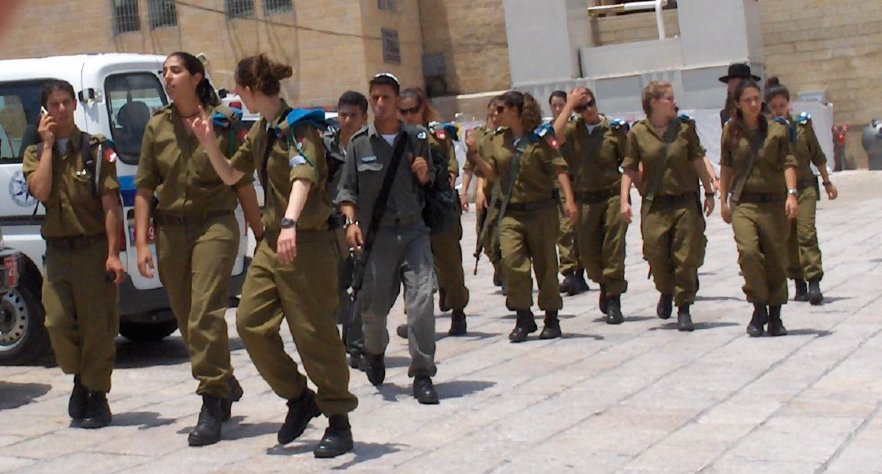
A group of soldiers protecting worshippers
at the Western Wall in Jerusalem (July 2006)

Be lenient with me as I return to a subject about which I have frequently griped in the past: "the Europeans." Today, I ran into an acquaintance of mine from a very small country in Western Europe, and asked her how she had passed the last few days. She mentioned that she had had a wonderful time at the beach in Tel Aviv. The only thing that had disturbed her, were the sounds of military helicopters moving across the sky. "Everything was so peaceful, and then this ...." she said with obvious resentment. The statement reminded me of the distaste some European visitors expressed to me about the police presence in some American cities, as well as the abundance of security personnel with guns on Israel's streets. I find it very difficult to understand this mindset. The helicopters are making it possible for me to sit safely on the beach. The security guards are there to prevent us from being blown up. Yes, I am resentful - but not at the people who are protecting me.

In conversations with Europeans, and while living on the Continent, I have often noticed a certain uneasiness with police and soldiers, even if they are representatives of democratic states pledged to safeguard the rights of their fellow-citizens. Some French and German acquaintances of mine, almost seemed to prefer the risk of being the target of violent crime to an increased police presence or more agressive patrolling.

What Does it Boil Down to for Locals?

I've been talking a lot of what is going on in my apartment in Haifa, but I'd like to slightly broaden the picture.
I'm in close contact with my friends from Haifa through MSN messenger, text messages, and phone calls. All of them except for one (who has been in a bunker for two days and was very close to the building that collapsed today) have decided to stay in Haifa. Although everyone has received invitations from all over the country (south of Haifa, of course), the people that I know do not want to leave their homes. I have heard that thousands of people have already left Haifa, but it seems to me that these are mostly families with children.
Though we are happy to stay in our city, most of us are stuck at home. Work was cancelled yesterday morning after the rocket attacks around 9:12 AM, and Haifans were told not to report to work today either. I've missed two days of salary already.
Looking out from the window, I see that the streets are deserted of people and cars. A few people hang out close to my building, but I know that those are the people who have taken up shelter at the local bunker and just came up for some fresh air, a change of scenery, and maybe to smoke a cigarette. They soon disappear back into the bunker.
University was also cancelled - it's actually exam time here. My roommate, who is a student at the Technion University, is quite frustrated. He doesn't know what to study for anymore - the tests that he was supposed to have had already, or the tests which are scheduled for the near future, which might also not happen? As well, this will push back all exams, a hassle for those students who had made plans to go abroad.
My boyfriend, who works for a Dutch company in the Jezreel Valley, has lost one of his four workers. The worker was ordered to back to Holland, even though he and his Israeli fiancee had made plans to get married in Israel within the next couple of months.
So, there's some boredom, frustration, and interestingly enough, a lot of munching going on! But the main thing is the uncertainty - it's difficult to make plans for the next day or even the week when we don't know whether we'll be able to go outside or not. Despite it all, I realize that my friends and I are lucky (tfu tfu tfu). It saddens me to see the TV reports of Lebanese civilians fleeing from their villages, and to think of all the people in both countries who are mourning loved ones and have had their homes destroyed.

The Sixth Alarm of the Day Sounds in Haifa


We're huddled in the hallway again after hearing another alarm sound. My roommate and I are anticipating the booms.
Still haven't heard any... it might be a false alarm, like the one at 5:55 AM.
A couple of minutes later, and I still haven't heard any katyushot land. At this point I'm assuming it was a false alarm.
My roommate and I are considering arranging some camping mattresses in the hallway and sleeping here tonight instead of being caught asleep in our beds.
The cat, Inch, is here as well, eating Bissli with me. One of the reasons my roommate doesn't want to go into a bomb shelter is because of Inch - she probably wouldn't be allowed in.

Very Unconfirmed Arab News Reports about Downed Israeli F-16

This morning, at least five hours ago (local Israel time), a number of Arab news outlets reported that an Israeli F-16 crashed or was downed north-east of Beirut. I've been doing some surveys of the websites of major satellite news station and I am fairly sceptical. My short survey was conducted around 4 to 5 pm Israel time and included only websites. I'm in the library at Ben-Gurion University now, so I can't listen to the radio or watch TV. I started on the al-'Arabiyya website, which had a headline that read:


التلفزيون اللبناني يعلن إسقاط طائرة حربية إسرائيلية وتل ابيب تنفي

"Lebanese television announces the crash of an Israeli fighter plane and Tel Aviv denies [the report]"

The Dubai-based and Saudi owned al-'Arabiyya article goes on to say that there are conflicting reports about the event, but that Lebanese television (they don't say what station) showed something falling from the sky. There are no pictures and there is no other evidence, and the article also notes that an Israeli security source has denied the reports. On Qatar's al-Jazeera, there's not even a headline or article about the supposed downing of the plane. This is about an hour and a half or even more after the news were first released. The news-ticker also doesn't mention the story. That must mean that is is too iffy even for al-Jazeera to publish. The Lebanese TV station LBC also makes no mention of this story. America's Arabic-language news radio station Radio Sawa, is another news outlet that does mention the story. An article in Radio Sawa says that Lebanese defence sources asked about the matter said that they could not confirm the report:


من ناحية أخرى، قالت مصادر أمنية لبنانية إنها لا تستطيع تأكيد نبأ سقوط الطائرة


The same sources added that it is possible that some part of the fuel tank became detached from the plane:


ربما يكون عبارة عن صهريج وقود انفصل عن جسم الطائرة

They're not Letting Up

The alarm sounded for the fifth time today, and I heard two more rockets strike a couple of minutes ago. I haven't had a chance to leave the little hallway yet, but I can hear the TV report from the living room. I'm finding it hard to focus though so I'm catching only part of the news. Apparently a three-story apartment building in Haifa collapsed. The phones in our home are ringing off the hook - all our cell phones (which curiously, are working now) and our landline. Everyone calls everyone to check if they're okay. Messenger is great, too, for keeping updated with our family and friends.

More Rockets

Another alarm and more bombs. The total number of bombs I have heard dropping today is 15. Still in the hallway, waiting.

It's Getting Really Close

The sirens sounded again and we ran into the hallway. It's the only space in our apartment that doesn't have exterior walls, windows, or doors. We heard four missiles striking, two of them extremely close. I couldn't help it but I burst into tears. At least this time, the sirens came before the bombs so we had time to retreat to a safer area in the house. Of course, the news can't tell us exactly where the bombs hit in order not to help Hezbollah pinpoint. Now the only sound I'm hearing is ambulances.

Under Fire Again...

It was a relatively quiet night and we were woken up only once by the siren. We waited it out in our living room but didn't hear anything fall in Haifa. Just now though, as I was about to head out, the katyushot started falling. The sirens came only after about three katyushot hit. I've heard about five more since then (all in the span of about five minutes). Already it's impossible to use our cell phones - the network has crashed again. In the most critical times, the network gets overburdened and there are no outgoing or incoming calls. We're waiting... and in the meantime, I'm staying home.

Lebanese Reactions

Screenshot of the Website of a Lebanese-Canadian Organization Opposed to Hizbullah

I've been reading various Lebanese blogs for months now, and I was especially curious what their views would be about the events unfolding in their country. Many Lebanese bloggers are quite opposed to Hizbullah and of course deeply critical of Lebanese and Iranian interference in their country's internal affairs. On the other hand, as is to be expected, few people are "understanding" of Israel. One prominent ex-patriate Lebanese blogger, Abu Kais, author of From Beirut to the Beltway and a Shi'i who is deeply critical of Hizbullah, argues that America, by not reining in Israel, has lost the support of many Lebanese. Abu Kais is voicing the anger of a person caught in the middle of a fight that he did not pick. America, on the other hand, sees Hizbullah as an agent doing Syria and Iran's bidding to frustrate American aims to impose a pax Americana on the Middle East. That might explain why it allowed the Israeli pounding of Hizbullah to continue. Another reason is that America knows that the Israelis believe that their long-term deterrence and security was at stake unless they reacted with the current campaign. So, it would have been hard to stop Israel without some very serious threats. And that just isn't worth it at this stage, especially since Israel is taking on a group with which America has a long score to settle.

As I said, there is a real diversity of opinion among Lebanese on this matter. My impression is that most Lebanese living in North America are angry at Hizbullah. The difference is in whom they blame most for ongoing crisis. Here's part of a statement that I received recently from a Montreal-based mainly Maronite Christian Lebanese umbrella group called the Lebanese-Canadian Coordinating Council (Arabic: al-mansaqiya al-'ama lil-mu'assisat al-lubnaniyya al-kanadiyya). The full statement is available at http://www.10452lccc.com/fpm.canada/diaspora17.7.06.htm":
We, the undersigned activists in the countries of the Lebanese Diaspora, and on behalf of ‎the organizations and clubs we represent, express our deepest regrets for the mounting ‎human losses among civilians that our homeland Lebanon is suffering as a result of the ‎destructive military confrontations that are ongoing on its soil between Israel and the ‎fundamentalist Hezbollah group. Those confrontations were imposed on the country ‎against the will of all segments of the Lebanese people [...] We affirm the necessity for an immediate intervention by the United Nations and the Free ‎World in order to secure a ceasefire [...] We reject the military and terrorist hegemony that is imposed on the Lebanese people by ‎the Hezbollah group and its sponsors in Iran and Damascus ...

Sunday, July 16, 2006

Going Back to Tel Aviv, Leaving Haifa

One of the few bus drivers working in Haifa, Sunday evening. If you look carefully, you
might be able to spot the large bag of sunflower seeds on which he is chewing.

A few hours ago, I made my way back to Tel Aviv from Haifa, as my duties as a university student beckoned. Few of the city buses were working. Many of the drivers as well as the operations staff had obviously not been able to show up to work. But after a long wait, a bus showed up. The central bus station was relatively empty. All the shops and information counters were closed, but there were long lines near the bays for the bus going to Tel Aviv. Train service from Haifa has been halted. Many people had obviously had enough of the rockets. They were going a bit further south to Tel Aviv and its surroundings. But I also saw a family heading for Beer Sheva, and one man who announced that he was heading for Eilat - literally as far away as possible from Hizbullah's katyushot. There were also many young soldiers on the bus, men and women, from various brigades and branches of the armed forces. I was unable to get on the first bus because there were so many people. The next bus, came 45 minutes later and it, too, filled up completely - people were standing in the aisle jam-packed. I was able to get on, and overall, it was an uneventful journey, especially given the large number of people, including young children, who were traveling on the bus. Very few people talked about the katyushot to each other, though every once in a while, acquaintances or relatives would call passengers on cell phones to ask for details of their experiences so far. My neighbor was coming from Nahariyah, where his sister's house had had its windows blown out, and his uncle had had his vegetable store destroyed.

My sister remains in Haifa.

Haifa's Lost Dogs

Nika, the Lost and Found Dog

It might seem a bit perverse to devote an entry to the lost dogs of Haifa, given that so many people have been killed and forced to leave their homes in Israel and in Lebanon. But the fate of Haifa's dogs also tells us something about their owners and the situation in which they have found themselves. As we were walking around our neighborhood, after a few hours of quiet, we noticed a number of ownerless dogs looking for their homes. One of these dogs followed us - we did not even notice it, until someone asked us whether we were its owners. Somehow it (she, we later discovered) even seemed to know where we were living and stubbornly followed us inside, terrifying the local cat. The dog was clearly suffering from the heat and drank all the water we put in front of her. She also devoured a whole bowl of cat food. I suspected that its owners might have abandoned her, as well as many of the other dogs we had seen, as they fled the city or descended to the bunkers. It is true that dog is man's best friend. The question though is whether man is dog's best friend. I began to have doubts.

However, we were able to locate the dog's owners and my pessimism proved unfounded. Our dog, who had quickly grown attached to us, had a chip whose ID a veteranarian helped us scan. From there, we were able to get in touch with the owners, who lived quite far away (the dog, her name was Nika, had wandered a long distance from home). The owners had of course noticed Nika's absence, but they had been too afraid to come outside because of the katyushot.

Silence after the Storm

Moriah Avenue, one of Haifa's major thoroughfares,
at rush hour on Sunday (a regular work day in Israel)

I arrived in Haifa after on Saturday night, hoping to hang out with my sister and enjoy one of Israel's most beautiful cities. Instead of walking around in Wadi Nisnas, Hadar, and Bat Galim, however, we spent most of the day inside, watching the news and waiting for a signal that everything was okay or that more katyushot were coming. Finally, we had enough, and ventured outside in the late afternoon, to buy some groceries and breathe a bit of fresh air. The streets were empty and most shops had closed. The supermarket was open though. There were very few people on the streets, except for a few film crews. We were stopped by one very intrusive cameraman on our way back home. He inquired why we had left our apartment and how we felt, and then zoomed in on our shopping bags, asking what we had bought. He also asked us whether we supported the IDF's current operations. Maybe our European readers can tell us whether we made it onto French television.

As we walked through the deserted streets, my sister observed several times that it felt like Shabbat.

Sunday Morning Quarterback

When and in what manner might the world’s major powers intervene to prevent further military escalation in the Middle East?

Those assembled at the G8 Summit in St. Petersburg this weekend have produced carefully worded but opaque statements. In one statement, the G8 declares, “These extremist elements and those that support them cannot be allowed to plunge the Middle East into chaos.” The NYT notes an apparent allusion in the phrase “extremist elements” to Hezbollah and its Iranian and Syrian backers, but is this formulation not also an attempt to stake out the “neutral” ground?

From what we’re seeing on the American Sunday morning talk shows, it seems unlikely that the US will take unilateral diplomatic action to pressure Israel into a cease-fire. Despite the clamoring from some parts of the American body politic, the Bush administration is not planning to send Condoleezza Rice to the region in the immediate future. I get the sense that the attitude in Washington is one of, “Let’s return to diplomacy after the military conflict clarifies and redefines the balance of power in the region.”

Will it be the UN that ultimately takes decisive action? On the diplomatic front, this seems unlikely. Yesterday, the US – unsurprisingly – blocked another Security Council resolution that called for an immediate cease-fire. But what about a deployment of a UN force to southern Lebanon? It is quite clear that for all the calls from people like Jacques Chirac for the Lebanese army to enforce Security Council Resolution 1559 – to deploy in the country’s south and reign in Hezbollah’s irregular forces there – this is in fact beyond the realm of the possible. There are already 2,000 UN troops in the region, and the G8 has called for the Security Council to consider the deployment of a new force. It seems to me that at the end of the day if any further restrictions can be placed on Hezbollah’s ability to amass weapons in southern Lebanon and conduct operations from its confines, this is a step forward. A UN force would mean more of the world’s eyes fixed on the Shiite militia’s activities. After all, it was just this international attention that at least in part drove the Syrian army out of Lebanon last year. Could it end up forcing the disarmament of Hezbollah?

Sirens Go Off

At 13:55 the sirens went off here again, but thank God, it was a false alarm. Many people are already in bunkers.