Friday, September 29, 2006
Harper takes principled stand at "La Francophonie" Summit
Prime Minister Stephen Harper, representing Canada at a summit of the Francophonie held in Bucharest, Romania, rejected a one-sided resolution on the Israel-Hizbullah conflict today. The Francophonie is France's imitiation of the Commonwealth whose exact pratical impact on world politics is unclear to me. Egypt, a member of the Francophonie (the Baltic states and Macedonia are also part of the club!), introduced a last-minute resolution at the summit that would have recognized only Lebanese victims of the war. Harper wisely vetoed the resolution.


Thursday, September 28, 2006
Pray for the Release of the Soldiers
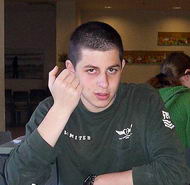 Cpl. Gilad Shalit
Egypt, which is the main mediator in the negotiations to free Gilad Shalit, is blaming Khaled Meshal of Hamas's Damascus bureau for blocking a deal that would have seen the release of the kidnapped Israeli soldier, who has been held by Palestinian militants since June 25, 2006. In a leaked letter, Omar Suleiman, the Egyptian intelligence chief, warned Meshal that he would be responsible for a major Israeli operation in Gaza if Shalit is not released by the end of Ramadan (October 23), Ha'aretz reported yesterday. Meanwhile, Ehud Goldwasser and Eldad Regev, kidnapped by Hizbullah on July 12, remain in captivity.
If you believe that it might help, please pray for the safe return of Gilad ben Aviva, Ehud ben Malka, and Eldad ben Tova to their families, God-willing before Yom Kippur. Many people are saying תהילים קכא (Psalms 121):
א שִׁיר, לַמַּעֲלוֹת:
אֶשָּׂא עֵינַי, אֶל-הֶהָרִים-- מֵאַיִן, יָבֹא עֶזְרִי.
ב עֶזְרִי, מֵעִם יְהוָה-- עֹשֵׂה, שָׁמַיִם וָאָרֶץ.
ג אַל-יִתֵּן לַמּוֹט רַגְלֶךָ; אַל-יָנוּם, שֹׁמְרֶךָ.
ד הִנֵּה לֹא-יָנוּם, וְלֹא יִישָׁן-- שׁוֹמֵר, יִשְׂרָאֵל.
ה יְהוָה שֹׁמְרֶךָ; יְהוָה צִלְּךָ, עַל-יַד יְמִינֶךָ.
ו יוֹמָם, הַשֶּׁמֶשׁ לֹא-יַכֶּכָּה; וְיָרֵחַ בַּלָּיְלָה.
ז יְהוָה, יִשְׁמָרְךָ מִכָּל-רָע: יִשְׁמֹר, אֶת-נַפְשֶׁךָ.
ח יְהוָה, יִשְׁמָר-צֵאתְךָ וּבוֹאֶךָ-- מֵעַתָּה, וְעַד-עוֹלָם.
For all those who are observing on Monday, we wish you an easy fast and גמר חתימה טובה. And to our Muslim readers, Ramadan Mubarak.
Tuesday, September 26, 2006
Iranian-Turkish Offensive Against Iraqi Kurdistan "Imminent"
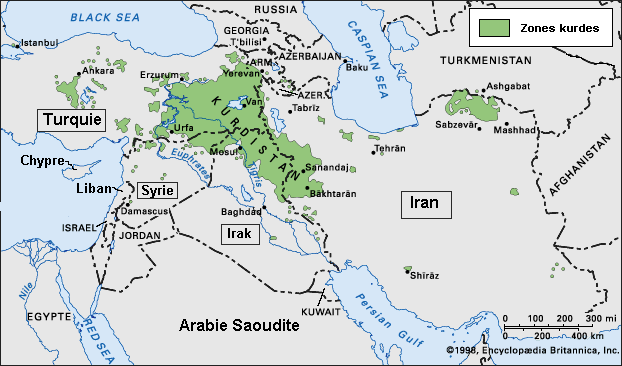 One of many controversial maps of Kurdistan.
 DebkaFile claims that Turkey and Iran are coordinating a preemptive attack on Iraqi Kurdistan with the aim of crushing 5,000 Kurdish guerrillas said to be hiding out on their borders, inside Iraq. Both countries accuse the rebels of carrying out and supporting terrorist attacks inside Turkey and Iran respectively. According to DebkaFile, Iranian and Turkish troops have long been operating inside Iraq.
Tensions recently escalated with the publication of a "semi-official" American military map that labelled territory inside Turkey as well as Armenia as "Kurdistan." Both Ankara and Yerevan fear that the US may be giving tacit approval to plans by Iraqi President Jalal Talabani (who is also the head of the Patriotic Union of Kurdistan) and Massoud Barzani, President of the Autonomous Region of Kurdistan in Iraq to "help themselves" to Turkish and Armenian territory in the event of imminent attack. Iran has been growing increasingly agitated about Kurdish cross-border raids into its territory.
DebkaFile's allegations seem rather fanciful at first glance. Turkey combining to fight an American ally with Iran? Armenia entering the war basically on the side of Turkey? But it is clear that American and Turkish interests do not coincide when it comes to the Kurds of Iraq. Furthermore, US-Turkish relations are a far cry from what they were before the invasion of Iraq. Combine that with the recent high-profile bombings in Turkish Kurdistan, and a precedent (according to the Turks) in Israel's actions against Hizbullah, which were conducted with US approval, and things begin to look more plausible, at least as far as Turkey is concerned.
ADDENDUM: I seem to have confused at least one of our readers - so just for the record, the map depicted above is NOT the "semi-official" map to which I refer in the post. As you can see, it is a French map that appeared in the Encyclopaedia Britannica in 1998.
Sunday, September 24, 2006
The Benefit Concert
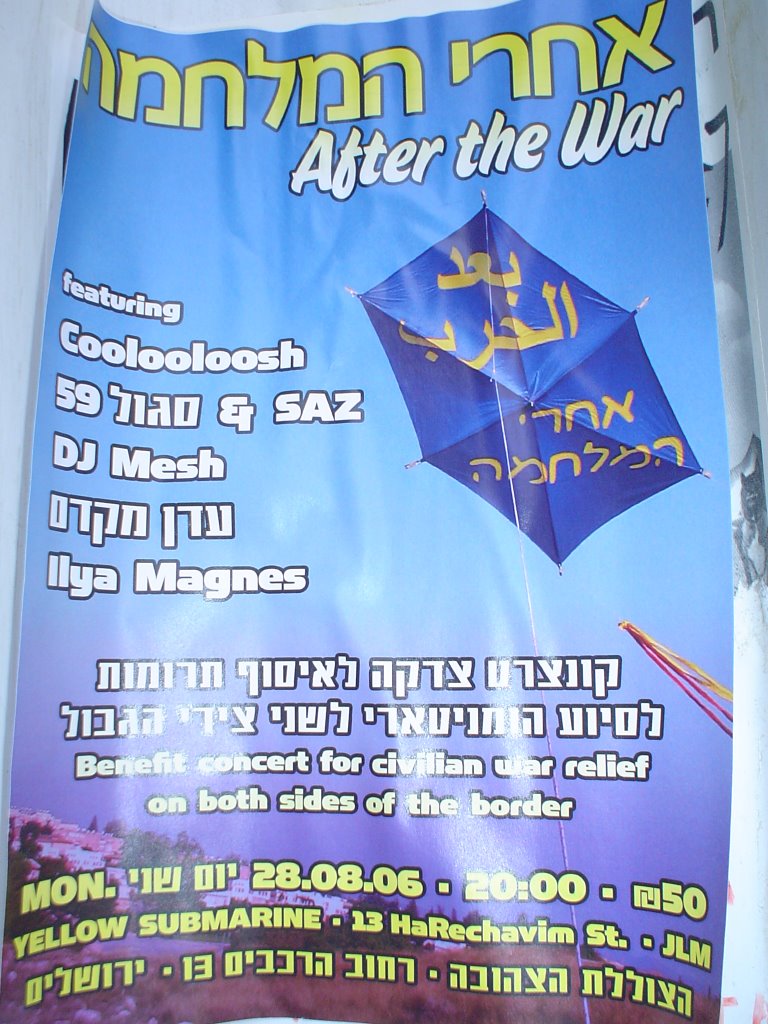 Though the date has passed, this flyer still hangs on a wall in the Ben Yehuda pedestrian mall in Jerusalem.
Saturday, September 23, 2006
Aznar Against Apology

Former Spanish Prime Minister Jose Maria Aznar has waded into the polemics surrounding Pope Benedict XVI's September 12 speech. The last time I heard Aznar speak was in Spanish at the AJC's 2003 annual meeting in Washington, DC. Back then, he spoke through a translator. Judging from several quotes attributed to him in the Herald Tribune, he should have done the same at a recent engagement at the Washington-based Hudson Institute. But who am I to discourage people from practicing their English public speaking skills? Referring to the 800-year period of Muslim rule over Iberia, Aznar is said to have declared:
"I never (heard) any Muslim apologize (to) me (for) conquer(ing) Spain and to maintain a presence in Spain during eight centuries. What is the reason ... we, the West, always should be apologiz(ing) and they never should ... apologize? It's absurd."Wow, that seems to be a record number of parentheses in a quotation. In all seriousness, I do think that J.M. has a point, although I'm not sure that it's worth opening that particular can of worms (history of Medieval Spain). Nevertheless, Aznar should be commended for his courageous statements in support of the United States and Israel. In contrast to his successor, Prime Minister José Luis Rodríguez Zapatero, this man has cojones.
Trivia of the Day: In Arabic, the Pope is called "al-baba" as in this al-Jzaeera headline:
أزنار يدافع عن البابا ويطالب المسلمين بالاعتذار
"Aznar defends the pope and demands that Muslims apologize"
Thursday, September 21, 2006
Berkeley's Byzantinist on Benedict's Blunder
The Pope claims he was just quoting. But Berkeley's Prof. Maria Mavroudi has very kindly provided us with some historical context and glossed a few of Palaeologus' words:
If we assume that the Pope's use of Manuel's "Dialogue with Persian" is not the result of scholarly incompetence regarding things Byzantine on the part of the Pope's advisors and speech writers, then it is a (mis)reading of the past in light of the present and an example of how one can take a historical source completely out of context and employ it for the purposes of one's own rhetoric.I for one think it's very important that the Pope's speech be scrutinized. This isn't a learned pope's fleeting pedantic allusion to a learned emperor. It's actually quite a significant clue as to the part the Vatican will play in the coming "debate" on Civilization, which Tony Blair has, in a sense, inaugurated with his polished oratory.
Manuel II was an intellectual emperor; he left a whole body of work, generally written in highly rhetorical style and classicizing language. The "Dialogue with a Persian" belongs to an established literary genre of Christian-Muslim polemic that came into existence soon after the rise of Islam. The format of the dialogue is supposed to help communicate complicated thoughts in a simple manner. Such polemical disputes between representatives of the two religions were frequent in the 14th century, not only in literary form, as imaginary works of fiction, but also in reality.
The "Dialogue with a Persian" is a Christian's (=Byzantine's) dialogue with a Turk. "Persian" is how Byzantine sources in classicizing language tend to call the Turks, a fact that the Pope's speech neglects to clarify. The "holy war" Manuel discusses in the dialogue is essentially the war (whether holy or unholy) that the Turks waged successfully towards the end of the 14th and the beginning of the 15th century, as a result devouring his empire.
As hostage to the Turks, Manuel had been forced to participate on the Turkish side in the siege against Byzantine Philadelphia and witness its fall. He resided in Thessaloniki (the second largest city of the empire at the time) during the time of its siege and capture by the Turks. He spent a few years in Paris trying to secure military aid (trips away from their territories were extremely unusual for Byzantine emperors, therefore this is indicative of Manuel's desperation); at the same time his capital was besieged by Bayezid, and the Ottomans would have taken it, had it not been for Timur Lenk who defeated them in Ankara. Manuel's surviving letters show him a witness to increased Islamization and Turkification in the territories that he continued to lose to the Turks.
Authoring the "Dialogue with the Persian" is also a call to the Christian flock (Manuel's own conquered subjects) not to convert; under the circumstances, the ideological purpose of the "Dialogue" could not have been aggressive, only defensive.
I will let the readers of your blog draw their own conclusions regarding the reasons why the Pope did not clarify the identity of the "Persian" or the "Dialogue's" context and what he was trying to achieve by not doing so.
Wednesday, September 20, 2006
Kurds deny Israeli presence in Iraqi Kurdistan
I just heard a Radio Sawa broadcast in which a spokesman of the Kurdish provincial government in Iraq categorically denied allegations that there is an Israeli presence whatsoever in the Kurdish controlled region. Apparently, the Kurds have come under fire for relying on Israeli military and security experts to build an airforce and train their security forces. The Kurdish spokesman emphasized that there are no Israelis in the Kurdish region, but said that the regional government does not discriminate against members of any religion, be they Christians, Muslims, Jews, or Yazidis. He also voiced his anger at the fact that the Kurds are singled out for alleged ties to Israel, while a number of Arab states (Egypt and Jordan) have Israeli embassies. Finally, responding to renewed talk about the historic links between the late Kurdish KDP leader Mullah Mustafa Barzani, father of the current ruling KDP leader Mas'ud Barzani, the spokesman argued that the late Barzani's action have to be viewed in their context and light of the dire situation of the Kurds at the time.
Previous Kurdish denials can be read on the website of the Kurdistan Regional Government (note the lack of an Iraq suffix in the .org domain). The Kurdish Regional Government's professional website full of English commentary is just one more indication of how much better the Kurds have fared in the new Iraq. As much as they might deny it, the Kurds are building a state and they're going about it the right way.
Previous Kurdish denials can be read on the website of the Kurdistan Regional Government (note the lack of an Iraq suffix in the .org domain). The Kurdish Regional Government's professional website full of English commentary is just one more indication of how much better the Kurds have fared in the new Iraq. As much as they might deny it, the Kurds are building a state and they're going about it the right way.
Sunday, September 17, 2006
Stop the Genocide in Darfur
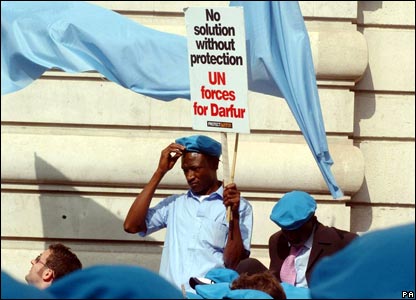 Protests today demanding intervention in Darfur
More than 200,000 people killed and millions displaced.
Rabbis Criticize Pope's Comments; West Bank Churches Attacked
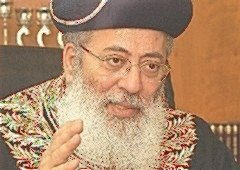 Chief Rabbi Shlomo 'Amar
In an interesting development, one of Israel's two chief rabbis, R' Shlomo 'Amar has written a letter to Qatari Sunni legal scholar Sheikh Yusef Qardawi, criticizing the recent remarks of the Pope. Here is an excerpt from the letter, which R' 'Amar wrote in Arabic:
Our way is to honor every religion and every nation according to their paths, as it is written in the book of prophets: 'because every nation will go in the name of its lord.'"Israel has a Sephardi and an Ashkenazi Chief Rabbi. R' 'Amar was born in Casablanca, Morocco in 1948. He came to Israel at the age of 14.
...
Even when there is a struggle between nations ... it cannot be turned into a war of religions.
The letter was preceded by an introduction written by R' Menahem Froman, the head rabbi of Tekoa, a settlement in the West Bank. R' Froman has been involved in interfaith dialogue with Muslim leaders for years. In his introduction, he writes that
every Jew who learns the writings of the great sages - who, at the head of them all stands Maimonides - knows that our great thinkers wrote in the Arabic language, lived in Islamic states and participated with the great Muslim thinkers in the effort to explain the words of God, according to the paths of the sages and amidst the difficult bloody battles that we have had since the beginning of Zionism with the Muslims.This is a rabbi identified with the national-religious camp, who studied at Yeshivat ha-Kotel and taught at Makhon Me'ir, two places not usually known for their affinities to such views.
In another twist, the letter was delivered to Sheikh Qardawi by the leader of the Islamic Movement in Israel, Sheikh Abdullah Naimar Darwish.
Just two days ago, the head of the northern branch of the Islamic Movement Sheikh Ra'ad Salah, a known radical, announced that Jerusalem would soon become the capital of an Islamic nation. In front of a crowd of 50,000, he declared that Israel's "occupation" of the Temple Mount was approaching its end. Just to pour a little more oil on the fire, he accused the Israeli government of damaging the al-Aqsa mosque in Jerusalem (Ha'aretz).
Meanwhile, churches across the West Bank were attacked on Saturday, and violence against Christians and Christian institutions was reported elsewhere in the region and beyond. The targets included Anglican, Roman Catholic, and Greek Catholic houses of worship.
I appreciate the efforts of R' Amar and R' Froman, and I think Pope Benedict would not disagree with their more general statements. Nevertheless, it would have been nice if they had added some condemnation of the threats against Christians and asked Sheikh Qardawi to speak out against those too.
I do not believe that Pope Benedict actually endorsed Palaeologos's view that Mohammed's innovations were "only evil and inhuman" ones. He should have made his opposition to that part of the Byzantine Emperor's polemic clearer. I am also not sure how correct some of his characterizations juxtaposing Christianity and Islam were. But who can argue with his efforts to condemn the use of religion to promote violence?
The Catholic Church has made significant progress in the past half-century in confronting the injustices committed by Christians, in the clergy as well as well as the laity, which resulted in the persecution or marginalization of Muslims, Jews, "heteredox" Christians, as well as people of other faiths merely on account of their beliefs. I am certain that Pope Benedict does not want to turn the clock backward in this respect. Rather, he is challenging adherents of the world's religions to find peace rather than violence in their traditions.
In any case, it is unacceptable that the Pope's remarks, no matter how critical of Islam, should be turned into a pretext for violence against Christians. All those Muslim religious leaders who, instead of preaching moderation, are further inciting their followers represent precisely the kind of evil that the Pope was talking about. Ironically, they are also likely to further cement the impressions of some observers, who believe that Islam is indeed the "religion of the sword."
Saturday, September 16, 2006
Haifa Cinematheque
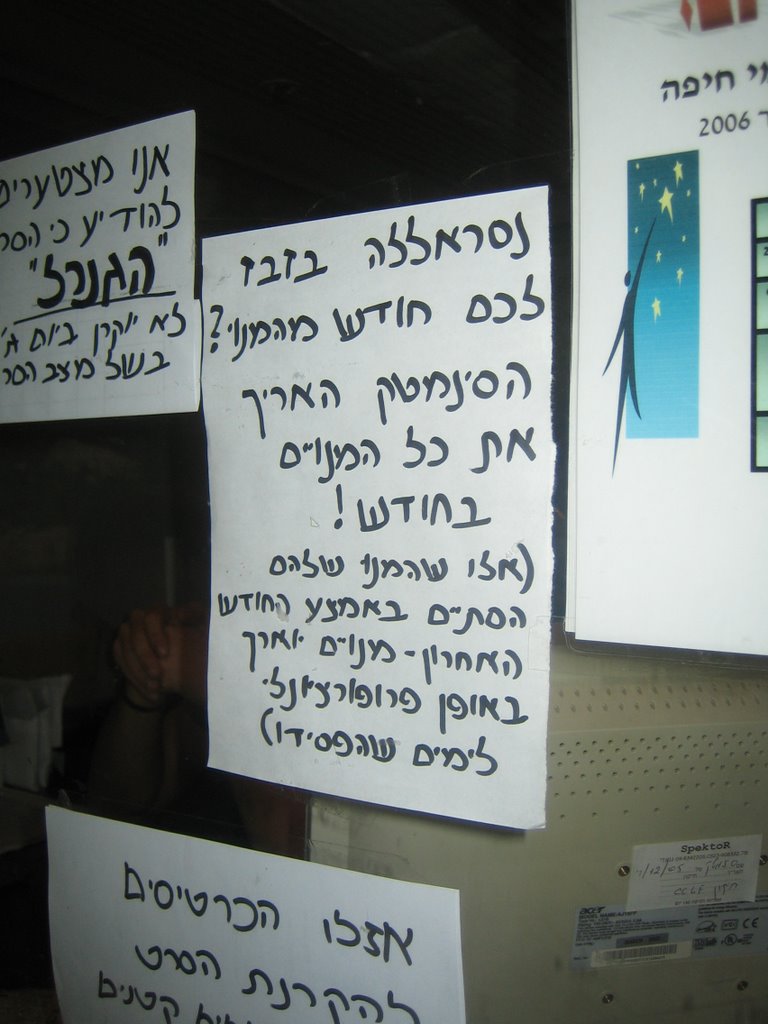 Like most other places in Haifa, the cinematheque was closed for the duration of the Hezbollah-Israel war. But members, who prepay for a year in advance, are not to worry.
The sign on the left reads, "Did Nasrallah waste a month of your membership? The cinematheque will extend your membership by one month! (Those whose membership expired in the middle of last month will have their membership extended in proportion to the days they have missed!)"
Friday, September 15, 2006
Boogie Bares All - Now in English
For those who haven't had a chance to read it yet, Ari Shavit's stunning interview with former Chief of Staff Moshe "Boogie" Ya'alon, on which John blogged earlier, is now available in English. I highly recommend it, as Ya'alon's is the most penetrating critique of the war's management and of the current leadership I have read until now.
Pope Benedict Faces Wrath of Muslims
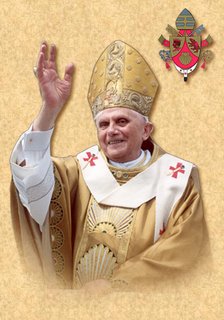
It looks like another storm is brewing in the Muslim world. This time, the spark seems to be a recent speech by Pope Benedict XVI delivered on September 12 at Germany's Regensburg University. The original German speech and an English translation are available on the Holy See's website. In the speech, the Pope argues that the "will of God" cannot be divorced from "Reason". He emphasizes the links between early Christian thought and Greek philosophy to make the point that Christian faith and reason are compatible. To establish that link, he refers to a theological discussion between the Byzantine Emperor Manuel II Palaeologos (14th century) and a Persian Muslim, which was recently published in a volume edited by a Professor Theodor Khoury at the University of Münster (a German school with a well known Near Eastern Studies department and a lot of philologists). In the course of their conversation, the Emperor is to have told his Muslim interlocutor
"Show me just what Mohammed brought that was new, and there you will find things only evil and inhuman, such as his command to spread by the sword the faith he preached."The Pope seems to have cited this statement not because he was trying to make some point about Islam, but in order to prove that this Byzantine Emperor saw Christianity as based on reason. According to the pope,
The emperor, after having expressed himself so forcefully, goes on to explain in detail the reasons why spreading the faith through violence is something unreasonable. Violence is incompatible with the nature of God and the nature of the soul. "God, " he says, "is not pleased by blood - and not acting reasonably is contrary to God's nature. Faith is born of the soul, not the body. Whoever would lead someone to faith needs the ability to speak well and to reason properly, without violence and threats... "Yet, while the Pope’s and Khoury’s central argument seems to be related mainly to Christianity and Reason, rather than Islam, they make their point by contrasting "Muslim teaching" with the Byzantine Emperor’s Christianity, which they characterize as being rooted in Greek philosophy. According to Khoury, cited by the Pope in his speech,
For the emperor, as a Byzantine shaped by Greek philosophy, this statement [denying that conversion must be achieved through argument, not violence] is self-evident. But for Muslim teaching, God is absolutely transcendent. His will is not bound up with any of our categories, even that of rationality.I know too little about Islamic thought to comment about the accuracy of Khoury’s interpretations. What bothers me is the apparent failure of Muslims and heads of state of Muslim countries to engage the Pope more deeply. I hope I turn out to be wrong, but it seems to me as if we are in for another round of violent demonstrations. Palestinian Prime Minister Isma‘il Haniyye has already begun organizing protests to "express Palestinian anger toward the comments that offended Islam and the Muslims." Ha'aretz is already reporting that a Greek Orthodox (!) Church in Gaza suffered minor damage from a homemade explosive device planted next to its door. That would be a useful diversion for a government that is becoming increasingly unpopular.
Thursday, September 14, 2006
The UN Outpost Bombing
 UN troops carrying the body of one of the peacekeepers killed on July 25
On July 25, an Israeli air strike led to the tragic deaths of four UN peacekeepers manning an observation post in southern Lebanon. The world reacted with widespread condemnation of Israel. United Nations Secretary-General Kofi Annan even accused Israel of deliberately targeting the peacekeepers. These were his words on that day:
I am shocked and deeply distressed by the apparently deliberate targeting by Israeli Defense Forces of a United Nations observer post in southern Lebanon that has killed two United Nations military observers, with two more feared dead (SG/SM/10577).Israeli Prime Minister Ehud Olmert, justifiably, reacted with outrage. The charge that Israel deliberately targeted the peacekeepers has never made sense to me. Some of our readers will recall the discussion about this incident that took place on these pages about this question. I was especially disturbed that a teacher of mine, whose judgment I respect, was convinced that Annan had been right. This person told me that because the position of the peacekeepers had been so well-marked, it was clear that the air strike had been part of a deliberate attempt to discourage an international or UN-sponsored peacekeeping intervention in the war. My teacher was unequivocal that the attack was deliberate, and that it would be "hard to convince many of us otherwise." In retrospect, this makes very little sense. First of all, deliberately targeting UN personnel blatantly contradicted military directives and law. Second, Israel has actually welcomed the new UN peacekeeing force, so that the idea that this was a signal to discourage such a peacekeeping missions lacks traction.
Canadian newspapers have been following this story carefully from the beginning, in part because the country lost one of its soldiers in the incident. (The other peacekeepers were from China, Finland, and Austria respectively). On July 27, the Ottawa Citizen reported that Major Paeta Hess-von Kruedener, the Canadian in the outpost, a few days before July 25, had sent reports which implied that Hizbullah had been using the UN soldiers as human shields. Now, the Globe and Mail has a report on the latest findings by an Israeli inquiry into the incident. First of all, it turns out that Hizbullah was firing rockets from a position only 180 meters away from the UN outpost. Apparently, it was the deployment of new Israeli forces in the area that led to this tragic mistake. The new deployment required a duplication of charts and maps of the area; in the course of this duplication, Israeli Foreign Ministry Spokesman Mark Regev said, the UN position was not accurately marked on the duplicated maps.
Subscribe to:
Posts (Atom)