Friday, December 01, 2006

France: Racism Down, Antisemitism Fairly Stable

Police officer Antoine Granomort in front of the McDonald's where
he fired his gun at the hooligans (STEPHANE DE SAKUTIN, AFP)

Le Monde reports that the latest statistics from the direction générale de la police nationale (DGPN) reveal a 24.3% drop in racist hate crimes, and a 3.5% decrease in antisemitic acts, in 2006. Racist and xenophobic crimes went down from 378 in 2005 to 286 in 2006. According to the statistics, 436 anti-Jewish hate crimes (threats, insults, harassment, and violence) took place this year. In 2005, there were 452 such crimes.

Anti-Jewish hate crimes are down significantly from the peak of 974 in 2004. However, the number of violent crimes committed with antisemitic motives rose to 97 in 2006; a 14% increase over the 85 reported in the previous year. The secretary general of France's National Commission on Human Rights, Michel Forst, commented that

En 2005, nous avions été déjà frappés par la hausse significative de la gravité des actes ... On perçoit un faisceau de phénomènes : une hausse générale des violences aux personnes en France, une radicalisation de certaines opinions, une sensibilité toujours très forte aux événements internationaux. [In 2005, we were already struck by the significant rise in the gravity of the acts. We perceived a cluster of events: a general increase in violence perpetrated against people in France, a radicalization of certain attitudes, and an ever strong sensitivity to international events.]

In other words: when there is trouble in the Middle East, French Jews must fear for their safety.

The article in Le Monde begins with a reference to the recent events at Parc des Princes, where a black police officer defended a Jewish football fan from a group of racist and antisemitic hooligans (see our earlier post).

Wednesday, November 29, 2006

Eyeing the Iranian Threat in Iraq

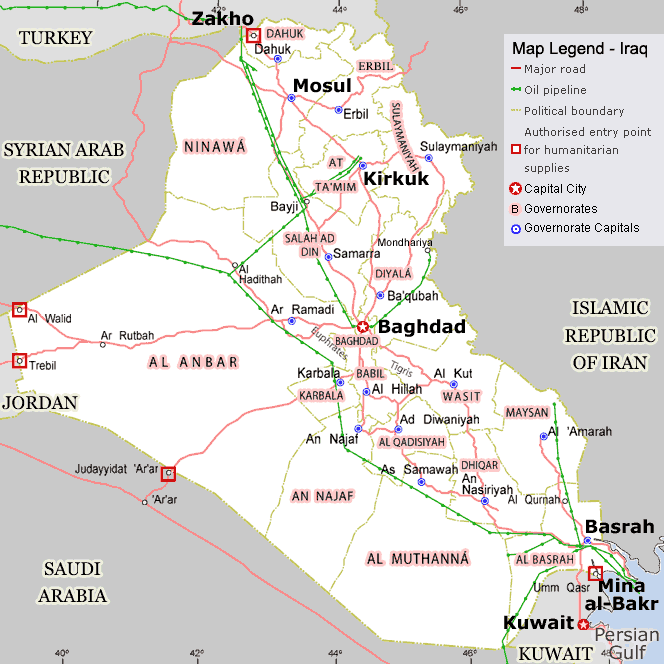
(Another map of Iraq. This one shows oil pipelines, in green.)

Last Sunday (November 26, 2006), U.S. Senator Chuck Hagel (R-Nebraska) called on America to withdraw from Iraq on the Washington Post editorial page. Responding to calls by Senator John McCain (R-Arizona), among others, to increase troop levels in another bid to defeat the insurgency, Hagel writes that
The time for more U.S. troops in Iraq has passed. We do not have more troops to send and, even if we did, they would not bring a resolution to Iraq. Militaries are built to fight and win wars, not bind together failing nations. We are once again learning a very hard lesson in foreign affairs: America cannot impose a democracy on any nation -- regardless of our noble purpose.
I would substitute "failed states" for "failing nations" and replace "Militaries are" with "The U.S. military is." But I am afraid that Hagel is right. There are currently more than 140,000 American armed forces personnel in Iraq, exposed to constant attack and seemingly impotent in the face of indiscriminate assaults by militias on Iraqi civilians. It is time to go. The question is how and where. Here, I think Hagel and other legislators who support a pullout are guilty of a certain myopia that could cost the U.S. dearly in the future. I was amazed, for example, by the following description:
It may take many years before there is a cohesive political center in Iraq. America's options on this point have always been limited. There will be a new center of gravity in the Middle East that will include Iraq. That process began over the past few days with the Syrians and Iraqis restoring diplomatic relations after 20 years of having no formal communication.

What does this tell us? It tells us that regional powers will fill regional vacuums, and they will move to work in their own self-interest -- without the United States. This is the most encouraging set of actions for the Middle East in years.
Encouraging? Allow me to remove the rose-tinted glasses. Yes, regional powers will fill regional vacuums, which is precisely why America should be very scared. It astounds me that in Hagel's op-ed there is not a single reference to Iran - the regional power that has the most to gain from an American withdrawal, and the state with the grandest ambitions in the Gulf.

U.S. President Bush as well as Senator McCain continue to talk a great deal about al-Qaeda. One of the arguments against a withdrawal is that the resulting vacuum will provide a secure base for the terrorist group. These are legitimate concerns, but al-Qaeda is not a state, and its power pales in comparison to that of Iran. I suspect that the emphasis on al-Qaeda is designed mainly to appeal to American voters and, at the same time, to al-Maliki's government in Iraq, which sees the Sunni militias and al-Qaeda as its primary enemy.

Iran is already active in Iraq. For now, however, the Iranians are waiting for the Iraqi Shi'a to consolidate their hold on power. National Security Council Adviser Stephen Hadley's confidential memo (from November 8), printed in the New York Times today, acknowledges that Maliki's government, despite assurances or hopes to the contrary by the prime minister, is pursuing Shi'a hegemony rather than a partnership among Sunni, Shi'a, and Kurds:
Despite Maliki’s reassuring words, repeated reports from our commanders on the ground contributed to our concerns about Maliki’s government. Reports of nondelivery of services to Sunni areas, intervention by the prime minister’s office to stop military action against Shia targets and to encourage them against Sunni ones, removal of Iraq’s most effective commanders on a sectarian basis and efforts to ensure Shia majorities in all ministries — when combined with the escalation of Jaish al-Mahdi’s (JAM) [the Arabic name for the Mahdi Army] killings — all suggest a campaign to consolidate Shia power in Baghdad.
Shi'a rule means Iranian influence, and let there be no doubt about it at that Iran sees Shi'a across the region as stepping stones to regional superpower status. It doesn't matter that not all the Iraqi Shi'a factions are actually pro-Iranian. If the Americans leave, Iran will either back its favorites or force other factions to toe its line. This scenario would present a very serious threat to vital American interests in the Gulf. Iraq's most productive oil fields are in areas of the country that are indisputably Shi'a. Iran could easily support Hizbullah-type forces there or pressure the Iraqi central government directly to put the squeeze on oil exports, should the need to confront the U.S. arise.

Furthermore, if Iraq becomes an Iranian satellite, U.S. allies such as Bahrain, which actually has an increasingly militant Shi'a majority (who, though in the opposition, scored a big victory in recent parliamentary elections), will be threatened. There is no doubt that the Sunni gulf states, led by Saudi Arabia, would do everything they can to undermine the extension of Iran's influence to their doorsteps - first by sponsoring Sunni fundamentalist proxies (who would have no qualms about attacking America), and eventually by going nuclear.

Unfortunately, it will not be easy to work against these Iranian efforts. Hopefully Bush has been talking seriously to the Saudis about some of these issues. Today, it is clear that Iran has captured the Arab street. Playing to the Arab masses with antisemitism and by fighting Israel through its proxies, the Iranian regime has earned the affection of millions of Sunni. Al-Qaeda, the vanguard of Sunni extremism, which is trying desperately to gain followers for its anti-Shi'a struggle among Sunni outside of Iraq, has fallen behind in this respect. It cannot compete with the powers afforded to a sovereign state, even a non-Arab one. Al-Qaeda's tactical attacks on symbols of U.S. power have been diminished by perceived Iranian strategic successes against
core American interests in the Persian Gulf and the Middle East. The enormous public approval that the Iranian regime enjoys, makes it hard for the Arab states to maneuver with the U.S. and against the Iranians, especially since many of these states are already teetering on the brink of collapse.

Is there no solution then? Some American policymakers are banking on a counter-coup in the form of a Saudi-sponsored "victory" for Islam or the Arabs on the Israeli-Palestinian front. This seems like a very risky investment, on both the supply and demand sides (supply: who knows whether the initiative will deliver the goods; demand: who knows if the Arab street will prove as satisfied by a solution as it is by news of blows against Israel).

To be sure, I am not advocating that the U.S. "stay the course." America must withdraw its troops from the shooting gallery that is Iraq. Rather, I think that the solution lies in withdrawals to well-situated, fortified bases in the south, that will be able to guard oil fields and prevent Iranian incursions on the one hand, and to Iraqi Kurdistan in the north on the other.

Tuesday, November 28, 2006

Early Christmas Presents for the Prez

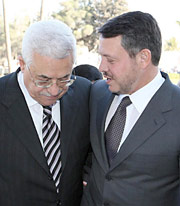
'Abbas and 'Abdullah II in 'Amman today (AP)
Discussions probably centered around George's Christmas wish list

There should be absolutely no doubt in anyone’s mind that Bush and Rice’s imminent visit to the Middle East is going to be more than a mere courtesy call. Bush and Rice will be arriving in Amman, Jordan on Wednesday and meeting with Iraqi PM Nouri al-Maliki there. It seems premature to expect any major announcements on Iraq and Syria. Deliberations about Iraq are still ongoing (in a number of different fora), while the debate about a possible détente with Damascus has only intensified as a result of the Gemayel assassination. The area in which the administration will deliver something to appease its allies/critics in the Arab world and in Europe is on theIsraeli-Palestinian front. The Israelis already know that something is going to happen, and they’ve made sure to align themselves with the administration - in advance.

Olmert’s recent declarations about his determination to go ahead with a withdrawal from the West Bank and his willingness to offer the Palestinians concessions, as well as the surprising ceasefire agreement reached with the Palestinians in Gaza, at a time when everything was pointing to an imminent invasion of the Gaza Strip by the IDF, must be understood in this context. Israel believed that it had a good case for launching a large scale offensive in the Gaza Strip – the tragic deaths of more innocent civilians in Sderot and the western Negev, the injury of one of Amir Peretz’s security guards by a rocket, and the frightening specter of Qassams reaching the town of Ashqelon, add up to a very convincing casus belli. In addition, the past weeks have seen no shortage of ominous pronouncements by officials (e.g. Shin Beth chief Yuval Diskin) about Hamas’s expanding arsenal and of “leaks” by military officers warning of a repeat of the Lebanon war on Israel’s southern front. Nevertheless, suddenly, miraculously, Israel agreed to enter into a ceasefire, and to withdraw IDF forces from the Gaza Strip, which was crawling with special forces and tanks only last week (as the world focused on the Gemayel assassination, the IDF was in the midst of what seemed to be the precursor to an invasion of the Gaza Strip). The launching of additional Qassams hours after the ceasefire came into effect did not draw any military reaction and IDF commanders were even ordered not to respond if they noticed rocket-launching squads in the Gaza Strip.

The sudden Israeli reversal must be seen as a gesture by Olmert to Bush, who is obviously desperate for some good news. Bush’s other allies, Jordan’s King Abdullah II and Palestinian President Mahmud ‘Abbas did their part by today by congratulating Olmert’s initiative. What remains to be seen is whether the administration’s pending announcement is going to be substantive, or whether it will be just another in a long series of declarations.

Update: The Canada-Israel committee has a transcript of Olmert's policy speech delivered on Monday, November 27 at Sde Boqer (the kibbutz where Ben-Gurion spent his last days and where his grave is today. It's surprising how little attention the speech received. It actually has some very remarkable declarations that are a clear nod to the Bush administration and which recognize America's increasing indebtedness to the Saudis and its other Arab friends:
We will seek the assistance of those neighboring Arab States which strive for a peaceful solution to the conflict between us, including: the Kingdom of Jordan, Egypt, Saudi Arabia and the Gulf States, in order to benefit from their experience and receive backing for direct negotiations between us.

The voices emanating from those States regarding the need for recognition and normalization of relations with the State of Israel – including, for example, some parts in the Saudi peace initiative – are positive, and I intend to invest efforts in order to advance the connection with those States and strengthen their support of direct bilateral negotiations between us and the Palestinians.

I have been following with great appreciation the serious efforts made by those States to bring about a cessation of violence in the region, and I respect their sincere desire to create a new atmosphere between us, so as to facilitate a solution to the conflict.

It sounds like the Saudi Peace Initiative is being revived. Olmert comes out quite the statesman in this latest speech. He'll continue to be maligned in Israel for his failings during the Lebanon war, but he has redeemed himself, in my view, as a clever diplomat. Rather than pulling a Yitzhaq Shamir and having the State Department impose a plan on Israel, Olmert is being proactive and trying to co-opt the new ideas being floated, while at the same time twisting them to conform to Israeli requirements (note his insistence on "direct bilateral negotiations" between Israel and the Palestinians, rather than multi-lateral Arab-Israel peace negotiations; Israel has always favoured negotiating with different Arab groups and states separately.)

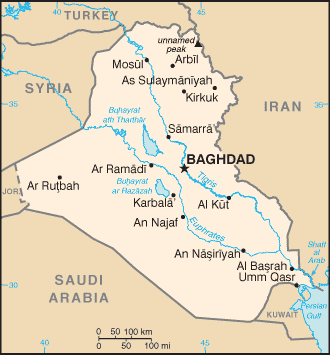
Failed Province: Marines Lose Hope in Anbar

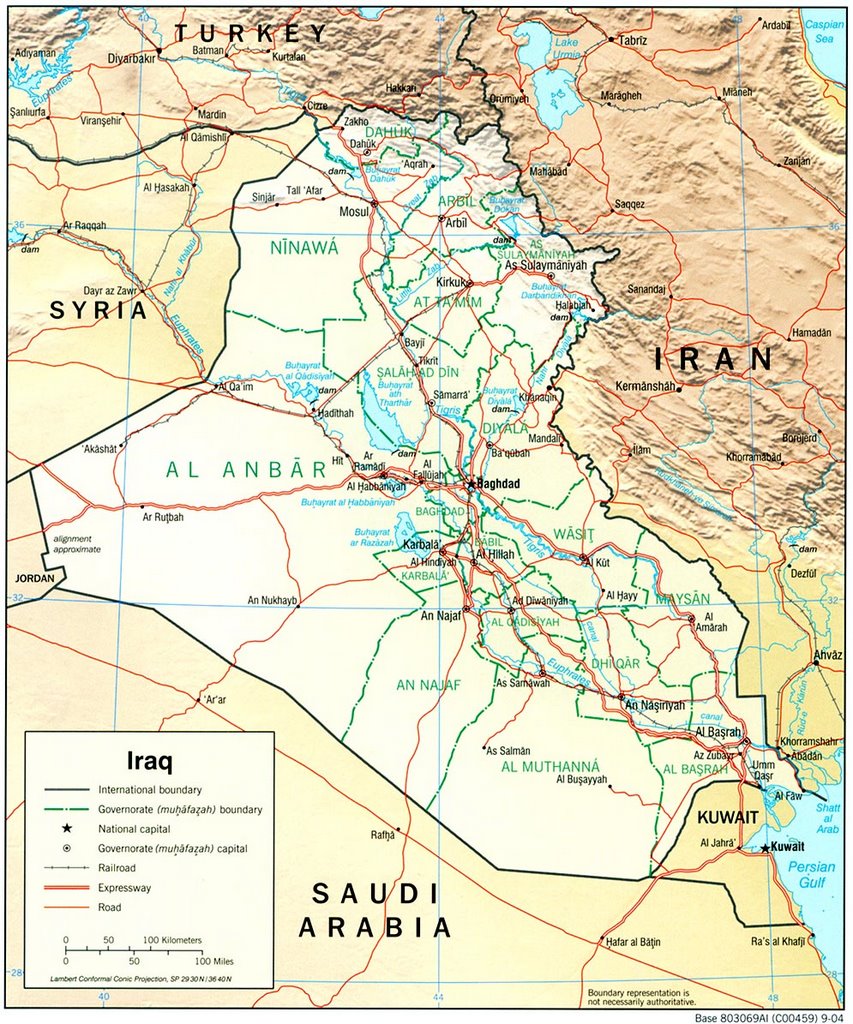
(Political Map of Iraq. See Anbar in the southwest)

Back in September, the Washington Post reported on a memo circulating among American military officials on the state of affairs in Anbar province in western Iraq. Now, the Post reports, more details from the five-page report ("State of the Insurgency in Al-Anbar") by Col. Peter Devlin, a veteran intelligence officer with the Marine Expeditionary Force, have been made available. The picture that the paper paints is very grim. It concedes that the US cannot defeat the insurgency in Anbar and that the province is becoming a base for al-Qaeda.

Al-Anbar, is Iraq's largest province, home to 1.25 million people, most of whom are Sunni. Its major cities, Fallujah, Ramadi, and Haditha were the sites of some of the worst fighting for American troops. Today, they are run by militias and criminal gangs. The report by the Marines claims that al-Qaeda is taking over whatever institutions exist. As a whole, al-Anbar is probably the most dangerous place for US soldiers in Iraq.

Unlike the Shi'a-dominated south and the Kurdish north, Anbar has no significant oil fields, though a major pipeline runs through the province to Syria. One of the main sources of income in the region seems to be oil smuggling. No doubt, other criminal activity fills the rest of the coffers of the militias there. Perhaps foreign money is also flowing in to support al-Qaeda affiliates or similar such groups.

Al-Anbar is one of the last Sunni outposts in Iraq. Even before the American invasion, Salafi groups were allowed to organize here, so that it is no wonder that the area's residents are both virulently anti-American and anti-Shi'a. Although one of the biggest fears in the area is the encroaching influence of the Shi'a-dominated central government and the various Iranian proxies active in Iraq, ordinary people in Anbar probably suffer most from the lack of order and ubiquity of weapons so characteristic of failed states.

Anbar province illustrates the pitfalls of the policy of regime change. The "failed province" is likely to become a staging area for attacks on US forces, the Iraqi central government, as well as on Saudi Arabia and Jordan. At the same time, as Iraq becomes more and more Iranian, the Saudis and others might be tempted to use the province as a buffer. In any case, it is unlikely that the flow of guns and fighters into and out of Anbar - no doubt much of them through Syria - will stop soon. It does not look like the US can afford to back any of the factions in the province; most of them would probably not be very interested in such a deal anyway. On the other hand, the US would probably be reluctant to support Shi'a efforts to crush the insurgents there, because this could very well play into Iran's hands.

Those who still think that Iraq can avoid disintegration in anything but name are advised to check out a September article by Michael Totten on his visit to Kurdistan, "The Kurds go their own way." In the meantime, I am trying to get a sense of where the oil fields and pipelines are. The following December 2005 report on the "Geographical Distribution of Iraqi Oil Fields," is quite useful.

For a PDF of all of Iraq's provinces and administrative regions see this UN map.

Turkey Days

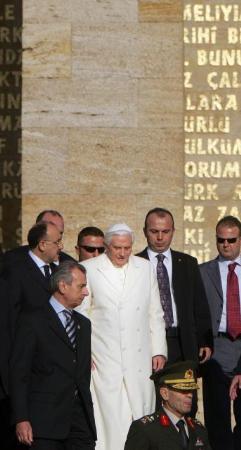
"Papa" at the Ataturk Memorial, I believe (-A).

The Pope is in Turkey this week, and PBS's "The News Hour with Jim Lehrer" is airing a series of reports from that country, narrated by Margaret Warner. I haven't caught today's yet, but last night's was very disturbing. The level of anti-American sentiment in Turkey at present is astonishing. Just how unfortunate this is can only be grasped when one considers the evolution of Turkish public opinon on this count. An archaeologist friend who's worked in Turkey for several decades recently told me that children in villages in southeastern Turkey today say, "Kill Bush," when he encounters them, while in years past a more friendly salutation was the norm. Warner's report cites a best-seller in Turkey, which depicts a Turkish nuclear attack on Washington in retaliation for, I believe, an American invasion of Turkey from Iraq.

What are the sources of Turkish anger with the US? Several are obvious, but one, perhaps less so, is hinted at in the report: a growing feeling among Turks that the prestige and indeed the territory of their state, cobbled together in the wake of the Ottoman collapse, are under threat. The US has exercised a steady hand in restraining Turkish raids across the border into Iraq in pursuit of Kurdish militants, but it's unclear how long the Turks are willing to be held back. I, for one, was not aware of the sheer numbers of Kurdish attacks inside Turkish territory this year or the scale of the casualties.

This is a country where public opinion matters. It was the Turkish public, after all, which elected an Islamist government, which denied US forces bases and air space from which Iraq "might" have been better secured in the invasion in March 2003.

Sorry Haters


Speaker of the House Elect Nancy Pelosi announced today that she won't tap Rep. Alcee Hastings (D-FL) to chair the House Intelligence Committee. There had been some controversy over whether Pelosi would put aside her personal differences with Rep. Jane Harmon (D-CA), the senior Democrat currently on the committee and a so-called "blue dog" conservative Dem, and select Harmon for the chair. Liberals have criticized Harmon for a perceived lack of aggressiveness in questioning the Bush case for war in Iraq. Well, today, instead of the cautious Democratic selection, we get this entirely incautious statement from Rep. Hastings, who, as I take it, was impeached from the bench in Florida by some (other) haters:
"Sorry, haters, God is not finished with me yet."

Monday, November 27, 2006

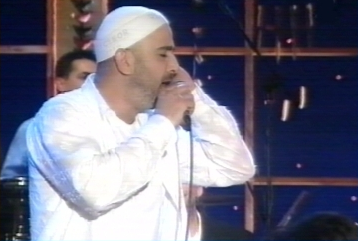
"Without you, I am half a person," or the State of Muzika Mizrahit

Ofer Levi: "You and I, that's love from heaven ..."
!אני ואת זו אהבה מהשמיים, אני ואת זה החיבור הכי נכוווון


Muzika mizrahit
(literally, "eastern music") is a genre beloved by many Israelis and despised by even more. Drawing on the musical traditions of the Mediterranean and Middle East, it combines lyrics about heartbreaks and undying love (for boyfriends, girlfriends, and mothers) with infectious tunes and beats. Well-known singers include such luminaries as Kobi Peretz, Ofer Levi, Sagiv Cohen, Moshik Apiah, Sarit Hadad, Eyal Golan, Shlomi Shabbat, and many others - please don't be angry at me for omitting your favorite one! Old-school favorites include Margalit ("Margol") Tsanani and Zohar Argov.

A typical specimen of the genre includes liberal use of the terms neshama (literally, soul, as in neshamah sheli, "my soul" or "my love"), kapara (atonement offering - I will leave the explanation to someone else, in the interest of time), and biladayikh ("without you"). The most common language nowadays is Hebrew, usually with proper enunciation of the letters 'ayin and het. But singers may also be heard bursting into Greek, Arabic (of various regional flavors), Turkish, and Farsi.

To the chagrin of some residents of the country, young diaspora Jews tend to go crazy about the poppy but exotic songs. However, among the more fashionable segments of the Israeli population, putting on a mizrahi disc can be as devastating as playing a country music album (though the genre's real American equivalent is probably r&b).

The stereotypical male fan of this music is the ars (literally, "pimp"), who is roughly equivalent to the American guido or the Canadian gino. Females who listen to muzika mizrahit are often derided as freykhot. Needless to say, these stereotypes are loaded with socioeconomic and ethnic prejudices.

Whereas in the United States, listening to hip-hop has long become acceptable and is no longer automatically sneered at, muzika mizrahit is likely to provoke immediate censure by the self-appointed guardians of civilization in the Levant. There is a deep-rooted fear among many Israelis about exposure to the "primitive," and muzika mizrahit undoubtedly carries associations of primitiviyut. The more overtly racist of these bullies will refer to the music as "Arab" in some way or other - a damning indictment for these people. Indeed some of the people who enjoy muzika mizrahit also have a liking for "Arabic music" - a category that ranges from the pop tunes of sexy Lebanese singers such as Nancy Ajram and Elissa to 'Amr Diab (from Egypt), rai singer Khaled (Algeria), all the way to the classics, such as Umm Kultum. But outside of the Arab sector, not many young Israelis listen to these.

The big radio stations, such as Galatz (Army Radio) and Galgalatz (Army Radio with more music) do not play very much muzika mizrahit, except for occasional cross-over hits. Rather, its main purveyors have been regional stations. Unfortunately (for those who like it), however, a two-year-long royalty dispute is preventing many artists from being heard even on these stations. There is quite a bit of concern in the industry about the viability of the genre, and some, such as Ma'ariv's former mizrahi music critic Dudu Cohen, cited in a Ha'aretz feature on the industry, see the signs of its degeneration in the hits of the past few years:
"As for success and the audience's demands, there's no knowing what will happen in the future," adds Cohen. "In terms of music quality, the big money in this industry appeals to quite a few entrepreneurs and interested parties with no artistic pretensions. At this rate, it won't be long before songs with lyrics like Balbeli oto, al ta'asi lo heshbon, - mix him up, don't take him seriously - become mega hits. Oops, actually, that's already happened [Cohen is referring to a very popular song by Kobi Peretz]."
For those who want a listen, try searching on YouTube - here's is one sample of Kobi and here's another: balbeli. Oh, I forgot to mention that the video production standards tend to be a little on the cheesy side. The online radio station Radio Noshmim Mizrahit [Breathing Mizrahit] is also a good place to start.

Unfortunately, I was unable to find the Hebrew version of the Ha'aretz article linked above, but it is worth checking out the second reader response to the English piece. Under the subject line "Good lets [sic] hope it stays like that," SJ writes:
Well duh !
dont we get enough of Mizrahi music when some arsi drives past in his souped up BMW with the winodw open to the screaching and whining of some "Mizrahi artist" who seems to have an obsession about his mother, lila and "at yafe".
Please people its 2006 and this rather cheap ugly version of Arabic music belongs in the trash can and not on the airwaves.

Exiting Iraq

(Source: Wikipedia)

It appears that the Iraq Study Group, which is expected to release a draft report today, will not set a timetable for a withdrawal of US troops from Iraq. Rather any withdrawals will continue to be linked to progress in the performance of Iraqi troops. This is likely to change when the group releases its final report in December. More and more people are coming to the conclusion that as long as America promises to "stay the course," the Iraqi government will continue to do nothing to protect its citizens.

Meanwhile, American commanders on the ground and voters at home are tired of sending their soldiers on patrols that turn them into target practice for Sunni and Shi'a militiamen. Americans are sick of losing their sons and daughters to an insurgency and a civil war that seems only to be exacerbating. And it is not as if Iraqis have been especially grateful (for what after all - the chance of being one of the more than 100 people killed on a given day?) to American efforts.

It's funny that the specter of an American withdrawal has elicited public protests by the Iraqi government, when most of its Shi'a ministers have been half-hearted at best in supporting American operations against the militias. Just a few months ago, it still sounded as if they couldn't wait to get rid of the US troops soon enough. Most ordinary Iraqis apparently still support attacks on American soldiers by the "insurgents" - i.e., by the same people who are blowing up Iraq civilians on public streets.

I don't see why American troops should be patrolling districts infested with insurgents. Especially when they have been so powerless to bring about any real improvement in the lives of most residents of these areas, who in any case don't want the Americans there. Can matters really get so much worse once the Americans leave those districts? Let the Sunni and Shi'a militias fight it out; once they get tired, in ten or twenty years, they will come to an agreement.

In the meantime, US troops should re-deploy to bases in Iraqi Kurdistan in the north, and to some of the other well-fortified installations in the Shi'a south, with a continued presence in key parts of Baghdad and other major cities. Ensconced in these bases, America's troops should focus on guarding communications lines and on staging in-and-out raids on militia forces poising a threat to American bases. In Kurdistan, US troops will be able to work closely with the local population and militias against attacks by Sunni insurgents on strategic sites. An American force stationed here would also assuage Kurdish fears of a Turkish attack. In the south and along the eastern border of the country, the focus should be on maintaining a credible force against Iran, should the need arise.

Given this scenario, US troop deployment could be cut to 80,000. That is still a very significant presence and a major investment. But hopefully it will result in a dramatic decrease in US casualty rates. It simply does not make sense to keep sending American soldiers to the shooting galleries of Anbar province to be picked off by insurgent snipers.

Update by John: Nawaf Obeid, a Saudi security analyst, recently gave a semi-official Saudi policy statement on Iraq in the Washington Post. In essence, he stated the obvious: in the event of a US withdrawal from Iraq, Saudi Arabia will not stand idly by as Iran extends its influence and props up the Shi'a. Here's a quote from a Reuters article:
Nawaf Obaid, writing in The Washington Post, said the Saudi leadership was preparing to revise its Iraq policy to deal with the aftermath of a possible U.S. pullout, and is considering options including flooding the oil market to crash prices and thus limit Iran's ability to finance Shi'ite militias in Iraq.

"To be sure, Saudi engagement in Iraq carries great risks -- it could spark a regional war. So be it: The consequences of inaction are far worse," Obaid said.

The article said the opinions expressed were Obaid's own and not those of the Saudi government.

"To turn a blind eye to the massacre of Iraqi Sunnis would be to abandon the principles upon which the kingdom was founded. It would undermine Saudi Arabia's credibility in the Sunni world and would be a capitulation to Iran's militarist actions in the region," he said.

Five years after the collapse of US-Saudi relations following the 9/11 attacks, Saudi Arabia has redeemed itself as America's trusted client (partner?) in the Middle East. A client is most effective when his interests overlap with those of the patron. If Iran can act as a spoiler in Iraq, who says that America and its local allies can't do the same after an American withdrawal? The Saudis have a lot of experience in that role from their days in Afghanistan. In the Iraq case, their incentive to intervene is 100 times greater and their capacity to effect change is also more formidable.

Friday, November 24, 2006

Racist Football Fan Shot by French Police Officer

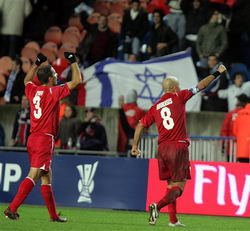
Hapoel Tel Aviv Players Celebrate in Paris

One man is dead and another seriously wounded after a plainclothes police officer shot into a crowd of French hooligans trying to lynch him and a Hapoel Tel Aviv fan in Paris. According to statements from the police and government officials, the shooting had been preceded by racist remarks directed at the policeman, Antoine Granomort, who is of Caribbean origin, and at the fan Yaniv Hazout, aged 21.

The incident took place on Thursday night, after Hapoel Tel Aviv defeated Paris St-Germain 4:2 in an UEFA match at the Parc de princes stadium. The Paris football team's fans have a reputation for hooliganism, and its hardcore fan club, the Boulougne Boys, is affiliated with right-wing extremist groups. The loss to the Israeli team apparently did not sit well with them.

Eyewitness and football reporter Philippe Broussard writes in L'Express, that several hundred PSG supporters roamed the streets outside the stadium looking for a supporter of the opposing team, after the match. He describes coming upon a scene of a group of 100 to 150 young people surrounding a tall black man in a beige, woolen sweater carrying a tear gas grenade and urging another man, apparently a Hapoel supporter, to stay behind him. The crowd was yelling at the two men, hurling insults at them and acting in a threatening manner. Suddenly, Broussard writes, he heard shouts of "he's got a piece, he's got a piece." He saw the first man drop his tear gas grenade and pick it up again, retreating with the other man whom he seemed to be guarding from the crowd. Several minutes later there were gun shots. Only afterward, according to the L'Express reporter, did the hooligans realize that the man in the sweater was a plainclothes police officer:
"C'est un flic, c'est un flic!", crient les assaillants, qui semblent également découvrir sa qualité de policier. ["He's a cop, he's a cop!" shout the attackers, who also seem to be discovering [i.e., at the same time as the reporter Broussard] that the man is a police officer.]
LeMonde reports that according to the Paris district attorney, Jean-Claude Marin, the PSG fans shouted racist insults at the two men before the shooting:
Il semble que des injures racistes assez massives aient été proférées : "sale nègre, sale juif." Il y avait aussi "Le Pen président," des cris de singe et des saluts nazis [It seems that they hurled serious racist insults, "dirty nigger, dirty Jew." There were also cries of "Le Pen for president," monkey grunts, and Nazi salutes].
President Jacques Chirac expressed his dismay at the "scandalous violence," and Interior Minister and presidential hopeful Nicolas Sarkozy said that it was unacceptable that a fan of a football team would be chased with cries of "dirty Jew."

There is some controversy at the moment as to whether the police officer revealed his identity to the hooligans.

Thursday, November 23, 2006

Ending the Carnage

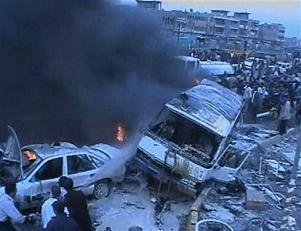
Sadr City, the Aftermath

In a recent piece on Iraq in the New Republic, "Bribe the Insurgents," the celebrity historian Niall Ferguson writes that

History strongly suggests that, once such internecine warfare gets underway, it is extremely hard to stop without external intervention. Violence begets more violence. Vendettas poison relations between neighbors. Though low-intensity conflict can continue inconclusively for decades (think of Sri Lanka), it is also possible for the killing to increase exponentially (Bosnia, Rwanda) until large-scale ethnic cleansing has created homogeneous statelets.

Ferguson's title suggest the external intervention that he has in mind. He recommends that America

  1. buy out the militiamen by paying for and then decommissioning their weapons,
  2. bribe the tribal sheiks (old elites) to support peace-building, and
  3. turn to the permanent Security Council members plus Germany and Japan to aid in reconstruction.

Ferguson makes clear his opposition to an early withdrawal as well as to the rumored Baker-Hamilton strategy of engaging Syria and Iran. This three-pronged strategy ("More money, old elites, plus the United Nations"), sounds like a good idea, especially if the aim is to prevent the kind of "ethnic disintegration" about which Ferguson writes in his latest book (The War of the World: Twentieth-Century Conflict and the Descent of the West) as well as the negative economic and international political consequences of continued instability in Iraq. I fear, however, that it might already be too late for such a solution.

The Sunnis know that the American invasion put an end to their privileged status in Iraq. With their patron gone, they will be the losers in a stable Iraq – at least when they compare their new position to their previous status under Saddam. Thus, Sunni insurgents are doing everything possible to prevent the majority Shi’a from wielding effective state power. However, the tactics of the Sunni insurgents, combined with the memory preserved by Shi’a (as well as Kurds) of Saddam’s cleansing and settlement policies, has convinced many Shi’a that they will only be safe once the Sunni are gone from Shi’a majority towns.

One of the problems with Ferguson’s analysis is that he ignores the decidedly mixed record of external intervention in stopping internecine conflict. In those cases where it has "worked," such as in the former Yugoslavia, the external intervention basically occurred on behalf of one of the warring factions or, more specifically, against the party perceived as the aggressor and threat to peace (by NATO and most of the international community) . It also entailed the de facto recognition of relatively homogeneous nation states or autonomous regions. Croatia for Croats, Bosnia for Muslims, Serbia for Serbs, and Kosovo for Albanians. I do not see how Iraq will somehow prove to be the great exception to the logic of ethnic conflict over the past century.

The Civil War in Iraq

More Murder in Baghdad

There is no reason to attach any particular significance to the coordinated attack by Sunni fighters on Shi'a targets in Sadr City, which killed more than 160 civilians today. This latest massacre is not unprecedented in its brutality. Nor does it reflect a shift in tactics or alter the political balance in any meaningful way. It does, however, illustrate the growing irrelevance of the Americans in this conflict. What began ostensibly as an insurgency against the US occupation of the country has long turned into a civil war between Iraqi Shi'a and Sunni for control of key cities, provinces, and institutions. The fiction of the "resistance to the occupation" (so enthusiastically embraced by idiotic Berzerkely protesters, among others) has long revealed its true fratricidal visage.

Sunni Iraqis are fighting against the ascendance of the long suppressed Shi'a majority, using spectacular terrorist attacks on civilians as well as government organs. Supporting them are smaller foreign terrorist groups, who initially came to Iraq to fight the Americans but are now killing Shi'a. Arrayed against them are Shi'a militias who are running death squads to exact revenge on Sunni fighters as well as random civilians, with the tacit support of government ministers and security personnel. In addition to this, various Shi'a militias are competing against each other and the government for control of local towns and money-making enterprises. Iraqi government forces, in so far as they are not freelancing for militias, are not doing very much other than getting killed by Sunni insurgents. It's hard to fault those who have given up on the government's ability to protect its citizens, such as this man cited in the New York Times:
I’m very, very angry because the government did nothing for us,” said Muhammad Ali Muhammad, a 27-year-old laborer in Sadr City. “There’s no protection for us.
or Mohammed on Iraq the Model:
The government stinks—that’s the overwhelming impression that is undermining the public's support for the government and its institutions
There has been much talk recently of a solution in Iraq involving American rapprochement with Syria and Iran. It seems to me that the expectations surrounding such an initiative are grossly inflated. Given the legacy of Saddam Hussein's rule, the struggles between Sunni and Shi'a would be going on with or without Iranian and/or Syrian encouragement. Neither Syria nor Iran have real influence on the brutal war being waged on the ground between Sunni and Shi'a. Furthermore, at the moment, these two countries are mainly interested in supporting attacks on US forces with the aim of weakening American military capabilities in the region.

Happy Thanksgiving to our American readers!

Tuesday, November 21, 2006

The Gemayel Assassination

Pierre Gemayel Jr. (1972-2006)

Zvi Bar'el has a somewhat confused and confusing analysis of the Pierre Gemayel assassination that rocked Beirut today. On the one hand, Bar'el claims that "pure political and diplomatic logic makes it difficult to see Damascus behind the assassination." On the other hand, he concludes that
One of the Syrian intelligence organizations might have been behind the act, as revenge on those it deems responsible for the bashing it will take at an international tribunal.
It's plausible that the order did not come from Assad this time around. But the pro-Syrian forces in Lebanon have been agitating for a coup for months. Meanwhile, the Hizbullah lovers are going wild with conspiracy theories blaming March 14 for assassinating the Christian minister in order to cement the current government's hold on power. Abu Kais writes that
Pro-Syrian minister Suleiman Franjieh, who was interior minister when Hariri assassination, has practically accused Pierre Gemayel of assassinating himself during an interview with NBN.
Please refer to the coverage by Abu Kais on From Beirut to the Beltway, by Michael Totten, and by Anton Efendi on Across the Bay.

We extend our sympathy to all the mourners.

UN High Commissioner for Human Rights Visits Sderot

Sderot says "Haide!" to Arbour

United Nations High Commissioner for Human Rights and former Canadian Supreme Court justice Louise Arbour visited Sderot this morning, where she inspected areas hit by Qassam rockets together with the mayor of the city. Arbour's reputation (deserved or not) as well as that of the United Nations and her office in particular seems to have preceded her. Ynet reports that a "disturbance" broke out at the scene of one of the sites she was visiting, with residents of the town hitting the doors and windows of UN vehicles, and protesting what they saw as the body's one-sidedness and indifference to Israel.

Meanwhile, the New York Times has an editorial this morning lambasting the successor to the Commission, the Human Rights Council. Calling this body a "Discredit to the United Nations," the Times especially noted its condemnations of Israel:
The council is new, but its deliberations have already fallen into a shameful pattern. When it comes to the world’s worst and most consistent human rights violators, like China, Iran, North Korea, Myanmar and Sudan, there has been a tendency to muffle words and conclusions and shift the focus from individual and political rights to broader economic and social questions.

But when it comes to criticizing Israel for violations committed in a wartime context that includes armed attacks against its citizens and soldiers, the council seems to change personality, turning harshly critical and uninterested in broader contexts.

If the Times is annoyed, no wonder the residents of Sderot are upset.