Sunday, December 31, 2006

Memories of a Murderer: the Hanging of Saddam Hussein


It's almost amusing to witness the proliferation of competing memories of Saddam Hussein's hanging yesterday. As ever, it is not easy separating history from its narration. Zeyad's transcript of a cell phone video of the execution and its apparent divergence - however slight - from the reports of the New York Times illustrate how difficult it will be to unpack the event as it really happened from the rumors, myths, stories (or histories?) told by all those who have a stake in the affair - which is to say, most of us.

Every utterance by Saddam, the executioners, officials, and witnesses is likely to prove significant for the shaping of competitive memories of the event. Predictably, those memories break down along sectarian lines. The fact that the hanging took place on the holiday of 'Eid ul-Adha, which commemorates Abraham's willingness to sacrifice his son (Muslims believe that Abraham/Ibrahim wanted to sacrifice Ishmael; Jews and Christians believe that the designated sacrifice was Isaac), only added additional religious powder to the explosive mix of history and memory. Is Saddam the ram sacrificed in lieu of the nation (however defined) or is he the willing martyr, Ishmael himself, martyred for his people? Is his execution a holiday gift or insult added to injury?

Many Sunnis the world over, with the exception of Kuwaitis, denounced the killing. The Palestinians have long seen Saddam as their patron; more significant were the voices coming out of Saudi Arabia. In a statement read on the country's official news agency, the Saudi government said that "Leaders of Islamic countries should show respect for this blessed occasion ... not demean it," (Ha'aretz).

Sunni condemnations took aim at the Shi'a as well as the Americans. Doubtlessly, their collective memory of this event will prove increasingly important as the Saudis and other Sunni regimes in the region step up their support of Iraqi Sunni against Iraqi Shi'a and the Iranians. So far, many of these voices are still talking in nationalist terms. They take aim, for example, at the divisive nature of the event of the execution - divisive of the Iraqi nation. They are of course right. As all the reports and transcripts of the hanging make clear, the men who lynched Saddam were Shi'a, supporters of Moqtada al-Sadr no less. Saddam's ignominious end was the revenge of the Shi'a, and that is exactly how they staged it. But the Shi'a believe that they are the Iraqi nation. That is why the Kurds were not really represented at the execution, and that is why the hanging of Saddam took place before the dictator's trial for his atrocities against the Kurds was completed. The Iranians, in the meantime, emphasized that the execution was "a victory of the Iraqi people." They also chastised America for seeking the credit for Saddam's fall - funny, considering U.S. troops aided by Kurdish intelligence actually caught Saddam.

In fact, with their nationalist rhetoric the Saudis and the Iranians are merely paying lip-service to Iraqi unity. Everyone knows that under Saddam an Iraqi nationalism cutting across sectarian lines amounted to an illusion supported by brutal violence - a fiction from which Sunni benefited at the expense of Shi'a and Kurds. Today, Iraqi unity means Shi'a running things and letting the Kurds handle their own business in the north. By chastising the Iraqi Shi'i leaders for "demean[ing]" 'Eid ul-adha, the Saudis and others in the region are presenting themselves as leaders in a religious struggle on behalf of Sunni against Shi'a in Gulf and possibly beyond it.

Ironically, while the Iranians warned the U.S. not to take credit for the execution, much of the world pinned the blame for the hanging on the Americans alone. Indeed, a Korean friend of mine said that in most of his country's media, the rush to hang Saddam was presented as the result of a cynical ploy by Bush for higher domestic approval. I think this reaction is fairly representative for the intelligentsias of countries such as India, China, as well as for much of the European public. The Chinese foreign ministry, however, no doubt anxious to maintain positive relations with both the Iraqi government and the Iranians, stated that "Iraqi affairs should be decided by the Iraqi people," (Xinhua News).

ADDENDUM: Big Pharaoh has a nice sectarian breakdown on who executed Saddam ("the question really depends on who you are"). This is his answer for
"All other Arabs and Muslims:":

The Americans executed Saddam and they've done so during the first day of the Muslim feast to humiliate us and show our leaders what awaits them if they stood against the US.

Saturday, December 30, 2006

Death of a Tyrant

There's some harrowing footage of Saddam's last moments available at Zeyad's blog, Healing Iraq. Apparently, one of those present at the execution captured the hanging on his cellphone camera. Saddam executed thousands of Iraqis, but to me this footage is a powerful statement about the barbarity of capital punishment. Definitely not recommended for the faint of heart.

Friday, December 29, 2006

Montreal Antisemitism


The Cummings Centre for Jewish Senior Citizens defaced by a swastika - Thursday, December 28, 2006

The above are pictures of the latest Jewish institution to be defaced in Montreal. The Cummings Centre provides services for senior citizens, including kosher meals, lectures and social activities. The swastika pictured above must have been spray painted in the evening of Thursday, December 28, 2006. There are almost certainly Holocaust survivors among the people who will be visiting the centre this Friday morning. The Jewish community in Montreal has been feeling under fire since the outbreak of the second intifada. There have already been several attacks on Jewish schools in Montreal, including a firebomb attack on a Jewish school reported on in this blog last September. Lately, an inordinate amount of media attention has been focused on Jewish issues: much of this attention is unfortunately negative. The reaction to a recent report by a Montreal police committee that issued "cultural advice" to improve community policing is especially instructive. In the report, a cultural advisor from the police department suggested that in cases where police had to intervene in Orthodox Jewish communities (something that is in any case rare), male police officers talk to Orthodox men and that female officers address Orthodox women so as to show sensitivity to religious customs. As far as I could tell, the report simply intended to make community policing more effective - it was not triggered by any refusal on the part of Orthodox men to speak to female police officers. Nevertheless, the lines of French-language talk shows in Montreal were jammed by callers complaining about the alleged refusal of Jews to conform to Quebec's "tolerant" values and the whole affair was cast as a surrender by the Montreal police to sexist demands by the Jewish community.

Thursday, December 28, 2006

Tsipi Livni Goes Solo on Olmert

Israeli FM Tsipi Livni with U.S. Secretary of State
Condoleeza Rice last February (State Dept.)


Israeli Prime Minister Ehud Olmert is said to be furious about reports that Foreign Minister Tsipi Livni met with Fatah officials Yasser Abed Rabbo and Salam Fayyad earlier in the week. Livni apparently organized the meetings without Olmert's approval or knowledge. According to Ha'aretz, she
outlined her plan to negotiate with moderate Palestinians and shape the future of the peace process. She advocates an Israeli pullout from the West Bank east of the separation fence and the establishment of a Palestinian state - which would also be the solution to the Palestinian refugee problem - in the evacuated area.
No wonder Olmert is ticked off. Here is someone finally showing initiative and an interest in some kind of progress. In a recent post, Zach, over at Epichorus, quips that
Unlike President George W. Bush, who has conveniently shortened his title of Commander-in-Chief to "The Decider," Prime Minister Ehud Olmert cannot even make the decision whether or not to change his title to "The Vacillitor."
Livni is making him look bad.

I don't know if there is a Tsipi-bandwagon yet, and I'm not sure I would jump on it, but Israel desperately needs some real leadership, and neither Olmert nor Peretz are providing much of anything these days. I don't think Livni shone during the war with Hizbullah, but I think if she had been given more breathing room, she might have made a difference then. As Israel's representative in Europe and the U.S., she has certainly out-performed Olmert.

Anarchists Bring Roadblocks to Tel Aviv

The "roadblock" set up in Tel Aviv (Ha'aretz).

Activists from the "Anarchists against the Fence" movement brought the roadblocks of the territories to Tel Aviv today - albeit only for a few minutes. The protesters set up barbed wire and military warning signs, apparently taken from pieces of the security fence in the West Bank, on fashionable Basel street in the north of the city. The twenty or so demonstrators wanted to inform Tel Aviv residents of the daily reality in the Palestinian territories only a few kilometers away from them. A traffic jam quickly developed at the location (though this is not a rare occurrence even without protests) and drivers contacted the police. The anarchists fled the scene before the police arrived.

The anarchist action seems like a smart modification of the anti-disengagement protests two summers ago, which infuriated so many Israelis. Unlike the settlers, the anarchists are conveying their message creatively without getting arrested. The inconvenience (and danger) to motorists is negligible compared to what transpired in the "orange days" of 2005. It is good to make Israelis aware of the suffering caused to Palestinians by checkpoints and roadblocks. I wonder though what the protesters would say to those who insist (rightly) that the fence and checkpoints have saved and continue to save hundreds of lives. The dramatic decrease in suicide bombings over the past year is proof of that. The often cited argument that checkpoints create terrorists, on the other hand, is hard to verify. Surely, suffering by itself does not create suicide bombers.

There is a police station just one block south of Basel on Dizengoff, so the cops must have taken their time.

This is the second Basel Street protest that has made it onto Kishkushim. Last summer, Arab Israelis demonstrated in front of the Egyptian embassy down the street.

NEXT: Palestinian leftists blow up mini van loaded with effigy passengers on Ramallah street to protest suicide bombing. Or: Gaza anarchists fire model Qassam at Palestinian houses. Oh wait, that's already happened.

Watching the Caspian Sea Basin

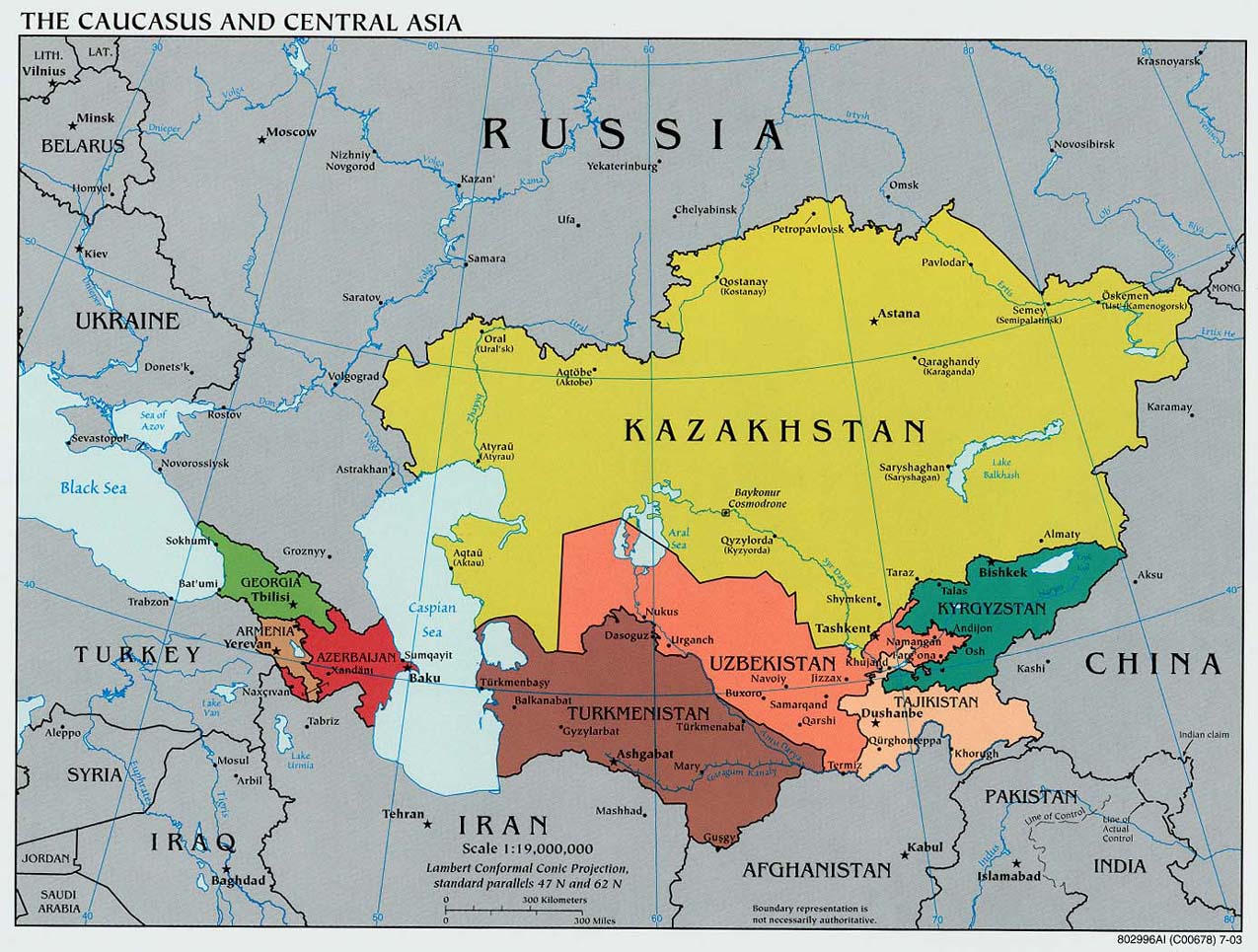
A view of the region (Source: Perry Castaneda)

Most observers of the Middle East would agree that Iran has been making a successful run at establishing itself as a regional hegemon. So far, attention has been focused on its moves in Iraq, the Levant, and to a lesser extent, in Afghanistan. The elimination of Iraq as a threat on its western frontier has been the biggest boost to Iranian ambitions. Iran's successes in challenging the pro-Western government in Lebanon via its proxy Hizbullah and its ally Syria have further extended its westward reach all the way to the Mediterranean. Reports of Iranian activity in Afghanistan have also surfaced, especially recently. But Afghanistan offers little in the way of resources. A much more lucrative catch for Iran is the Caspian Sea basin to its north - an area with significant oil and natural gas reserves. Iran shares borders with the countries on both the Caucasian and Central Asian sides of the Caspian Sea - Azerbaijan in the west and Turkmenistan in the east.

Turkmenistan recently made the headlines when its eccentric post-Soviet dictator, Turkmenbashi Saparmurat Niyazov died. Like its other post-Soviet Central Asian neighbors, with the exception of Kazakhstan perhaps, Turkmenistan has little in the way of modern state institutions to ensure stability following the death of its revered leader. Peter Zeihan of Stratfor (you have to sign up to read it and pay, unless someone forwards it to you) is predicting that the Iranians will be hard-pressed not to make some sort of move on Turkmenistan - in order to control key oil and gas pipelines and to secure itself against an attack from the northeast. In so doing, however, Iran risks a showdown with Russia, which has been intent to monopolize Central Asian energy distribution networks through Gazprom. ADDENDUM: Josh and Nathan over at Registan are merciless in their criticism of Zeihan. The titles of their posts, "Piecing It Together, Sort Of" and "Dumb Things Written about Turkmenistan," respectively, give an indication of their critiques. I guess we'll see who's right 5 years from now.

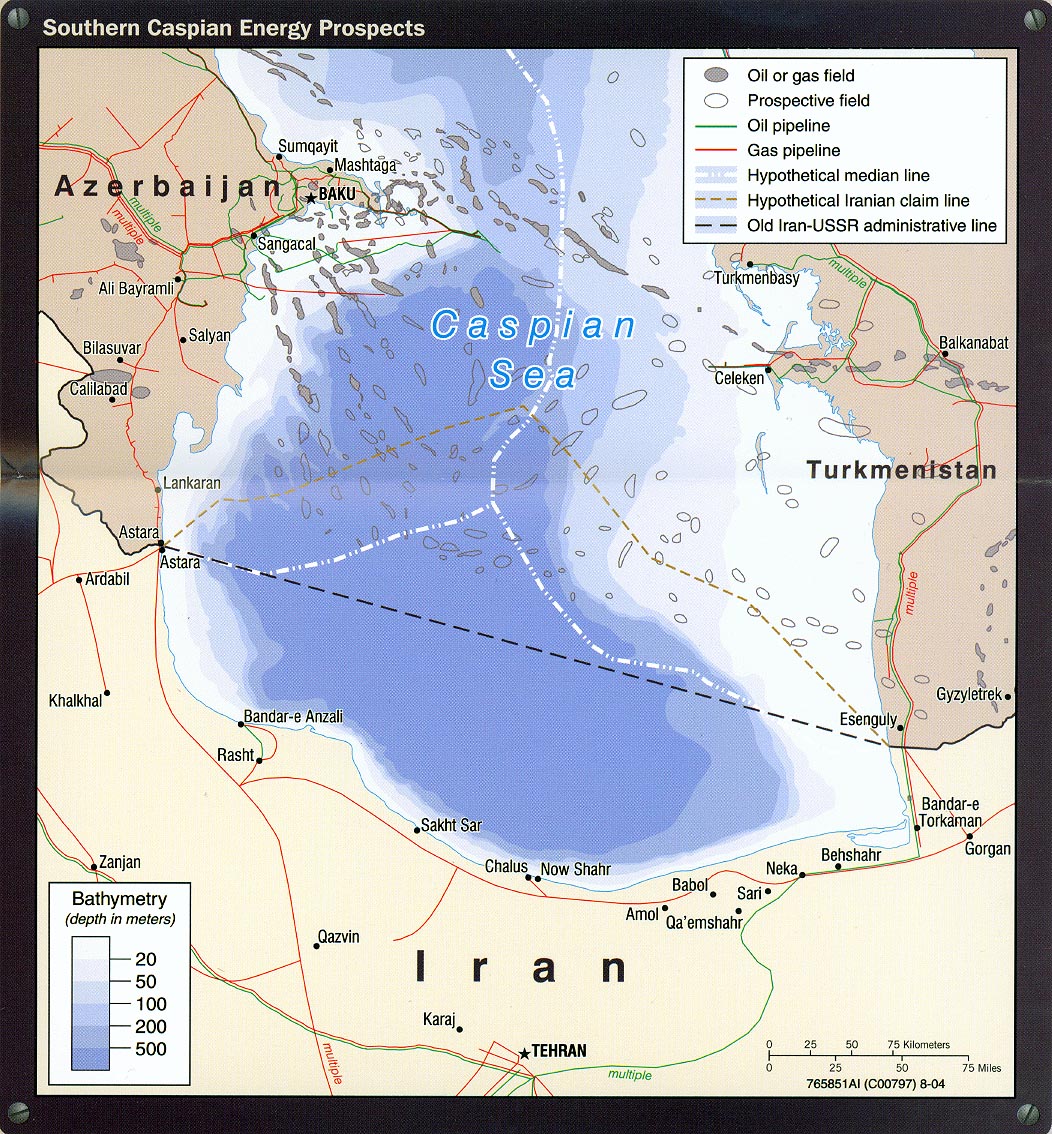
Oil and gas fields in the southern Caspian (Perry Castaneda, 2003)

Azerbaijan has been in the news mostly due to its increasingly aggressive posturing vis-a-vis Russia. While its enemy Armenia has been moving ever closer to Russia, Azerbaijan has been seen as a Western ally, together with Georgia. Both Georgia and Azerbaijan are aiming for greater energy independence from Russia. Together with Turkey, the two Caucasian states are also trying to build an energy supply network that will bypass Russia and Iran as it delivers oil and gas to Europe and other markets (see our earlier post, "Pipe Dreams"). Iran is wary of Azerbaijan's ties to the U.S., and perhaps even more nervous about the country's potential to incite the large Azeri minority in Iran, especially in its northern provinces. A recent New York Times article suggests that the Iranians may be playing a similar kind of game they have pursued with such success in Lebanon and Afghanistan. Azerbaijan is overwhelmingly Shi'a, and although it is often represented as quintessentially secular and frequently compared to Turkey, there is a large market for Iranian-style Shi'a Islamism. Especially in the poor rural areas, Iran is investing in social programs and religious centers. According to local observers, the Iranian investment is paying off. As evidence, they cite reactions to a recent article by two Baku secularists who criticized Islam's negative impact on Azerbaijani's economic development. Provincial imams denounced the pair and an Iranian ayatollah called for their execution. It doesn't help that the regime has made no moves toward democratization (contra U.S. President Bush's statement in May 2006 after a meeting with President Ilhalm Aliyev that Azerbaijan "understands that democracy is the wave of the future"). Sooner or later, the current Azerbaijani government will face opposition from both conservative Shi'a in the provinces cut out of the oil and gas spoils as well as the secular urban elite in Baku demanding liberalization. But Iran might not have to be subversive in its activities for much longer. Although Azerbaijan has traditionally been very careful not to antagonize its southern neighbor, Aliyev has recently come out against sanctions being placed on Iran and announced that he would look to replace Russia with Iran as the country's electricity supplier.

Needless to say, Turkey, Russia, and the U.S. will not look on passively at Iranian moves northward. But who will join whom?

Tuesday, December 26, 2006

The End of Another Ceasefire

An ambulance in Sderot evacuates the wounded

Despite a cessation in Israeli army operations in Gaza, as per an agreement reached with the Palestinians, militant groups have fired more than 50 Qassam rockets since this latest ceasefire began. A number of rockets have hit perilously close to strategic installations in Ashqelon. Today, one teenager is in critical condition after a Qassam hit a residence in Sderot. Another youth suffered moderate injuries. The Islamic Jihad took responsibility.

There have been numerous cases in which rockets landed in family living-rooms or narrowly missed people's bedrooms. There are certainly factions in the Gaza strips who do want a cease fire, including members of Hamas. But it is clear that neither those with the strongest militias nor those with the most popular legitimacy have been able to prevent the ongoing rocket fire. Of course, even military action - whether in the form of ground incursions, air force strikes, or artillery - has not been entirely effective. For now, Israel has appealed to the United Nations. But can the Israeli government really continue to treat these rocket launches as mere crimes or small-scale cease fire violations? Already yesterday, Defense Minister Amir Peretz called for an end to the policy of restraint.

World opinion will probably continue to condemn Israeli counter-attacks, while belittling the impact of the Qassams. At the same time, with every Qassam strike that Israel absorbs during cease fires such as this one, the Palestinians lose credibility among those powers who have invested in mediation.

Battling for the Horn of Africa


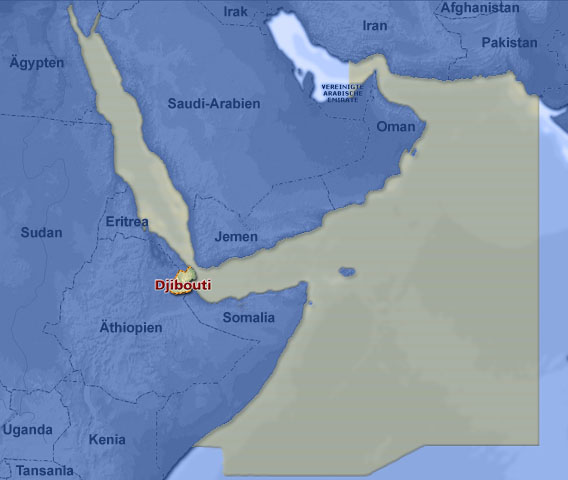
The Horn of Africa (Google Earth)

Somali transitional government troops, backed by the Ethiopian air force and land forces, are apparently routing Islamist fighters in Somalia. The U.S. seems to have given carte blanche to the Ethiopians to pursue their current counter-offensive, which began after Islamic Courts Union (ICU) militiamen attacked the city of Baidoa, which is in the Somali interior, approximately halfway between Mogadishu and the Ethiopian border. The Ethiopian-backed forces are pursuing the ICU fighters who are retreating to the capital on the coast.

Although Somalia has largely faded into the background since 9/11, the CIA and the Pentagon have long watched developments in the Horn of Africa. Even undergraduates with knowledge of the region and its languages were recruited as consultants in the past five years. The near-anarchy in Somalia, and, more recently, the power of local Islamists, have made it an ideal base for al-Qaeda-type groups - though mainly as a conduit for attacks in Kenya or the Gulf of Aden. Pirates have also threatened the safety of shipping routes off the Somali coast.

The U.S. Combined Joint Taskforce - Horn of Africa in Djibouti has been engaged in counter-terrorism training of allies such as Kenya, Ethiopia, and Eritrea, as well as in coordinating a multinational, force that is monitoring shipping lanes in the Red Sea and Indian Ocean (Taskforce 150). Most of the monitoring is being carried out by the German navy, which currently has a frigate with two helicopters and a tanker deployed for this purpose. The deployment falls under Operation Enduring Freedom. It actually covers the area from the Red Sea around the Arabian peninsula to the Strait of Hormuz.

Operation Enduring Freedom - the naval theater (Source: Bundeswehr)

Her Majesty's Army Demolishes Basra "Gestapo HQ"

The British Warrior Fighting Vehicle (Source: British Army)

Events in the oil-rich, southern Iraqi city of Basra have received relatively little attention in the American media. In part, this is because the province falls under the command of the British, whereas American forces are stationed in al-Anbar (USMC) and Baghdad (U.S. Army). The Christmas day raid of a rogue police unit heavily implicated in torture, executions, and criminal activity has focused attention back on Basra. The raid involved about a thousand British troops and members of the Iraqi Security Forces (not Iraqi Army). After successfully overcoming resistance, allied forces found 127 prisoners crowded into extremely cramped quarters. Many of the prisoners bore marks of torture, and British commanders claimed to posses intelligence that
they faced execution. The prisoners were transferred to another Iraqi detention facility. The police station, dubbed "Gestapo HQ" by some members of the British military, was demolished (see NYT and Times of London for more details).

The British operation was actually the second raid on the station. A year ago, the British bulldozed one of the prison's walls in order to rescue two special forces soldiers who had gone undercover to investigate the rogue unit. Then, as now, a number of Iraqi politicians and commanders condemned the raid. But this time, the British claim to have gotten clearance from the top.

The problems in Basra are somewhat different from those in the rest of the country. Because the town is almost entirely Shi'i, there is little sectarian fighting. Rather, it is the site of conflict among various criminal gangs allied with different Shi'a militias. It's unclear how much control the various leaders such as Moktada al-Sadr or Abd al-Aziz al-Hakim have over the local actors. Thus it is possible that even they believe that the criminals running things in Basra were out of control. The operation had backing from both Iraqi PM al-Maliqi as well as the governor of Basra, Mohammad Waeli.

It remains to be seen what the long-term effects of this operation will be. Her Majesty's Armed Forces certainly performed admirably. The British surrounded the target with overwhelming force - five tanks and 40 fighting vehicles, and there were apparently no British casualties. The raid might have taken the enemy by surprise. Instead of engaging the militias on patrols, the Brits gathered intelligence and then entered the city in a massive show of force to launch a pinpoint assault on a specific high-profile target. Symbolically, this is a blow to these local strongmen; if marketed correctly, it might enhance the legitimacy of British-backed big men against the centripetal forces terrorizing the local population with their gang wars.

Friday, December 22, 2006

Parochialism


Democratic House Representative Keith Ellison

The recent outcry raised by Virginia Republican Virgil H. Goode Jr. over the fact that Keith Ellison, a convert to Islam and the US Congress's first Muslim (Democratic) representative, chose to use the Quran during his private swearing-in ceremony in January, is the kind of narrow-minded parochialism that scares me. According to the New York Times, in a letter written on December 5, Goode
said that Americans needed to "wake up" or else there would "likely be many more Muslims elected to office and demanding the use of the Koran"
I have no doubt that Goode will be castigated by the American political mainstream for his comments. I am also confident that civil rights organizations, including Jewish groups such as the American Jewish Committee, will be among the first to come to Ellison's defence. After all, they've been fighting this kind of bigotry since the early 20th century. Nevertheless, these kinds of sentiments are a reminder that there are still people in North America - and they exist in the US as well as in Canada - who need some basic lessons in tolerance. I found Ellison's response especially encouraging. In an interview, Ellison declared:
I’m not a religious scholar, I’m a politician, and I do what politicians do, which is hopefully pass legislation to help the nation ... I’m looking forward to making friends with Representative Goode, or at least getting to know him ... I want to let him know that there's nothing to fear. The fact that there are many different faiths, many different colors and many different cultures in America is a great strength.

Taking Potshots at Israel

In a recent weekly briefing, Eran Lerman, the director of the American Jewish Committee's Israel office, referred to some "troubling signs of tension - from the Iraq Study Group report to the Jimmy Carter book and the Stephen Walt and John Mearsheimer paper" that have generated considerable anxiety among Israelis. I think it would be wrong to be too alarmist about this - and Lerman is not. But Lerman has put his finger on something by linking these three. It is becoming fashionable in Washington to take potshots at Israel. At a recent panel discussion on "US Policy Toward Iran" held by the Center for American Progress and broadcast on C-SPAN, audience members repeatedly asked about the constraints put on American foreign policy by its relationship with Israel. References to Israeli politicians by both panelists and questioners were accompanied by smirks and drew the kinds of laughs with which I am familiar from Berkeley teach-ins. Meanwhile, the people taking the potshots continue to do so with the pretense that they are breaking taboos.

Thursday, December 21, 2006

Radio Sawa and Mary Cheney's Baby

Since its foundation on March 2002, Radio Sawa, a radio network publicly funded by the American Broadcasting Board of Governors and U.S. Congress, has been struggling to influence Arab public opinion. Today, it can be listened to online, or on FM and medium-wave radio in Arab countries ranging from Morocco to Yemen. Radio Sawa has attracted its fair share of criticism. Ali Abunimah, the ideologue-in-chief at the Electronic Intifada website, basically lambasted the station in 2002 for not being more pro-Palestinian/anti-Israeli. He also compared it unfavourably with BBC’s Radio Arabic and with France’s Monte Carlo, which he argued had more critical news coverage, a higher level of discourse and discussion, and more audience participation. He also said that the station patronized Arabs, because of its low intellectual content – back then three quarters of its content was supposedly top 40 Arabic and western pop music, while one quarter of the programming consisted of short newscasts.

Nevertheless, Abunimah and Radio Sawa’s other critics have all been forced to concede that the radio station has people in the Arab world listening. The reason that it has become the station of choice in many parts of the Arab world should be obvious: the Middle East is made up mainly of young people who happen to like Britney Spears, Celine Dion, Justin Timberlake and the Lebanese and Egyptian divas and crooners who are their counterparts. I imagine that they also enjoy hearing the brief video game and movie reviews, as well as the occasional fitness and health tips delivered by Sawa’s anchors, usually a man and a woman speaking in fashionable Lebanese colloquial. Finally, Sawa’s listeners probably also like the fact that there are no boring commercials that they have to sit through. Frankly, they could not care less about the conclusions of a certain panel of Arab language experts who, after being hired by the US Inspector General’s office to review the Radio Sawa, concluded that
parents would prefer that their teenagers not listen to Radio Sawa because its broadcasts contained such poor Arabic grammar
Since when do teenagers care what their parents think? Radio Sawa is pursuing a clever marketing strategy and, based on my own listening experiences in Arab commuter cabs in the Negev, it is obviously succeeding.

So why is this subtle successor to the Voice of America still coming under fire? One reason is that the Arab nationalists who exalt al-Jazeera will never embrace a broadcaster that has news anchors who don’t call coalition troops “the forces of occupation”, and who don’t describe terrorists killed in action as “having martyred themselves”. They automatically disapprove of Radio Sawa, because it has Israeli reporters who occasionally file reports about Israeli politics in Arabic. In short, they want all news outlets that reach Arab ears to be nationalist-Islamist and to embrace their rhetoric. That is the main reason why these critics belittle Radio Sawa’s news programming and claim that Arab listeners automatically tune out when they hear its supposedly biased news casts.

I don’t claim to know whether Radio Sawa has succeeded at all in influencing Arab public opinion and in improving the way in which young Arabs view the United States. Sawa’s other critics in the US assert that the station has focussed too much on trying to win over the audience and too little on influencing it. These people would like it to be more aggressive about advancing American interests. I actually think that Sawa has taken a good middle road. The station has attracted young listeners through its soft content. The impact of Sawa’s news programming is probably underestimated. While the station wisely refrains from being a propaganda outlet, the insights it provides into American society and the different views it gives about the Israeli-Palestinian conflict are bound to have some influence. On Wednesday morning (Eastern Standard Time), the online broadcast of Jordanian Radio Sawa transmitted American President Bush’s press conference live (with simultaneous translation). Bush was questioned on everything, from his latest proposals on Iraq to Mary Cheney’s baby and its implication for his view on gay families. It was a powerful demonstration of American democracy and freedom of the press at work. Radio Sawa should stay the course.

Wednesday, December 20, 2006

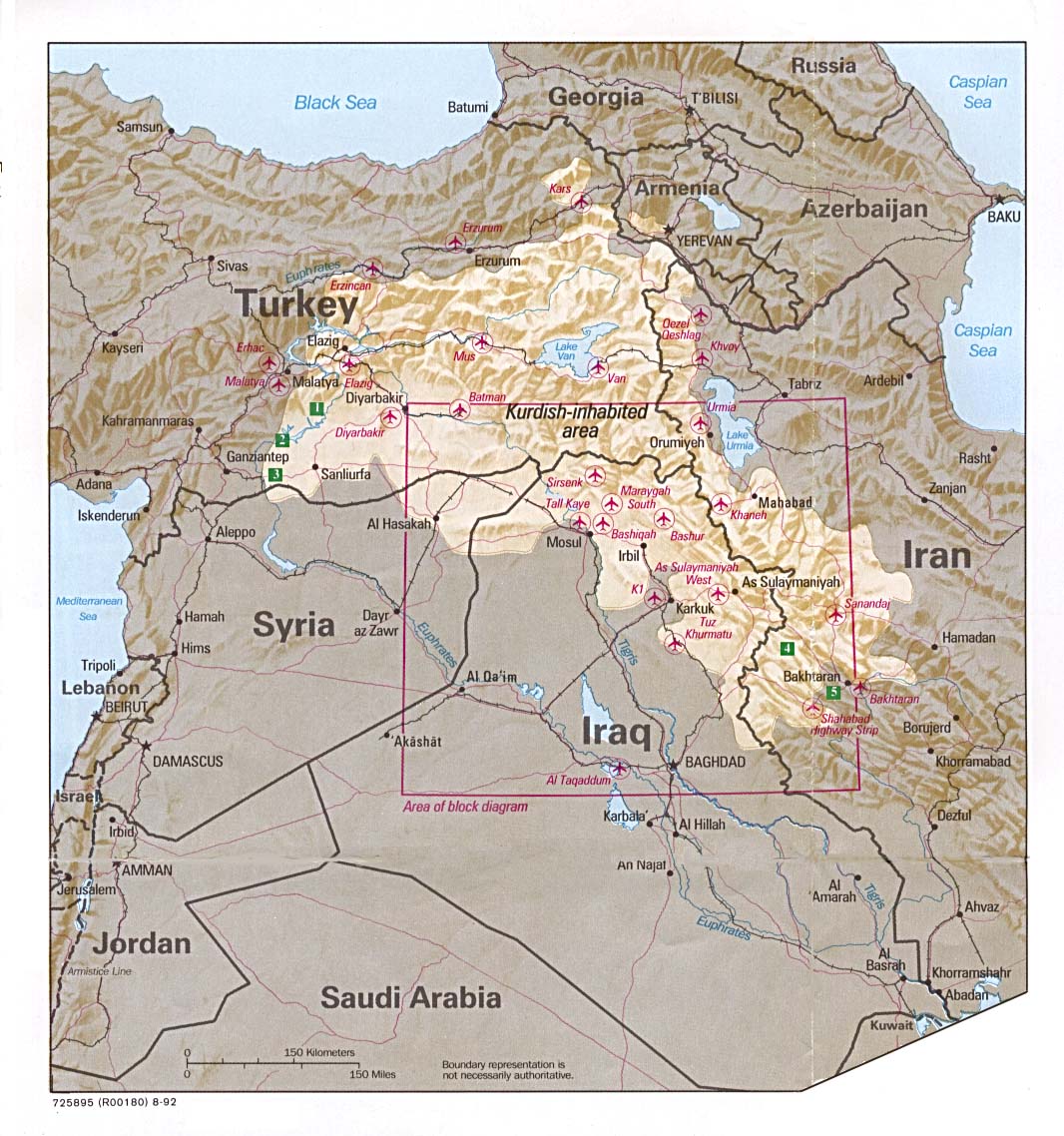
Kurds to Baker-Hamilton: Don't Sell Us Out Again

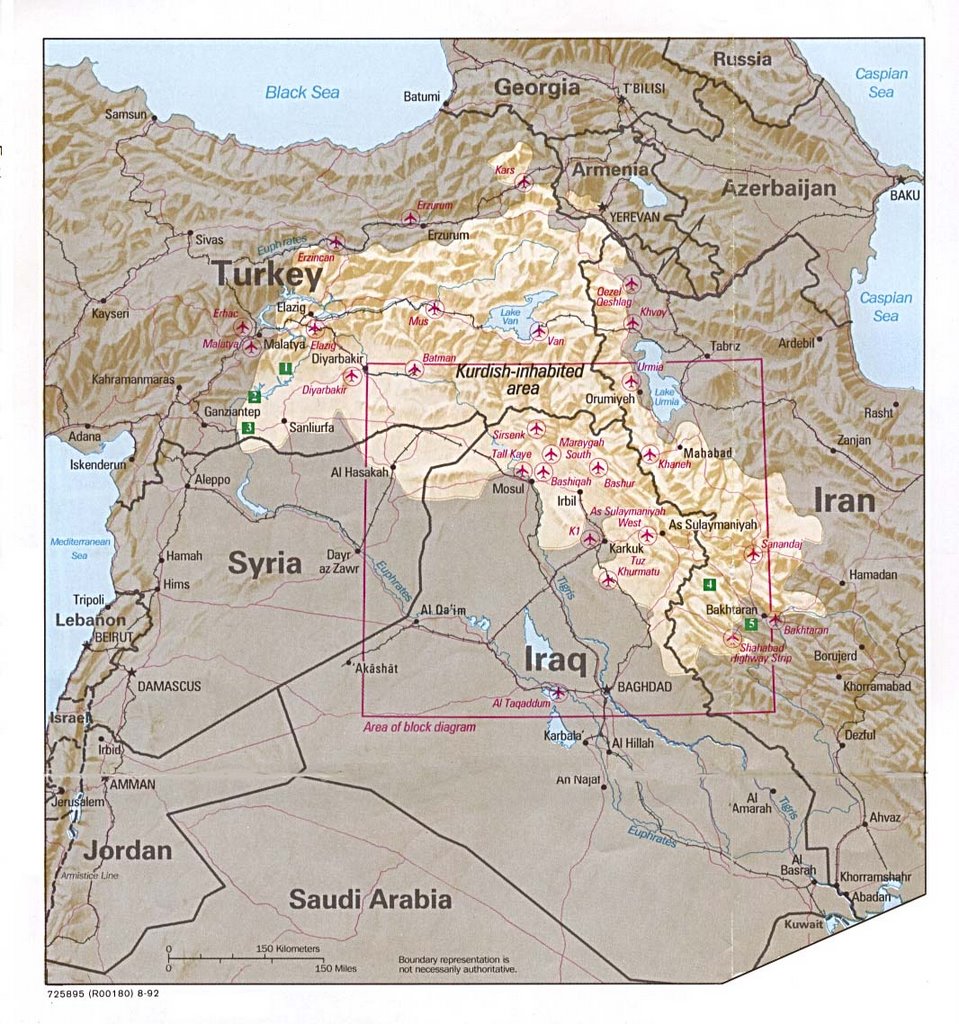
An old map of Kurdish lands, ca. 1992 (source: Perry-Castaneda Map Collection).

You can read Masrour Barzani's response to the Iraq Study Group Report in the Washington Post or on the Kurdistan Regional Government website. The immediate aim is clearly to prevent a cancellation of the popular referendum planned for Kirkuk. The long-term aim is to safeguard the autonomy of Kurdistan within Iraq - in other words to maintain the decentralized structure outlined in the constitution - and to protect the Kurds from hostile external intervention.

If you recall, the ISG Report warned about the violent fallout such a referendum might engender (see my previous post). Clearly, Baker and Hamilton want to stop such a referendum from taking place - ostensibly to prevent civil strife in Kirkuk but, more importantly, to keep Turkey happy. Turkey, it should be noted, claims that it is concerned about the safety of the Turkman population; it is probably most concerned about ceding any more oil-rich areas and powers to the Kurds. Barzani does not mention Kirkuk at all, but he objects vehemently to the ISG Report's "flippant" treatment of the constitution (after all, it guarantees the right of the Kurds to hold such a referendum). In the Baker-Hamilton report, the words "amending the constitution" often appear immediately before the phrase "settling the future of Kirkuk" (see for example ISG Report, p. 18).

The Baker-Hamilton report takes pains to portray the Iraqi constitution as a partisan document engineered by the Kurds and Shi'a at the expense of the Sunni. Yes, the constitution happens to reflect the interests of Shi'a and Kurds. There's a reason for that - as the report admits, "The Sunnis did not actively participate in the constitution-drafting process." Maybe if they hadn't been so busy killing Americans and other Iraqis, things would look different today. Why should the rejectionist forces be rewarded now? Is it all as part of the imperative to preserve a united Iraq? I think that if the ISG had visited Kurdistan they might have understood better that it's either this kind of Iraq or no Iraq at all for the Kurds.

What I like about Barzani's argument is that it points out the pitfalls of the "realist" bandwagon. The realists have been sharpening their knives against the neo-cons for years. Their current offensive builds on the demonization of neo-conservative visions of the Middle East. To be fair, when turned into policy, those visions have been disastrous. But to imply that Baker & co. represent a more moral approach is perverse. Let's not forget - lest we do, Barzani won't let us - that the report "was partly written by those who orchestrated the saving of Saddam Hussein in 1991." Let's not forget that this act of realism led to the deaths of thousands of Kurds. Yes, today, there are 3,000 Iraqis dying every month. But few of them are Kurds. Why should the Kurds have to pay for the mess that is Iraq? Why should their interests be sacrificed at the expense of those within Iraq and outside its borders who have consistently embraced the rejectionist and obstructionist policies that have led to the daily massacres of Iraqi civilians and the deaths of many American soldiers?

Against the logic of appeasement, which in this case means privileging the interests of regional powers over those of people on the ground, Barzani invokes democracy - he uses the word seven times. One, the constitution reflects a vote by the majority of the Iraqi population (true). Two, Kurdistan's autonomy is firmly anchored in the will of the Kurdish people. It seems bizarre that the only undeniably positive outcomes of the American invasion of Iraq should be sacrificed at the altar of a realpolitik that is likely to make things worse for America in the long-term. At the minimum, those championing this part of the Baker-Hamilton report should not be allowed to get away with presenting themselves as morally superior to anyone. It would behoove them to take note of Barzani's appeal:
Don't sell us out to our authoritarian neighbors and those who are terrorizing our communities. We agreed democratically to participate in this project because we were guaranteed the rights needed to protect our people. We Kurds are asking President Bush and America to remember the sacrifices we have made to keep your loved ones safe in Iraq. We are asking you to keep a promise where those before you have failed.
Unfortunately, in today's political climate, the opponents of Bush are likely to be so blinded by their thirst for revenge against the neo-cons, that they will dismiss this as mere rhetoric.

Tuesday, December 19, 2006

A "New" Iraq Strategy


A banner from the Kurdistan Regional Government website.
Note the Kurdish (not Iraqi) flag blowing in the wind.

It appears that the White House is leaning toward the plan that U.S. Senator John McCain has been pitching for a dramatic increase in American troops in Iraq. Tens of thousands additional American soldiers are supposed to be deployed in Baghdad at another last-ditch effort to beat the insurgency. The new objective? To end the "cycle" of sectarian violence (New York Times). The idea seems to be that by making Baghdad safe from the Sunni insurgents, the Iraqi government will gain credibility to clamp down on the Shi'a militias, and perhaps public approval.

All this is more wishful thinking. The Shi'a are not going to be won over by the U.S. They will be happy to watch the Americans continue to fight on their behalf, but they know that the U.S. will not be in Iraq forever. Those politicians calling for another troop increase will be sending more American soldiers to their deaths for gains that will be reversed once America finally withdraws - if these gains materialize at all. In any case, it is doubtful that the Shi'i population will credit the U.S. or the Maliki government with such gains. At the end of the day, the residents of Sadr City will see the Mahdi Army as their savior. Like it or not, the militias' sectarian cleansing is also seen by most Shi'a as their ticket to safe neighborhoods. Any attempts by Americans to limit militia activity, on the other hand, is perceived as a deliberate effort to put Shi'a in harm's way.

Meanwhile, the Sunni insurgency, spearheaded mainly by former Baathists but abetted by al Qaeda, is continuing the fight against the Marines deployed in the western provinces, most notably, al-Anbar. Despite the pessimistic reports by such seasoned observers as Col. Peter Devlin (see our earlier post, "Failed Province: Marines Lose Hope in al-Anbar"), the young Marines serving in the province are more optimistic. An acquaintance of mine who is the executive officer (second in command) of a rifle company deployed in al-Anbar told me that the Marines were "laying the smack down" and that things were getting "incrementally better." The Americans in al-Anbar might be embarking on another offensive soon. But to me it seems that failing a deal with credible authorities on the ground, the effects of these operations are likely to prove ephemeral. And of course, the costs are incredibly high. The same officer said that in his company there had been 4 men killed in action and 42 wounded. A company is just under 200 rifle men. The battalion to which his company belongs had lost 16 men and counted 150 wounded. (A battalion is made up of five companies or around 2,000 men).

There is one population that still views the Americans positively - the Kurds. Although they are getting more and more annoyed about being taken for granted (as they were in the Iraq Study Group report), they are America's only reliable ally on the ground in Iraq. The Kurds are enjoying the benefits of relative prosperity and security mainly because there are no Sunni in their territory and because they were able to develop autonomous institutions during the sanctions and no-fly zone period. They have been doing their best to protect Kurdistan from the havoc that rules in most of Iraq. Thus, they routinely turn away Arabs - Shi'a or Sunni - at the border. Unlike other Iraqis, the Kurds know that they could use the help of the U.S. in protecting them from the hostile states surrounding Iraqi Kurdistan. But instead of reassuring the Kurds, Baker, Hamilton and company seem to have gone out of their way to antagonize them. For example, the Iraq Study Group Report refers repeatedly to the "contentious" issue of Kirkuk. Kirkuk, a city in the north of Iraq, is home to a mixed population of Kurds, Turkomans, and Arabs. For years, Kurdish inhabitants of Kirkuk suffered from Saddam's Arabization campaign there. It is, needless to say, a big oil center. In post-Sadddam Iraq, according to the Iraqi constitution, the population of Kirkuk is supposed to hold a referendum on whether the city should join the Kurdish Regional Government (KRG). The ISG Report warns that such a referendum would spark further violence, and then, in the next paragraph chastises Kurdish (as well as Shi'a) leaders for "not working toward a united Iraq" (ISG Report, pp. 18-19).