Tuesday, January 29, 2008
Legislators Propose Bills to Ban Gay Pride Parades in Jerusalem

Earlier today, two bills were presented for first reading by the Israeli parliament, both of which attempt to prevent gay parades from being held within the city of Jerusalem, by amending the municipality's Basic Law from above. One parliamentarian, MK Nissim Ze'ev of Shas (about which more below) condemned the homosexual community for "carrying out the self-destruction of Israeli society and the Jewish people" (Ha'aretz).
Much of our last discussion of the gay pride parade in Jerusalem focused on the opposition of the "ultra-Orthodox" or haredim, as they are called in Hebrew. I realize that for people less familiar with Israeli society and the Jewish world, there is bound to be some confusion about which particular groups this term encompasses. Hence, I hope that those who understand will excuse the rather long excursus on Israel's political and religious landscape that follows.
Until relatively recently, the term "haredim" ("trembling ones") referred almost exclusively to the various black-clad Hasidic and "Lithuanian" groups (Note: the term "Lithuanian," refers to those who identify with opponents of the Hasidic movement; the division between hasidim and their opponents dates to the late 18th century), most of whom either rejected the Zionist state or had an ambivalent attitude toward it best described as "non-Zionism." The main political organ of these groups is the United Torah Judaism party, which is a coalition of the Hasidic Agudat Yisrael and the Lithuanian Degel ha-Torah, and has 6 seats in the Israeli Knesset.
In the past three decades, we have also seen an increase in another kind of "haredi" or ultra-Orthodox population, which has found its political expression in Shas, a party which derives its guidance from rabbinic luminaries of various mizrahi (Middle Eastern Jewish) communities. This party, however, also draws much of its support from "traditional" and even secular mizrahim, having marketed itself as a party opposing Ashkenazi hegemony in Israel. It currently has 12 representatives in the Knesset, and is a member of the governing coalition.
In addition to these two groups, another constituency involved in the opposition against the gay pride parade was the national-religious or "knit kippah" camp. This sector, which is today identified as the ideological backbone of the settlement movement, is religious (sometimes "ultra-Orthodox") but embraced the state (at least until the evacuation of settlements from Gaza) and interprets the Zionist movement in religious, messianic terms. Its main political organ today is the National Union - National Religious Party, which has 9 seats.
When I watched the documentary about the Jerusalem gay pride parade discussed earlier, I noticed that the approaches used by these various sectors differ significantly from one another. For example, the national religious camp used language much closer to that of the Christian right in America, as I think I noted earlier. Shas, it seems to me, is using more populist language that appeals to "tradition." I think it is not an accident that the haredi parties are keeping a low profile, and that they are probably not going to become involved in this. They do not see this as an issue to gain votes or to mobilize the ultra-Orthodox. Their caution also reflects a distrust of modern party politics and mass organization (i.e., democratization).


Friday, January 25, 2008
A Jewish State
 Theodor Herzl's 1896 work The Jewish State (or the "State of the Jews")
Most Jewish Israelis and most Jews living in the diaspora take it for granted that Israel is "a Jewish state." This particular description does not elicit a great deal of controversy for them; it seems obvious and relatively unproblematic. For many Arabs, whether Christian, Muslim, or atheist, and for many Muslims living outside the Middle East, however, the phrase seems unacceptable, and usually provokes an exclamation of disbelief that such a thing should be possible. To them it seems prima facie racist. Likewise, while most Jews see Zionism as the political expression of a belief in Jewish self-determination, dating to the late 19th and early 20th centuries, for many Arabs and Muslims it is a fascist, genocidal, and/or racist ideology with none of the legitimacy granted to other nationalist movements, including Pan-Arabism.
To me, this discord invites two different lines of inquiry.
- Of course, arguments must be made for and against. Indeed, I myself have been forced to engage in such arguments ad nauseam, a fact that at this point in my life tends to fill me with resentment as soon as I hear yet another person challenging me to resist their conversionary or enlightening zeal.
- However, a different line of inquiry would proceed more phenomenologically (I think). It would ask: what do all these different people mean when they talk about a "Jewish state"? Further, it would try to investigate why some people sees this self-description as unproblematic, while others vigorously oppose it; it would, moreover, ask the same thing about the desire of many Jews (in Israel and elsewhere) to have the Palestinians as well as others accept the definition of Israel as a Jewish state. This would be a study of fears, hopes, and their consequences.
We think that the fact that there’s a Jewish state is a good thing given the history of antisemitism and our understanding of how the world works. Here in the US, we have a melting pot society. This is not a Christian or Anglo-Saxon state. It’s a liberal state. There is no one ethnic or religious group that dominates; it’s a melting pot. I don’t like the idea of living in state dominated by one culture. But around world, there are lots of states where people identify themselves largely in terms of culture – take Japan: most people there consider themselves to be Japanese. Same is true with Israel – it’s a Jewish state; the same is true for Germany. It’s not the way I like to do business; but it’s perfectly legitimate way to do it in the international system today. I believe in national self-determination. Zionism is a form of nationalism and perfectly legitimate one. There is nothing wrong with having a Jewish state. We are arguing that Palestinians are also entitled to have a state of their own. If there’s national self-determination for the Jews, it should also exist for the Palestinians. The principal obstacle to establishing Palestinian state at this time is Israel. Israel is interested in colonizing the West Bank and giving the Palestinians nothing more than a few enclaves, keeping them disconnected, controlling borders, air and water. As long as that’s the case, the Palestinians won't have a viable state. The same logic that leads us to support a Jewish state leads us to support a Palestinian state.
Wednesday, January 23, 2008
Obama the Christian


In recent days, "accusations" that Democratic presidential candidate Barack Obama is a Muslim (as if this were a crime) have emerged again, ahead of the South Carolina primary. These "allegations" first surfaced in anonymous emails, some of which were sent to Jewish organizations. Apparently, those sending them out believed that since all Jews hate Muslims, these revelations would dissuade Jews from voting for Obama - whether in primaries or perhaps in a presidential election. In the wake of these emails, all of the major American Jewish organizations issued a condemnation of the "smear campaign" (see for example this press release by the AJC). What disturbed me at the time was that no one made a point of saying that "although Senator Obama is not a Muslim but a practicing Christian, the implication that a Muslim is not fit to serve as the president of the U.S. is horrifying and goes against the principles of the American constitution."
A few days ago, I saw Obama himself responding directly to the accusations in televised interview aired on CNN's Situation Room. The day before, I had seen him emphasize his belief in Jesus Christ during the debate with his competitors in the Democratic primaries, John Edwards and Hillary Clinton. He made a point during that debate of saying that he attends church services and believes in Christianity. During the interview the next day, which may originally have aired on "CBN" (Christian Broadcasting Network), he responded angrily about the smear campaign calling him a crypto-Muslim, something which he found deeply offensive as a sincere Christian. I can certainly understand someone being offended at having their religious beliefs mischaracterized, but again, I found it strange that he was so zealous in distancing himself from the suggestion that he might be a Muslim. Maybe this is the realistic, smart politician thinking. But if Obama couldn't do it, for whatever reasons, then someone else should have stood up and said unequivocally that even if Obama WERE a Muslim, no person's faith qualifies or disqualifies her from running for public office.
Of course, the reality is that for many Americans the faith of a presidential candidate apparently does matter. Mitt Romney's Mormonism is an issue for many evangelical voters. What I find alarming is that Obama's response to the "allegations" might actually reinforce this kind of bigotry. Someone has to stand up to it and show some courage. Why couldn't any of the other candidates say: "I do not think that being Muslim would make a candidate less suited for office than being Christian."
Sunday, January 20, 2008
Secularism, Critique, Blasphemy, and the 2006 Jerusalem Gay Pride Parade
 Two of the posters ("pashkavilim") shown above are part of the campaign against the gay pride parade in Jerusalem. The one on the right reproduces a headline from Ha'aretz which states that "Religious leaders have warned that the Pride Parade in Jerusalem will cause bloodshed." The second one, on the left-hand side, is from Ma'ariv and cites Shimon Peres as saying that "The homos have crossed the line." I took this photograph in Jerusalem in late June 2006. As always: click to enlarge.
Last Saturday, I had the opportunity to see the New York premiere of "Jerusalem is Proud to Present" (ירושלים גאה להציג, 2007) as part of the Jewish Film Festival at Walter Reade theater. In Israel, it has been shown on Channel 2 and Channel 8 and screened at various film festivals.
This latest documentary by the Israeli director Nitzan Gilady ("In Satmar Custody," 2003) is about the attempts to hold a Gay Pride Parade (מצעד הגאווה) in Jerusalem in the summer of 2006, as part of the international "World Pride" celebrations. The parade, which was to go through the city center, had originally been scheduled for August 6. It was postponed several times, in part because of the war still raging in early August, and in part because of the fears that police would not be able to protect marchers from the wrath of religious protesters. Ultimately, the "march" was held as a rally in a closed stadium, guarded by thousands of police officers, on November 10.
Gilady's film begins with a surreal press conference attended by Jewish, Christian, and Muslim religious leaders in Jerusalem, watching clips from previous gay pride parades in other parts of the world, and denouncing the planned event as an abomination. Throughout, it gives space to both supporters and opponents of the Jerusalem Gay Pride Parade, though it is clear that Gilady, who said after the screening that he had only recently come out to his parents, has chosen a position.
One one side, we see the activists and members of the Jerusalem Open House (English). They include the first openly gay Jerusalem city councilor, Sa'ar Netanel (Meretz), elected at the same time as its first ultra-Orthodox mayor, Uri Lupoliansky; Adam Russo, the victim of a stabbing attack at the first gay pride parade in Jerusalem on June 30, 2005 (the assailant was eventually convicted of attempted murder); Noa Sattat, the director of the Open House; and Boodi, a 19-year-old drag queen from Ramallah, who performs at Jerusalem's only gay club, Shushan (now closed), and eventually seeks asylum in the U.S. after being kidnapped by Hamas militants.
Arrayed against them, we see Mina Fenton, a national-religious municipal politician who not only organizes a group of American-born settler women using her bad English and crude sense of taste (the Americans seem slightly more attentive to public opinion) but also solicits support in Arabic from a hijab-clad by-passer. We also encounter a Brooklyn expatriate, Rabbi Yehuda Levin, a dogged opponent of the "gay political elite." Less openly involved than these somewhat ridiculous figures, are the various religious leaders of Jerusalem - the Christian clergymen, the Muslim sheikhs, and the Sephardi and Ashkenazi rabbis. Finally, we see the anonymous masses of rioting ultra-Orthodox protesters.
As the date of the parade approaches, tensions rise and the incitement on the part of the opponents of the parade becomes ever more murderous. The director and Sa'ar Netanel find themselves surrounded in a car by a mob of haredi hooligans, beating on the windows. What follows is footage from various news channels of several days of rioting in the city by young ultra-Orthodox men. Traffic blockades are set up, dumpsters set on fire, and stones thrown. The police respond mercilessly with water cannons and beatings. One foreign commentator calls it the "intifada of the ultra-Orthodox."
The rhetoric of the Open House activists is unapologetically secularist. Netanel speaks of the forces of "darkness," and the black masses of haredi men who appear in the film, anonymous and often in conditions of near-darkness, only reinforce this rhetoric without problematizing it in any way. For Netanel and others, this is a battle of democracy against theocracy, of tolerance against bigotry, of liberalism against religious fanaticism, of progress against backwardness.
The "ultra-Orthodox" intifada invites comparison with the riots that swept across the Muslim world following the Danish cartoon controversy. In both cases, the aggrieved parties - religious believers -responded with violence to what they saw as symbolic desecration (of the Prophet or of the Holy City). The "perpetrators" of these blasphemies, however, presented their actions as a matter of inherent rights and freedoms, which had to be vigorously asserted.
Last October, I attended a colloquium at UC Berkeley's Townsend Center for the Humanities, which posed the question: Is Critique Secular? The first panel discussion of the day featured a paper read by Talal Asad (Anthropology, CUNY Graduate Center) called "Reflections on Blasphemy and Secular Criticism," with local superstar professors Wendy Brown (Political Science), Judith Butler (Rhetoric), and Saba Mahmood (Anthropology) responding.
In his paper, Talal Asad argued that
The conflict that many Euro-Americans saw in the Danish cartoons scandal was between the West and Islam, each championing opposing values: democracy, secularism, liberty, and reason on the one side, and on the other the many opposites – tyranny, religion, authority, and unreason (Asad 3).Referring to secular critique itself as a kind of violence, Asad, while claiming to stake out a position beyond the normative, blasted "Western secularists" who can conceive of blasphemy only as "a constraint on the freedom of speech guaranteed by Western principles and by the pursuit of reason so central to Western culture."
Asad wants us to see blasphemy "not simply as a bid for free speech against irrational taboos but as violence done to human relations that are invested with great value" (Asad 16). I may be wrong, but my intuition is that while such an argument finds an audience in the Western academy when the violent protesters are Muslims upset about an insult to Muhammad, it seems to lose a lot of its force when those rioting against blasphemy are ultra-Orthodox Jews upset about the "desecration" of Jerusalem by homosexuals.
Friday, January 18, 2008
INS Hanit
 The Israeli Navy Ship Hanit ("Spear")
There is an excellent article by the ever-dependable Amos Harel and Avi Issacharoff detailing, for the first time, the "intelligence failure" (it was more complicated than that), which led to the near-sinking of the INS Hanit by Hizbullah on the night of July 14, 2006. Readers will recall the discussion with Hazbani about this a few months ago.
The article also makes interesting points about the intense qassam firing of the past week.
Thursday, January 10, 2008
Lame Ducking It

The Two-State Solution (Image by Makaristos)
In the wake of Annapolis, we heard mostly skepticism and derision about the latest US-backed drive for an Israeli-Palestinian agreement. The naysayers would do well, however, to take note of the statements by President George Bush on his visit to Israel and the Palestinian Authority this week. This lame duck president does not have anything to lose on the domestic scene. In fact, he is better off immersing himself in the kinds of foreign policy ventures that will not entangle him with Congress. The announcement by national security adviser Stephen Hadley, following a speech by the president today, that Bush would be returning to the region before the end of his term is a definite signal that he means business.
The vision of an Israeli-Palestinian agreement that Bush endorsed adheres to the historic American line, as well as that of most of the international community. It is the vision of two nation-states, living side-by-side, with monetary compensation for the Palestinian refugees and their descendants. It runs decidedly counter to the dreams of a "one-state solution," which seek to turn Israel-Palestine into a staging ground for utopian experiments.
Wednesday, January 09, 2008
Putting Sderot on the Map
 Map from Wikipedia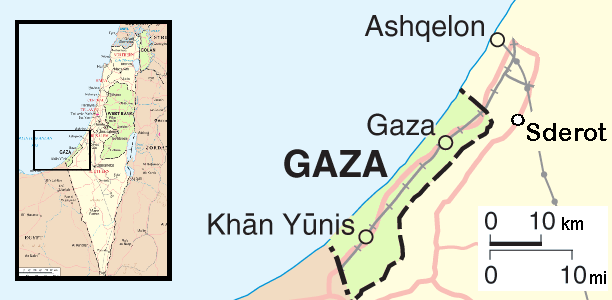
Steven Erlanger's story on the front page of today's New York Times (print edition) is, to my knowledge, the first time that the plight of the southern town's residents has made it there. The qassam attacks from Gaza began before the withdrawal of August 2005, but they have intensified greatly since. Erlanger's piece, accompanied by photographs of children peering at the destruction caused by the rockets, gives voice to the parents, sons, and daughters of the town, whose suffering has received relatively little attention until now.
There are some who try to relativize the qassam attacks, by pointing to the primitive construction of the rockets, their inaccuracy, and the low number of deaths that they have caused so far. They inevitably follow up with a comparison of the qassam to the F-15, with its deadly strikes on Gaza. This kind of comparison provides the relativizers with poetic justification, just like the image of rock throwers confronting tanks (in reality, they are more likely to face soldiers). We are entreated to view the struggle as one of heroic resistance fighters with limited resources confronting an awesome machine marshaling infinitely stronger state and military power. Or better yet, we are told that the rocket attacks resist "the occupation."
Such comparisons obscure the particularity of the terror that Sderot's residents experience every day. It is easy to remark, upon reading about one of Erlanger's teenage protagonists Razi, who "has seen 15 therapists" since seeing a rocket explode in front of his eyes, that Razi, unlike the children of Gaza at least has a therapist. This is a cynical and cruel game. The suffering experienced by Razi and all of Sderot's residents is not just and it is not unavoidable. It is the outcome of a deliberate strategy to terrorize civilians, which should be condemned as loudly as Israeli air strikes which kill innocent Palestinians.
The qassam attacks are all too often depicted as pin-point blows against the "powerful" by those sanctified as essential "victims." The reality of course is that they are aimed at one of Israel's poorest and most defenseless populations.
In this post, I have deliberately avoided the "causes" of the qassam problem and any discussion of its solution. I do not know whether the qassam attacks are being used for tactical or strategic purposes. These are issues I hope to address soon.
Monday, January 07, 2008
An American in Tel Aviv
 Will Bynum playing for the Golden State Warriors (Photo:nba.com).
I'm often struck by how hostile clubs and bars are -- an atmosphere I'm less and less comfortable in. This may sound banal, but I, for one, am continually astonished. So was this incident just good old-fashioned drinkin' and fightin' à la Americaine? I'm not sure. I would love to have been a fly on the wall. What was the dynamic here? A Boston Celtics fan blog ludicrously misread this as "Zionist" vs. Other. Some, understandably in light of a spate of recent attacks on pro athletes, see this as further evidence that heckling now involves bodily harm. And the American media hasn't picked up on the fact that, the Hebrew Israelites are, well, basically American, with an African-American pedigree that goes back to the inner circle of Marcus Garvey. Or maybe I'm making precisely the same mistake of mislabeling that Bynum and Vonteego made. Either way, the story should have been material for a perversely imaginative American writer like Ralph Ellison or Chester Himes.
Thursday, December 13, 2007
The Iranian Nuclear Program

The snippet of the National Intelligence Estimate (NIE) released on December 3 was a blow to those supporting tighter sanctions against Iran. The report, based on data from sixteen American agencies as well as shared information from the larger intelligence community - most significantly from the United Kingdom, but also from France, Italy, and even Israel (see Melman's piece in Ha'aretz) - argued that "in fall 2003, Tehran halted its nuclear weapons program." For many of those who opposed stricter measures against Iran (Russia and China) and those luke-warm about more meaningful steps (Germany), the report was welcome ammunition in the international war of words. A number of analysts declared that this American own-goal had wiped the military option off the table.
On the other hand, British intelligence sources disputed the veracity of the report, attributing the conclusions to the U.S. intelligence agents' misinterpretation of Iranian decoy conversations. Meanwhile, Israeli officials, most notably Defense Minister Ehud Barak, have vehemently criticized the American conclusions. Some American as well as Israeli commentators have raised the specter of a U.S. betrayal of its ally.
Of course, any hardline posturing by Barak should be evaluated with an eye to the domestic political front. The Labor Party defense minister in Olmert's government is trying as much as possible to profit from opportunities that the Iranian crisis as well as the ongoing qassam fire from Gaza provide him as he distinguishes his security record from that of Kadima and the Prime Minister. Nevertheless, no one is playing around merely to gain approval ratings. Israel is right to challenge the NIE and the interpretations of it advanced by those who have long been intent on throwing sticks in the spokes of the sanctions-wheel.
Iran did not stop its work out of humanitarian convictions about the evils of nuclear weapons. The regime fears both a preemptive military attack and international isolation. But it also knows the rewards that it would gain from reaching nuclear status. The Iranians, are thus going to do everything possible to continue covert work that would enable them to produce a nuclear weapon within a short period of time, even with a frozen nuclear program. As the NIE acknowledges, Iran is "keeping open the option to develop nuclear weapons (NIE, p. 9)."
Unfortunately, the NIE undermines the very mechanisms that led to increased international pressure against the Iranian regime. Without the credible threat of an American military option, the incentives for such states as Russia, China, or even Germany to support tougher sanctions against Iran decline dramatically. Where there were once two sticks - sanctions and a military strike - only one of these remains today. If the world refuses to see a nuclear Iran as a problem, Israel has no choice but to devote all its resources to developing a credible answer to the challenge.
It does not matter whether or not Iran is a "rational" actor. Iran's rise to the nuclear powers' club would be disastrous for American as well as Israeli interests in the region. This is not a moral argument about who deserves to have nuclear weapons but a simple statement of the geopolitics involved. There are some who think that the Middle East will be a better place with the Islamic Republic projecting hard power in the Gulf and in the Levant. Others appear to be longing for a day when the U.S. is no longer able to secure the world's most important oil shipping lanes without the cooperation of other powers. They will regret this when it is too late.
I have to agree with Rosner that this report should never have been published. It may very well have taken the winds out of the diplomatic struggle against Iran's drive for nuclear weapons.
Monday, November 26, 2007
Will Annapolis Surprise Us All?

When making predictions about developments in the Middle East, I have learned to follow a simple formula over the past half-decade: imagine the worst and multiply that by two. At first glance, there seems little reason to deviate from that rule when thinking about what the Annapolis Summit, which begins on Tuesday, November 27, will bestow upon us. But pessimism is easy, so let us look deeper and find at least a few positive indicators. Annapolis may yet surprise us all.
The Americans - President Bush and Secretary of State Rice - desperately need a victory. They will be pushing down hard on the Israelis to make symbolic concessions, and to give the Arab states and Fatah something to write home about. Israeli Prime Minister Olmert, for his part, seems to have prepared the ground for some bigger concession. So far, he has faced relatively little opposition. Despite a few whispering campaigns and speeches, the far right has not been able to mobilize its mass base to preempt Olmert.
One of the bigger concessions that Olmert could offer may not be related to the Palestinians at all. Rather, it may involve some overture on the Syrian side of things. There is no doubt that Syria's participation at the summit is highly significant. It may yet prove disastrous, but the potential exists for a big move forward.
Meanwhile, the Saudis' main concern, whatever their rhetoric, these days is Iran. Together with Egypt and Jordan, they will seek to reverse the Iranians' impressive muscle-flexing in the Gulf region as well as in the Levant. They have no choice but to turn the summit into something that can be exchanged on the market of Sunni public opinion.
The Palestinians, i.e., Abbas, Fayad, and the Fatah gang, can least afford to fail. They need to use the summit as an opportunity to gain solid commitments to Fatah rule in the West Bank. This will be more important to them than adherence to settlement freezes - as important as these are to the long-term viability of a Palestinian state.
Of course, Annapolis will not end the qassam strikes from Gaza on Sderot. Nor will it stop the IDF incursions into and roadblocks in the West Bank. However, the summit may very well initiate a major shift in the US's public commitments to the creation of a Palestinian state. We may witness something similar to President Bush's historic June 24, 2002 speech, but this time with a pro-Abbas tilt.
Friday, November 16, 2007
The Benevolent Empire Strikes Back

What makes an empire great? What makes it really great – more durable and expansive than its rivals? What makes an empire a “hyper power,” the center of things in a unipolar world? Yale law professor Amy Chua wanted to know, and so she studied world history’s “hyper powers.” The label owes its origin to a Frenchman, who in 1999 uttered it in an anti-imperial – or at least, anti-American, tirade. But in Chua’s new book, Day of Empire, it’s drained of any prejudice. Her definition, which to me, sitting in on her lecture today on the campus of UC Berkeley, seemed a bit loose, focuses on scale – these empires aren’t on the Aztec scale, but on the Roman, Persian, or Mongol – and, on economic and military preeminence. She argues that radical tolerance or pluralism is the foundation upon which any hyper power stands, bearing in mind that what was progressive in early modern Holland won’t pass muster with liberals today.
From her public comments, and from what one can read in this LA Times review, Chua’s attempt to analyze ancient and modern empires comprehensively, while admirable and ambitious, appears to miss the mark. I asked her whether her notion of “strategic tolerance” could indeed be applied equally well to a decentralized ancient empire, which bows to local custom and rule as a matter of practicality – say, the Achaemenid Persians in a place like Upper Egypt – as to a modern empire, like the American, which might, in the interest of gaining a competitive advantage over the Chinese, selectively offer visas to highly skilled foreign nationals to keep them from setting up shop in Hong Kong. She answered that colleagues had warned her of the brutality of pedants and specialists, had charged that she wouldn’t be comparing apples and oranges, but apples and nuclear power plants, and still, alas, she had carried on, secure in the notion that “tolerance” is a flexible yet coherent concept, the “glue” of each of these societies, and, ultimately, what for us should paste them all together. I’m jealous. Would that I were a lawyer and not an ancient historian.
Defunct are the empires of the past; a simple fact, perhaps a justification for shallow study, but also the source of an unmistakable fear of the future that animated Chua’s talk and spread to the crowd. In the western tradition, one finds the idea that empires rise and fall cyclically as far back as Herodotus. Chua faces off with a more difficult problem, encountered by a later Greek historian, Polybius, who took for granted that empires rise and fall, but somehow sensed that Rome was different, that the empire under which he lived was both born of time’s perennial cycle and transcended it. Chua wanted today to look to the future, and in her lawyerly way, to imply that the United States can escape the fate of past empires that failed to negotiate between the extremes of excessive tolerance, whereby internal cohesion suffers, and the backlash of intolerance that, she argues, often seems to follow an externally produced catastrophe on the scale of 9/11.
Chua is a Chinese-American, the daughter of a Berkeley computer science professor. And so it seemed fitting that her comments looked forward to an American clash with China, and also seemed to juxtapose the absorption of Asian immigrants here on the Pacific Rim in California with a failed approach to immigration and integration for Hispanics here and across the country. She tempered optimism on China by pointing to Chinese ethnic chauvinism. But she also fastened upon Jews, repeatedly, as the quintessential beneficiary of imperial tolerance, arguing that hyper powers that took in Jews invariably profited big time. I couldn’t help but wonder if she was driving at the conclusion that what some have called market-oriented ethnic minorities are better positioned than others to profit from the tolerance of hyper powers, and, in turn, fuel the growth of their hosts. In fact, in response to my question, Chua almost seemed to bemoan the ideological restraints that prevent modern, liberal, democratic empires from more effectively cherry picking the kinds of immigrants they desire.
The Middle East had to fit in somewhere. Chua elicited chuckles by pointing out that Coca-Cola and American blockbusters won’t turn a Palestinian into an American – or a pro-American; or that the US isn’t about to draw an army of civil servants from the Iraqi population, à la the British in India. Her more serious point, and, I think, one of the major arguments of her book, is that the US had better not impose its values and culture on Middle Eastern nations. That wouldn’t be tolerant. Instead, it would spell the beginning of the end of America’s reign as hyper power. Given that she very much left open the question of whether or not American hegemony, or even hyper power per se, is a good thing, I couldn’t help feeling that she wanted to have her cake and eat it too. Tolerance and pluralism, no doubt, are by Chua’s reckoning, good things. And the powers that practice them, get rewarded. (Here, Stanford’s Josiah Ober, the preeminent historian and theorist of classical Athenian democracy, would wholeheartedly agree). Then why, one wonders, shouldn’t the West be intolerant about intolerance in the Middle East? To protect our competitive advantage? In other words, is hyper power a zero-sum game; we keep tolerance and pluralism to ourselves and thereby retain our dominance? If instead, tolerance is a universal good, an engine of economic growth, the fons et origo of happiness, why shouldn’t we be pushing with Thomas Friedman for the pope to visit Saudi Arabia? Liberal values may prove just as much a casualty of the neocon putsch as the tragic loss of human life in Iraq.
Saturday, November 10, 2007
Delayed Reaction

Blogging about a Mearsheimer and Walt lecture a couple of weeks after the fact is a little odd, I know. The atmosphere surrounding this controversial and vaguely filial scholarly pairing usually elicits rapid fire rejoinders (think Alan Dershowitz on the Kennedy School website), easy labels, and point-by-point refutations. In my case, I’ve delayed posting my reaction to the talk Amos and I took in recently at Boalt Hall, Berkeley’s law school, not only because I’m busy, but because I’m rather uncomfortable with the blitz-style polemics one hears from some of M&W’s opponents.
Emotion, not dispassionate, scholarly curiosity, sells these professors’ book -- and prolongs their fifteen minutes of fame. And, frankly, I didn’t walk out of their talk very emotional. (Though the cry of, “Don’t taze me,” from an unruly audience member who was escorted out by the police, and the dark epiphany of a committed Darwinist during Q&A insured that I wasn’t unfazed). Much of what was said was reasonable, and, when young Walt spoke, well reasoned. That the pro-Israel lobby in Washington is a singularly efficacious interest group, with an enormous budget, and access to the inner circles of the Bush administration, isn’t something worth debating. These are the people who were eating at now disgraced – once wildly successful – lobbyist Jack Abramoff’s D.C. restaurant, and, sometimes, from his trough. As a case study in the sociology of the Beltway, The Israel Lobby, will probably read well. Then again, Mearsheimer did accuse the “Lobby” of driving former Rhode Island Senator Lincoln Chafee from office. As Walter Russell Mead points out in an excellent review of the book in Foreign Affairs, these guys tend to display a surprisingly naïve view of the American political system. Chafee was a moderate Republican from the northeast in the age of Karl Rove and Tom Delay, the men who've polarized politics. The evaporating congressional Center pushed him out, not the machinations of pro-Israel hawks!
That particular accusation is one that sexes up, even if it doesn’t strengthen M&W’s message. Moreover, it’s symptomatic of a larger attempt at inflating their story. They’re on much shakier ground as they move from their description and analysis of the “Israel Lobby,” broadly construed, to greater claims about the history of US foreign policy and contemporary international relations – this despite the fact that the two are eminently qualified to discuss those matters. One of their weakest claims has always been that the Israel Lobby got us (Americans) into Iraq. From what I understand, this is a claim that was toned down considerably along the way from article to book, but I still left their lecture utterly confused. The state of Israel and the Lobby – notice the conflation – were “two of the main driving forces” behind the war, they told the crowd in Berkeley. Their evidence? The Israeli population was gung-ho, with polls bearing out their support for the invasion. And the Lobby? Well, they brag – a lot. M&W place an inordinate weight on the boasts of AIPAC, et al., who claim to have had the ear of key neocons in Bush’s inner circle, (this being a major criticism of Mead).
Thankfully, in my opinion, the whims of the Israeli populace, in search of their psychological reprieve, and the puffed-up ambitions of a few Washington lobbyists aren’t enough to produce the greatest foreign policy disaster in American history. This country is having a hell of a time facing up to the debacle of Iraq. With so many culpable, it’s shocking how few are owning up. Those responsible are not just those who cheered on, nor only those who gave the Administration a pass out of political cowardice, but all those who lay down because they thought it would be easy. The most disheartening thing about M&W’s book is that it offers all these people amnesty, the comfort of a villain with real agency. AIPAC took us to war, not the Hillary Clinton’s of the world or the average American. We didn’t do it! Cindy Sheehan’s cry of, “My son died in Iraq for Israel” gets an academic imprimatur.
Finally, and here I’m indebted to a real political scientist, Asaf, M&W came off a bit disingenuous in their claim to be undermining with this book years of work that advanced “realist” theories of international relations. For Mearsheimer, this was something of a punch line: our book discredits us! In a way, the profs provide here an answer to the question, “Why this issue?” They didn’t take it on out of malice. They have no axe to grind. The absurdity of the matter is self-evident. According to realist orthodoxy, as I understand it, states operate rationally, and the United States, in the case of its relationship with Israel, has long been acting like an entirely irrational player in the world system. I don’t think M&W risk losing many realist diehards with this book. On the contrary, this is what Greek rhetoricians called auxesis – amplification. In a world of rational relationships this irrational alliance has no place. The most important challenge of M&W’s serious critics thus won’t be stubbornly making “the case for Israel,” but making anew the case American-Israeli cooperation in a brave, scary new world.
Thursday, October 25, 2007
Mearsheimer and Walt at Berkeley

What follows is my paraphrase transcript of today's Berkeley Teach-Ins Against the War (BTIAW) discussion featuring Stephen Walt and John Mearsheimer on their recently published book, The Israel Lobby (Farrar, Straus and Giroux, September 2007). I do not have time here to offer an analysis, which I hope will emerge from discussion of the event in future posts. As some of our veteran readers will recall, some of the earliest posts on this blog concerned the original article on the "Israel Lobby" published by Mearsheimer and Walt in 2006. That study, in my opinion, was riddled with small mistakes and careless assertions. The Walt and Mearsheimer that I saw in Berkeley earlier today - especially the Walt - were far more polished and careful than this original study. Walt in particular struck me as very persuasive and as an excellent teacher. Overall, I was very impressed by the level and civility of the discussion. Unlike the previous BTIAW that I attended, this was, for the most part, a model of what our universities should be about.
Needless to say, I continue to have serious disagreements with the claims advanced by Walt and Mearsheimer respectively, although there is also much in this latest version of their thinking that seems indisputable. Briefly, I found least convincing the arguments for
- a causative link between "the Lobby's" aims and the Iraq war (as Noah K. pointed out, the extent of the connection they postulate is always qualified; M&W spoke of "marked influence," for example)
- a STRONG connection between American foreign policy toward Israel and the 9/11 attacks (as Asaf pointed out, perhaps speaking about other aspects of their talk, M&W seemed to conflate US policy toward Israel with US policy toward the entire Middle East; I believe that it is the latter, far more than the former, which served as a motivating factor for al-Qaeda). Dan over at The Green Line has previously blogged on this.
In reading through this transcript, I think it is worth paying attention to the differences that exist between Walt and Mearsheimer - in substance and form. Mearsheimer was definitely less guarded than Walt. Nevertheless, both were clearly unwilling to endorse the positions articulated by George Bisharat, the discussant, as well as in the question and answer period.
Stephen Walt
Two main questions
1. Is there a powerful, pro-Israel lobby in the US? How does it work?
2. Is its influence positive or negative for US, and positive or negative for Israel?
The Taboo
I want to acknowledge how difficult it is to raise this subject in the U.S. If we were talking about energy or gun control or Indian-American nuclear agreement, it wouldn’t be controversial to talk about oil lobbies, NRA, various Indian-American groups.
Reasons for the Taboo
But with Middle East, when you talk about Israel lobby groups you are grabbing the third rail. This is in part because of the historical experience of the Jewish people – a history which includes the Protocols of the Elders of Zion, and accusations of undue influence. It is a history that has to be respected and which requires us to be cautious..
Rejection of Antisemitic Conspiracy Theories
Some may think that we’re saying there’s some kind of secret conspiracy to control American policy, the military, or economy. We reject these antisemitic conspiracy theories. The Israel Lobby is an interest group like lots of other ones. Most of its activities are entirely appropriate. We don’t question Israel’s legitimacy. We believe the US should come to Israel’s aid if its survival were ever in jeopardy. But we ought to be able to talk about the influence of the Israel Lobby in the same way as we might talk about any other groups.
Usual Rationales for US Support for Israel
Rabin: US support for Israel beyond compare in modern history – largest recipient of military aid. Israel’s GDP/capita is 29th in world. Israel builds settlements. US gives consistent backing to Israel in the UN. Almost always take its side in regional conflicts. Israel is rarely if ever criticized by officials nor anyone who aspires to high office .
The usual rationale given for this support is that Israel is democracy and a strategic asset. Israel may have been a strategic asset during the Cold War; but is it today? Giving Israel unconditional support is one of reasons we have a terrorism problem and makes it harder to address many problems in Middle East. Problems wouldn’t disappear if we had normal relationship. US gets some benefits. But it’s hard to argue that giving Israel so much and unconditional help is making Americans safer. It’s a strategic liability.
True, Israel is a vibrant democracy – but there are many other democratic countries. Further, Israel’s treatments of own Arab citizens and Palestinian subjects is sharply at odds with democratic values. Israel’s behavior no better than that of the Palestinians. Neither side owns moral high ground. Israel hasn’t acted substantially better than other countries. Its behavior isn’t exemplary to justify special treatment.
We think there’s a strong moral case for Israel’s existence, based on the history of antisemitism. But today, Israel’s existence is not in jeopardy.
The Lobby is Behind Israel's Privileged Position
What explains Israel’s privileged position? In our view, the Israel Lobby. Organizations such as AIPAC, ADL, Christians United for Israel, Conference of Presidents of Major Jewish Organizations, Washington Institute for Near East Policy; Weekly Standard and New Republic. Most special interest groups in US have a number of different components. Environmental movement = research organizations, local chapters, academics, journalists. It’s not a centralized organization. Not everyone agrees. It’s not a cabal or conspiracy that controls US foreign policy. Rather, powerful interest group whose actions are as American as apple-pie.
The lobby is not synonymous with Jewish Americans. Between one quarter to one third don’t care about Israel; some of the organizations aren’t Jewish. Lobby is defined by political positions it favors. We include only those who are actively working to influence US policy.
Small interest groups can sometimes wield strong influence – narrow topic that doesn’t interest so many people. Lobby works in Beltway – giving politicians clear incentives to embrace its positions. AIPAC works 24/7 to convince politicians to follow their views. Annual budget is $50 million – drafting legislation, publishing talking points. Very energetic grassroots base. It doesn’t give money directly to candidates, but it does help steer contributions from individuals. Pro-Israel political action committees gave $55 million to politicians from 1992-2006. Have driven some people from office. Lobby doesn’t control every election, but every Congressman and presidential candidate knows that they’re playing with fire if you question support for Israel.
The second strategy is try to shape public discourse on Middle East and Israel so that the country is viewed very favorable by mainstream Americans. US coverage is very pro-Israel – cf. Europe and Israel. No one like Robert Fisk and Patrick Seale, Akiva Elder, Gideon Levi, Amira Hass. It’s not the former are always right – the point is that critical voices like theirs are almost completely absent from US media. Even so, watchdog groups such as ADL and Camera mount boycotts, Campus Watch monitors universities. When Jimmy Carter published his book, ADL and Camera took out ads with publisher’s phone number. Pressure on CNN advertisers.
Efforts to stifle critical commentary often includes smearing critics by calling them antisemitic. Marty Peretz: Carter will go down in history as a Jew-hater. Distracts people from main issue – American policy. Deters people from criticizing the Lobby. Marginalizes people in the public arena.
It’s obvious to virtually everyone that America’s Middle East policy has gone off the rails but we don’t debate. It’s often argued that US policy is due to broad support for Israel. This is not persuasive. Americans in part do have a favorable image of Israel; but they don’t think US should give Israel one-sided and unconditional support. Recent survey: 70%+ Americans: be balanced. 87% of Jewish Americans want a two-state solution. Gap between what people want and American policy is due to influence of lobby.
Mearsheimer
The Negative Influence of the Lobby on American and Israeli Policy Its influence has been largely negative. The Lobby, working with Israel itself, has pushed Israel’s Middle East policy that are not in US’s interest and not in Israel’s. US support for Israel’s policies in occupied territories has helped fuel terrorism against US; role of Lobby in run-up to Iraq war; US policy toward Iran, Syria, and during Lebanon War of 2006 (will not talk about last 3 in this presentation).
Hatred for US is due to Support for Israel
Conventional wisdom among Israel’s supporters: treatment of Palestinians has little to do with US’s terrorism problem and why US is so hated. In fact, Israel = valuable ally. This is wrong. Survey data shows that US support for Israel’s brutal treatment of Palestinians and to colonize these territories angers huge numbers of people in the Arab and Muslim worlds. Citizens in these countries are genuinely distressed at plight of Palestinians and perceived role of US. I’m not saying this is only cause of our terrorism problem but a major cause: motivates some individuals to attack the US. It serves as powerful recruitment tool for terrorist organizations. Since LBJ every president has opposed building of settlements.
Critically important issue when talking about America’s terrorism problem: 9/11’s relation to brutal treatment of Palestinians. It’s common-place to hear people say that Bin Laden didn’t care much about Palestinians until recently; events had nothing to do with Israel; those involved in attack hated us because of who were not our Middle East policy. It is clear from the historical record that Bin Laden has been deeply concerned about plight of Palestinians since he was a young man; reflected in public statements throughout 1990s. Max Rodenbeck, in Economist review of 2 books about Bin Laden: of all the themes the notion of payback for injustices suffered by Palestinians is perhaps most powerfully recurrent in speeches. Major motivating factor of attacks: support for Israel. Bin Laden wanted bombers to attack Congress specifically; move up date in response to events in Israel. Principal architect of attacks, Khalid Sheikh Mohammed: animus stems from violent disagreement with US foreign policy favoring Israel (9/11 Commission Report). Hard to imagine more compelling evidence for role that US support for Israel played in inspiring attacks. Present relationship between Israel & US is provoking terrorism problem.
Israel and the Lobby were Main Driving Forces Behind Decision to Invade Iraq
Iraq War = one of greatest blunders in American history. Israel and Lobby were two of the main driving forces behind decision to invade Iraq. Hard to imagine that war happening in their absence. Israel was only country where both government and majority of population favored the war. Israeli government pushed Bush administration hard to make sure it didn’t lose its nerve in months before invasion. Barak and Netanyahu also implored US to take down Saddam Hussein. Israel was pushing so hard for war that its allies in US warned them to damp down rhetoric lest it be seen as war for Israel. President Clinton said in 2006: every Israeli politician I knew thought that Saddam was so great a threat that he should be removed even if Iraq didn’t have WMD. 77% of Israelis said they wanted US to attack Iran in month before war.
There is no question that in early 2002 when Israelis first got wind of Bush administration’s thoughts to attack Iraq that key officials went to Washington to make it clear that IRAN was greater enemy. Important to emphasize, however, that Israel wasn’t opposed to US toppling regimes in Iraq or Syria. Israel simply wanted US to deal with Iran first. But once Israelis realized that war party intended to deal with Iran after finishing job in Iraq, it enthusiastically embraced idea of invading Iraq. Israelis put significant pressure on Bush administration to choose war over diplomacy, while reminding US to deal with Iran after. No evidence that Israel warned US that Iraq would be a quagmire; they thought it would be a cake-walk.
Now that war has gone south, common-place to hear Israel’s supporters say that main organizations in Lobby didn’t push for war. May 2004 editorial in The Forward. As President Bush attempted to sell war in Iraq, America’s important Jewish organizations rallied to his defense – community leaders stressed need to rid world of Saddam and his WMD. Concern for Israel rightly factored in.
Hard evidence that AIPAC lobbied for the war. Its executive director, Howard Kohr, told NY Sun in January 2003: one of AIPAC’s successes for past year = quietly lobbying Congress to approve use of force in Iraq. Neo-cons were main driving force behind war. They initiated idea of toppling Saddam by force; especially after 9/11, they pushed relentlessly for war against Iraq. No other group or institution in US was as seriously committed to invading Iraq. Even after 9/11, there was significant opposition in State Department, uniformed military. Neo-cons are deeply committed to Israel; many are connected to key organizations in the Lobby. Our argument is not that the neo-cons or the leaders of the principal Lobby organizations were pushing a war that was in Israel’s national interest. On contrary, they believed that invading Iraq was in both the American and Israeli national interest. For them, what is good for Israel is good for the US. It was the events of 9/11 that created circumstances to help them convince that invading Iraq was smart idea.
Without Bush or Cheney onboard, there wouldn’t have been a war. If Al Gore had been elected, there would not have been a war. The neo-cons were necessary to have the war but by themselves couldn’t have made the war happen.
We’re sometimes accused of making argument that Iraq war = Jewish war. Polls taken before the war show that American Jews were 10% less supportive of war than general American public. War was due in large part to Israel Lobby, especially the neo-cons within it; not the American Jewish community. Lobby is defined by its political agenda.
What Should the US-Israel Relationship Look Like?
What we think US-Israel relationship should look like. US should treat Israel as a normal country; how it treats other democracies around the world – England, France, Italy, and India. When Israel is acting in ways consistent with American interest, Washington should back the state. When it harms US interests, America should get Israel to change its behavior. US should act as honest broker in Israeli-Palestinian conflict. US should make it clear to Israel that it must abandon occupied territories. Jerusalem should be told that US will oppose Israel’s colonial expansion in the West Bank. US should defend Israel’s right to exist within its pre-1967 borders with some minor modifications. Most importantly, if Israel’s survival is threatened, US should come to its aid.
George Bisharat
Some Adulation and Non SequitursIt is an important book because it is about a pivotal, consequential conflict that has emanations and consequences that affect us here within the US. Relationship between the conflict and the war in Iraq. If you think about the domestic dimensions of the so-called “War on Terror” – price of diminished civil liberties – this is another consequence of this conflict that affects each and every one of us in this country. It’s a book about an issue that’s very poorly understood. Lack of understanding is produced, manufactured, maintained – not by control but by substantial influence – over media, public discourse in universities and variety of other places.
Most importantly, the professor have broken a taboo and opened debate on this critical issue. From personal experience, the reality is that people who attempt to speak out on this issue face substantial forms of dissuasion – shall we say. What you have done, professors, was an act of intellectual courage that few people in the American academic community have shown.
No Shout-Out to People who Celebrate Hanukah (or Kwanzaa - NK)
I urge you all to buy the book, give it to your family and friends for Christmas.
Critique of Pivotal Assumptions about Israel's Right to Exist
Some questions: the professors repeatedly state throughout book that history of Christian European antisemitism provides a strong moral basis for Israel’s founding and continued existence. At same time, they argue that Israel’s establishment necessarily entailed crimes (term they use) against the Palestinians, including expulsion of approximately 750,000 Palestinians in 1948, seizure of homes. They also show in some detail that maintaining Israel’s character as a Jewish state requires continuing denial of Palestinian refugees to return to their homes. It also entails de jure and de facto discrimination against the Palesitnian citizens of Israel today. They speak of 1992 Basic Law of Human Dignity and Freedom – the professors point out that it does not contain an equality principle (14th Amendment); such a clause was specifically excluded. Laws that prevent Palestinian Israeli citizens from transferring citizenship to non-citizens whom they marry. How can there be moral justification? Is it appropriate for US to condition aid to Israel on its passage of an equal rights amendment – if not, why not?
Questions by Bisharat
At a number of points in the book, the professors state that it’s not antisemitic to criticize Israeli policies. It’s not clear whether you believe it’s antisemitic to criticize founding principles of the Israeli state, including the ones that dedicate it to being a state to one people and not of all of its citizens. Is there anything antisemitic about criticizing Zionism, establishing a state based on exclusivist ethnic criteria?
You state that Israeli Lobby acts in ways counter to Israel’s interest. Raises question about relationship between Israeli government and Lobby? Is the Lobby running amok? Or is the Israeli government acting in ways that run counter to long-term interests of its citizens?
I read with great interest section of the book that deals with prescriptions of how to make things better. You clearly state support for a two-state solution to problem. Book claims that other alternatives are undesirable.
How to deal with Lobby? They evaluate weakening it through financing regulations. Look at possibility that Lobby might be countered – they directly note that neither Arab nor Muslim-American community are likely to pose a significant challenge to Lobby. Possibility of transforming the Lobby, making it less maximalist and hardline – they rate it as plausible. The real hope they offer is in opening up public discourse and education. Silent majority is out there, amenable to what they say. But I worry because the Lobby is working overtime; professors were disinvited from prominent forum in Mearsheimer’s hometown. Program of colonization on the ground in Israel is not stopping either.
One of the alternatives they’ve offered to two-state solution: development of apartheid-like solution. Will political power ever be marshaled here or in Israel to stop this colonizing juggernaut? Is there not a point at which we have to admit that repartition of Palestine has become impossible. There is one effective sovereign as we speak; question will be about political principles on which that system should operate. Will it be a system based on equal rights and fundamental human dignity of both peoples.
Questions and Answers
Responses to Bisharat
Mearsheimer
We think that fact there’s a Jewish state is a good thing given history of antisemitism and our understanding of how the world works. Here in the US, we have a melting pot society. This is not a Christian or Anglo-Saxon state. It’s a liberal state. There is no one ethnic or religious group that dominates; it’s a melting pot. I don’t like idea of living in state dominated by one culture. But around world, there are lots of states where people identify themselves largely in terms of culture – Japan: most people consider themselves to be Japanese. Same is true with Israel – it’s a Jewish state; same true for Germany. It’s not the way I like to do business; but it’s perfectly legitimate way to do it in international system today. I believe in national self-determination. Zionism is a form of nationalism and perfectly legitimate one. There is nothing wrong with having a Jewish state. We are arguing that Palestinians are also entitled to have a state of their own. If there’s national self-determination for the Jews, it should also exist for the Palestinians. Principal obstacle to establishing Palesitnian state at this time is Israel. Israel is interested in colonizing the West Bank and giving the Palestinians nothing more than a few enclaves, keeping them disconnected, controlling borders, air and water. As long as that’s the case, Palestinians wont’ have viable state. Same logic that leads us to support Jewish state leads us to support Palestinians State.
Walt
Relationship between Israeli government and Lobby. Impact of Lobby has been unintentionally quite harmful to Israel. There’s nothing unique about that. Governments and special interest groups do stupid things; every government does things contrary to its own interest. 3 examples: many Israelis today would argue that entire settlement project was a “strategic and moral disaster of tragic proportions” (Wieseltier). Immensely costly.
Iraq was a blunder not just for US but also for Israel. It created a failed state in Israel’s neighborhood. Strengthened Iran’s position. Bush didn’t think it was a blunder to go into Iraq; neither did the Israelis. War in Lebanon in 2006 – Hizbullah was a problem, Israel had right to respond; but strategy that Israel adopted by trying to eliminate it from the air, trying to punish from the air – it was boneheaded. Not good for Israel. Aided and abetted by Israel Lobby here.
Some of Israel’s most ardent supporters in US have done it great harm.
Where do we go from here? Look down road where this is all leading. You can imagine expelling all the Palestinians. If you’re of ethnic cleansing, please raise your hands. You can have a binational democracy [strong applause, Walt says: I don’t agree with this] – if you favor that, you don’t favor having a Jewish state. Or you can have apartheid. That has many negative consequences for the Jewish state. Do you want that? If you’re pro-Israel, you should get behind a two-state solution with as much force as you can.
Mearsheimer interjects:
there is significant opposition in Israel to giving Palestinians a state. Most Israelis don’t have a viable state in mind. Very little support in Israel for the Clinton parameters. That means that US has to lean heavily on Israel. All this is heading for apartheid state, if this doesn’t happen. That’s why so much uproar over Jimmy Carter book.
Questions from the Floor - First Round
1. Ideology. Is it worthwhile to pursue notion that Zionism has an effect within substantial part of American Jewish population similar to effect that Stalinism had on Communists?
2. Statistical extrapolations that Arab population will outnumber Jewish one in Israel.
3. How will change in US foreign policy be sparked?
Mearsheimer
1. I think there is hardly any similarity between the two. Zionism is nationalism: Jews should have state of their own. Got started in Europe in late 19th when nationalism was a very powerful force. There’s nothing unusual about it. It was good old-fashioned European nationalism. Just happened to be that group pushing it was Jewish. Stalinism is an ideology associated with one man and his murderous policies; it has nothing to do with nationalism. Russian and Ukrainian nationalism is roughly equivalent to Zionism. With regard to Zionism’s role in US – there’s large body of literature is that religious part of Judaism no longer very attractive to them; large portions of American Jewish community see Israel as central part of Jewish identity. That’s due in large part to fact that religion isn’t a strong glue anymore. It’s not surprising that inside American Jewish population today there’s substantial support for Israel. Public opinion polls on American Jewish community, 35 or younger, much less identification with Israel.
Walt
2. Changing demographic balance? Israelis are well-aware of this. Explains why Sharon eventually woke up to fact that creating situation that wasn’t sustainable in long term. There’s also shifting demographic balance within Israel.
3. We are under no illusions that Lobby can be turned around instantly. Some cause for optimism: the costs of such a one-sided policy are becoming obvious. Our screwed-up relation with Middle East, our problems, are making people think – of course Israel and Lobby aren’t only source of this. Two: it’s hard to see how policy changes once you change the conversation, shift the discourse. This is why groups in the Lobby have been so energetic in trying to squelch conversation about elephant in the room. Case for unconditional support for Israel is incredibly weak.
Questions from Floor - Second Round
4. Egypt doesn’t have much of Lobby at all. Why are they second in aid?
5. Book explains political and financial aspects. Speaking as Darwinist: isn't this a war between superstitious primitives?
6. Itamar Haritan asked an excellent question which I couldn't get down verbatim - if you are reading this, please correct this very inadequate (and possibly wrong) paraphrase. Itamar asked whether American foreign policy in East Asia, Southeast Asia, and Latin America during the Cold War could also be explained with reference to the activities of "the Lobby." He wondered whether it might not be more accurate to see US foreign policy in the Middle East today as related to the structures of American imperialism, including such factors as the power of the military industrial complex.
Addendum: This is from Itamar - an elaboration of what he asked at the lecture:Many people in this room share your concern about US imperialism and would like to understand it so as to end it. Frequently in our social science classes we draw parallels between US behavior during the Cold War and US behavior today, drawing the conclusion that despite differences between the War on Terror and the War on Communism, the two serve the same purpose of mobilizing America for war, masking its economic interests abroad, and serving the Other through which politicians scare the American people to support their policies. Doesn't your analysis contradict comparisons to previous analyses of American imperialism by saying that this latest wave of aggression is explainable, in large part, by a group of organizations? What of the comparisons that many people see between the US-Israel relationship and US policies toward client states, and between its invasions of Vietnam, Korea, etc. as compared with Iraq? What about the military industrial complex?
Mearsheimer
4. It’s true that Egypt is #2 recipient of US foreign aid, and Jordan is #3. Why are they #2 and #3? After Egypt signed peace treaty with Israel in late 1970s, we greatly increased our aid. Bribe money. Money designed to keep Egypt and Israel on a peaceful footing. Jordan’s aid also shot up after signing peace agreement with Israel. Keep Hashemites in power in Jordan and to make sure that there are good relations with Israel and Jordan over long term. Israel would have had a peace deal with Syria if it had not walked out of it in 2000. Saudis have been pushing peace inititive since 2002.
6. History of American imperialism and how America acted in Cold War in Vietnam. Israel Lobby had virtually nothing to do with it. Our argument is not that US acts in benign and responsible way every place in the world and that it’s only in Middle East that it acts in foolish ways because of Israel Lobby. US has behaved like rogue elephant at different times in different places in world. Nothing to do with Israel Lobby. But if you look at Middle East policy today and you think about what forces are pushing US to pursue the policies in that region you see that Israel Lobby has had marked influence on that policy. Contrary to what one might think, the oil lobby and military-industrial complex and oil-producing states in that region have had nowhere same influence. We are both realists; we have vested interested in discovering that war in Iraq was all about geopolitics and oil because it would support our basic theories of how world works. What we’ve written is a direct contradiction of the theories we’ve spent most of our lives developing. We began to look very closely at Middle East policy and began to understand that our theories didn’t apply very well. We had to admit that domestic politics were playing a key role in shaping Middle East policy. I’m not saying Israel Lobby is principal driving force; but in Middle East last 3 decades, power of Lobby is not to be underestimated.
Walt
5. For some of the inhabitants of region, religious beliefs greatly complicate efforts to solve problems – you see this very closely with Holy Sites in Jerusalem. But I don’t believe that religious convictions determine people’s political stance on this question. You can be Jewish and pro-peace.
Questions from the Floor - Third Round
7. You compare, in your book, terrorist attacks of Zionist groups and Palestinians [...].
8. Don’t you think characterization of Zionism as “good old-fashioned nationalism” would be more accurately rephrased “good old-fashioned European colonialism”?
9. What specifically should US condition its military aid to Israel on?
Mearsheimer
7. Differences in terrorism: there’s rich literature on Zionist terrorism. It’s quite clear that the Zionists indiscriminately killed civilians and idea that they never attempted to kill them and always warned them is not borne out by historical record. The truth is there isn’t a lot of difference between what Zionists did against British and what Palestinians are doing vis-à-vis Israelis. Terrorism is weapon of the weak. They wanted to get the “occupiers” [his quotation marks] out. The Palestinians are doing the same thing. I’m not condoning terrorism here. What the Palestinians are doing today is largely the same thing as what the Zionists did.
8. Person who made that point (about colonialism) is essentially correct [applause]. If you think about situation in Palestine ca. 1900 – there were very few Jews and lots of Palestinians. There was no way that large numbers of Jews or Zionists coming out of Pale of Settlement could enter Palestine without behaving way that European powers behaved around world. It’s hard not to do that. How was US created? White men colonized North America. Same thing is true in Israel. Many American Jews find this hard to understand. You have to do terrible things to local population. Defense has to be: it was absolutely essential for the Jews to create state of their own given what was happening in Europe at that time. It’s too bad from Jews’ point of view that they didn’t have a state earlier, in 1933, because then there wouldn’t have been a Holocaust. This is one of the principal reasons that the Zionists went to the Middle East. But to create that state there is no question that they had to expel large numbers of Palestinians.
Walt
9. I’m uncomfortable conditioning aid on attaching human rights clause to constitution. I don’t think it’s our business to tell Israel that it must have a constitution or what’s in it. We should of course be pressing them to improve the status of Israeli Arabs within Israel = 2nd class citizens. Most obvious thing we should be conditioning aid on is occupation itself and settlement constructions. Money is fungible – money given as military aid can be used for other purposes. As a practical matter, any peace deal that comes about will involve a substantial amount of money from the US – to Palestinians and to Israelis. EU will also have to pay; given that Europeans had large part in creating this problem, they should pay.
Fourth Round of Questions
10. Set up an Internet-based discussion group; then crazy talk about 9/11 (commission?) lies.
11. Given that you think main players are neo-cons and evangelicals, have you thought of using a different term than "Israel Lobby"?
CORRECTION from Peggy: the questioner offered LEN ("Likudniks, Evangelicals, and neo-cons") as a substitute for "Israel Lobby."12. Some have argued that Israel wanted Iraq war in order to destabilize entire Middle East to embroil Arabs in inter-tribal warfare. What do you think about this [the questioner seemed to think that was a good explanation].
Walt
10. We actually have regular jobs [so we don't have time for your stupid internet newsgroups].
11. Why did we call it “Israel Lobby” – that is the simplest label for it since what unites all the groups in the Lobby is desire to maintain special relationship between US and Israel, keep US providing large amounts of support. There are disagreements among them on whole range of policy issues. They didn’t all support the Iraq war, but they all agree on special relationship. That would include more moderate or left orientations. Other labels you suggest wouldn’t capture phenomenon accurately. Lobby is defined by political agenda it’s pushing.
Mearsheimer
12. Question whether pro-Israel forces wanted to destabilize entire region – i.e., sort of what we’ve been watching happening in Iraq. Two points for why that’s not case. There is no evidence that neo-cons, who were main driving force behind war, were thinking along those lines. In fact, they were remarkably idealistic when they imagined how they thought it would play out. Walt & I were two of the most outspoken opponents of the Iraq war. We had a big debate on Council on Foreign Relations. We ran up against neo-cons on many occasions before war. Basic story they told about how we would live happily ever after in Iraq was to say that we would see situation in Iraq and elsewhere in Middle East that resembles Europe in 1989. We have tryant in control in Iraq; remove him and democracy will bubble up from the bottom. It was reasonably easy argument to counter over half-hour but not over a few minutes; it did look like history moving in that direction post-1989. They were genuinely shocked, especially Paul Wolfowitz – a very idealistic man, though simplistic in his worldviews, a powerful belief in democracy as an inevitable force. Second reason you’re wrong: no way they could do Syria and Iran and all the other countries on hit list if they got bogged down in Iraq. For neo-con strategy to work, they had to be able to “float like a butterfly, sting like a bee.” Go in, knock off regime in Iraq, have democracy quickly sprout, then go after Iran, and then Syria. Believed that everyone in region would get message and jump on American bandwagon. If we did what you described, we’d end up stuck there with 100,000s troops. General Shinseki was asked how many troops necessary to occupy – he said couple 100,000 – Wolfowitz and Rumsfeld went ballistic about this, because they knew this meant they wouldn’t be able to deal with other countries on the hit list. They believed that democracy would break out. They pooh-poohed State’s extensive plans for occupying Iraq.
Subscribe to:
Posts (Atom)