Wednesday, February 27, 2008
Escalations

Today's escalation in qassam rocket fire makes for an interesting case study. Hamas had been slightly increasing its rocket launchings in the past few days, hitting targets in the western Negev and Sderot that led to casualties. The Israeli air force's operation on Wednesday morning, which seems to have killed at least five members of Hamas's military brigades traveling in a van (New York Times), elicited a massive response from the organization. Hamas is reaching deep into its arsenal, employing those missiles capable of hitting Ashqelon, which suffered several hits today. In response, the Israeli air force struck hard, destroying Palestinian government buildings. One thing that this episode tells us is that Hamas reacts most strongly when senior members of its organization are killed, using its ability to strike Israeli civilian targets as deterrence against Israeli air strikes. For Israel, Ashqelon seems to have become the red line, at which it turns to considering assassinations of Hamas's political leadership.
UPDATE: Amos Harel has a good analysis of the escalation, which I think supports my take.


The Jewish State Again
 Michel Aflaq, Arab nationalist (Photo)
Before I wrote my post on A Jewish State, several weeks ago, a good friend of mine took objection to my lament that no one seems terribly concerned about the fact that there are many "Islamic States" in the world or that various countries in the region define themselves as "Arab states."
I cannot do justice to his entire argument here, and I anticipate that he will view whatever I post as a distortion of what he was saying. Furthermore, since he has not given me permission to do so, I cannot quote his words directly. Nevertheless, here is my attempt.
According to my friend, the comparison of "the Jewish state" with Islamic states lacks rigor. Islamic states such as the Islamic Republic of Iran are "Islamic," he argues, because they derive their laws from shari'ah (Islamic religious law). But Israel's laws are not derived from halakhah (Jewish religious law). Rather, the Jewishness of the state, according to him, is something that resides in people not texts. Citizenship is linked to blood in a way that citizenship in Islamic states and Arab nationalist ones was never conceived. That is, citizenship in Arab states was not a matter of "Arabness" - as evidence, he cites the Armenian citizens in Jordan, Lebanon, Syria, and Egypt, and the Kurdish citizens of Iraq.
I think my friend is confused and mistaken on several fronts, but I have a feeling that this argument resonates with some people. I would like to use this opportunity to resume the discussion we began in the last post, by subjecting the argument above to critique in the comments.
Tuesday, February 26, 2008
Failed Gaza Policies

The latest Haaretz-Dialog poll shows that a majority of Israelis support direct talks with Hamas in order to achieve a cease fire and free Gilad Shalit. Most Israelis are simply fed up with the continuing rocket fire on Sderot, and they are skeptical about the military's ability to bring about a lasting solution. They also do not want Gilad Shalit to become another Ron Arad. However, significant obstacles stand in the way of such talks. Israel is bound by commitments it has made to the U.S. and the Palestinian Authority's Abu Mazen.
Both Israel and the U.S. have been pursuing a policy of regime change with respect to the Hamas government in Gaza. The aim of the blockade is not only to prevent the smuggling of weapons and materials for rocket production but also to thwart the Hamas government's ability to function. The hope seems to be that Hamas's inability to provide services and the Gaza Strip's growing isolation would lead Palestinians to reject Hamas in favor of Fatah. This policy has so far failed. While Hamas has not necessarily gotten stronger, it has not declined significantly enough. Furthermore, Fatah forces are not ready for a take-over, and even if such a thing were to happen, it is not at all clear that they would have the support of a majority of the population.
Israel's other policy vis-a-vis Gaza has evolved in the face of the continued qassam attacks since the disengagement. Today, it consists of frequent incursions to arrest wanted men, infantry ambushes of Palestinian fighters, air force attacks against qassam crews, and occasionally artillery strikes. The goal has been to dislodge Hamas and other Palestinian forces from the border with Israel. Occasionally, Israel has also assassinated military and political leaders. Alongside this activity, there has been extensive planning for a major ground operation similar to Operation Defensive Shield in the West Bank in February 2002. The aims of all of these policies are mainly tactical; they do not necessarily seek to bring down the Hamas government but rather try to make it difficult for Palestinian forces to mount attacks against Israeli military and civilian targets.
There is no doubt that Hamas will use any chance it gets - whether through a formal cease fire, informal truce, or direct talk - to build up its offensive arsenal and its defensive capabilities, taking Hizbullah as its model. Thus, the worst solution would probably be an informal truce or deescalation, of the type that has existed sporadically between Israel and Hamas. While it may guarantee temporary security to the residents of Sderot, it will endanger their lives to an even greater extent in the long-term and yields no real guarantees of any kind in the interim. Direct talks, however, are probably off the table - certainly as long as President Bush is in power. Thus, what we are likely to see is an ongoing war of attrition, that may explode into a full-out IDF offensive when a qassam rocket achieves a direct hit killing a family or a group of schoolchildren. Such an offensive, however, will hardly be able to eradicate the qassam firings. Without a diplomatic horizon, all the IDF can hope to do is to keep the various militant organizations operating in the Strip off-balance. That is a very modest aim that can hardly justify an operation with dozens of IDF casualties.
Sunday, February 24, 2008
The Gaza Offensive from Gaza

While the much-anticipated Gaza offensive by the IDF is far from operational, it appears that the Palestinians are planning an offensive of their own against Israel. We will find out in a few hours how Hamas's attempts to replicate last month's border-breaching action turn out. Unlike the well-planned events that transpired on the Egyptian border with Gaza in January, however, any such actions at the Erez crossing and other sites will lack the crucial element of surprise. It remains to be seen how the world would react to such a mass demonstration. It is likely to increase pressure on Israel to lift the blockade on Gaza, although the chaotic scenes on the Egyptian border did not exactly bolster the reputation of the Hamas government on the international scene.
A staged "popular" mass action, choreographed for international cameras, perhaps involving the deaths of a few civilians sent to the fence will provide plenty of ammunition for those long opposed to Israel's blockade of Gaza. From the beginning of this embargo, which followed the election of Hamas in January 2006, the blockade has been denounced for its injustice; the fence on Israel's southern border has been denounced as a "cage" and an "apartheid wall." Such condemnations are ludicrous. There is nothing immoral about Israel's blockade of the Hamas government in Gaza. We are talking about a fence that basically runs along armistice lines - the route of the border is not in dispute, except among those who oppose the existence of the Israeli state in toto. No state has an obligation to open its borders to non-citizens, let alone to those from a hostile country. It is quite telling that no one has ever described the blockades of Israel by the Arab states as "apartheid."
I may be wrong, but the practice of sending civilians to deliberately violate the sovereignty of a neighboring state seems to me unprecedented. It is, however, indicative of the mechanisms of rule employed by Hamas in Gaza and previously by the Palestinian Authority in the West Bank. When Israel unilaterally withdrew from Gaza, it did so with the expectation that the Palestinians would establish sovereignty in the territory and perhaps focus on building institutions resembling those of an independent state.
With Israeli forces and settlements gone, it seemed to many Israeli and international observers that the key motivations for armed struggle would be eliminated. But the Palestinians have done nothing of the sort. Instead, the terrorist organizations and later the Hamas government have banked on a kind of anarchic, anti-sovereignty to legitimate their authority and rule. From the beginning of this new state of affairs, Hamas has fostered all the attempts to improve the qassam rockets and launching operations that daily terrorize the residents of the western Negev. No real effort has been undertaken to better the economic situation of ordinary Gazans. The only improvement that Hamas rule has achieved is entirely destructive - the various gangs of terrorists have become better at firing rockets at Israeli civilians. I refer to this as "anti-sovereignty," because the Hamas government has deliberately abstained from establishing a monopoly of violence, instead fostering a competitive atmosphere of factions whose sole reason for existence is the violation of Israel's sovereignty, by continually endangering Israeli civilians.

In other words, the Hamas government cannot be expected to act like a rational state. This government thrives on the state of siege and tension that it prolongs with every qassam launch. Its domestic and international support rests on the misery of its population, which is attributed entirely to Israel - despite the fact that the occupation ended two years ago. The obvious parallel to the situation which the Hamas government is aiming for is that of post-withdrawal southern Lebanon. How one deals with such an entity - on the military, economic, and diplomatic fronts - is still an open question.
Sunday, February 10, 2008
Squeezing the Central Bank

A coalition of populist (or demagogic) forces is pressuring Bank of Israel Governor Stanley Fischer to lower interest rates (see Ha'aretz). Those pushing for the change are the Israeli Manufacturers' Association, which is suffering because of the high shekel, on the one hand, and parliamentarians ranging from Shelly Yachimovich (Labor) to Amnon Cohen (Shas). They want to see a reduction in interest rates to help workers in the export industry. If implemented, their agenda would set Israel back two decades. This kind of short-sighted intervention in fiscal policy by politicians, concerned about upcoming elections rather than the long-term economic growth of the country, will severely undermine investors' confidence in the Israeli market. The Central Bank's role is to check inflation by maintaining a strong currency; it should not be instrument of particular economic and social sectors. The export industry will have to adjust, just like the exporters in other countries who have experienced increases in the value of their currency against the dollar.
Tuesday, January 29, 2008
Legislators Propose Bills to Ban Gay Pride Parades in Jerusalem

Earlier today, two bills were presented for first reading by the Israeli parliament, both of which attempt to prevent gay parades from being held within the city of Jerusalem, by amending the municipality's Basic Law from above. One parliamentarian, MK Nissim Ze'ev of Shas (about which more below) condemned the homosexual community for "carrying out the self-destruction of Israeli society and the Jewish people" (Ha'aretz).
Much of our last discussion of the gay pride parade in Jerusalem focused on the opposition of the "ultra-Orthodox" or haredim, as they are called in Hebrew. I realize that for people less familiar with Israeli society and the Jewish world, there is bound to be some confusion about which particular groups this term encompasses. Hence, I hope that those who understand will excuse the rather long excursus on Israel's political and religious landscape that follows.
Until relatively recently, the term "haredim" ("trembling ones") referred almost exclusively to the various black-clad Hasidic and "Lithuanian" groups (Note: the term "Lithuanian," refers to those who identify with opponents of the Hasidic movement; the division between hasidim and their opponents dates to the late 18th century), most of whom either rejected the Zionist state or had an ambivalent attitude toward it best described as "non-Zionism." The main political organ of these groups is the United Torah Judaism party, which is a coalition of the Hasidic Agudat Yisrael and the Lithuanian Degel ha-Torah, and has 6 seats in the Israeli Knesset.
In the past three decades, we have also seen an increase in another kind of "haredi" or ultra-Orthodox population, which has found its political expression in Shas, a party which derives its guidance from rabbinic luminaries of various mizrahi (Middle Eastern Jewish) communities. This party, however, also draws much of its support from "traditional" and even secular mizrahim, having marketed itself as a party opposing Ashkenazi hegemony in Israel. It currently has 12 representatives in the Knesset, and is a member of the governing coalition.
In addition to these two groups, another constituency involved in the opposition against the gay pride parade was the national-religious or "knit kippah" camp. This sector, which is today identified as the ideological backbone of the settlement movement, is religious (sometimes "ultra-Orthodox") but embraced the state (at least until the evacuation of settlements from Gaza) and interprets the Zionist movement in religious, messianic terms. Its main political organ today is the National Union - National Religious Party, which has 9 seats.
When I watched the documentary about the Jerusalem gay pride parade discussed earlier, I noticed that the approaches used by these various sectors differ significantly from one another. For example, the national religious camp used language much closer to that of the Christian right in America, as I think I noted earlier. Shas, it seems to me, is using more populist language that appeals to "tradition." I think it is not an accident that the haredi parties are keeping a low profile, and that they are probably not going to become involved in this. They do not see this as an issue to gain votes or to mobilize the ultra-Orthodox. Their caution also reflects a distrust of modern party politics and mass organization (i.e., democratization).
Friday, January 25, 2008
A Jewish State
 Theodor Herzl's 1896 work The Jewish State (or the "State of the Jews")
Most Jewish Israelis and most Jews living in the diaspora take it for granted that Israel is "a Jewish state." This particular description does not elicit a great deal of controversy for them; it seems obvious and relatively unproblematic. For many Arabs, whether Christian, Muslim, or atheist, and for many Muslims living outside the Middle East, however, the phrase seems unacceptable, and usually provokes an exclamation of disbelief that such a thing should be possible. To them it seems prima facie racist. Likewise, while most Jews see Zionism as the political expression of a belief in Jewish self-determination, dating to the late 19th and early 20th centuries, for many Arabs and Muslims it is a fascist, genocidal, and/or racist ideology with none of the legitimacy granted to other nationalist movements, including Pan-Arabism.
To me, this discord invites two different lines of inquiry.
- Of course, arguments must be made for and against. Indeed, I myself have been forced to engage in such arguments ad nauseam, a fact that at this point in my life tends to fill me with resentment as soon as I hear yet another person challenging me to resist their conversionary or enlightening zeal.
- However, a different line of inquiry would proceed more phenomenologically (I think). It would ask: what do all these different people mean when they talk about a "Jewish state"? Further, it would try to investigate why some people sees this self-description as unproblematic, while others vigorously oppose it; it would, moreover, ask the same thing about the desire of many Jews (in Israel and elsewhere) to have the Palestinians as well as others accept the definition of Israel as a Jewish state. This would be a study of fears, hopes, and their consequences.
We think that the fact that there’s a Jewish state is a good thing given the history of antisemitism and our understanding of how the world works. Here in the US, we have a melting pot society. This is not a Christian or Anglo-Saxon state. It’s a liberal state. There is no one ethnic or religious group that dominates; it’s a melting pot. I don’t like the idea of living in state dominated by one culture. But around world, there are lots of states where people identify themselves largely in terms of culture – take Japan: most people there consider themselves to be Japanese. Same is true with Israel – it’s a Jewish state; the same is true for Germany. It’s not the way I like to do business; but it’s perfectly legitimate way to do it in the international system today. I believe in national self-determination. Zionism is a form of nationalism and perfectly legitimate one. There is nothing wrong with having a Jewish state. We are arguing that Palestinians are also entitled to have a state of their own. If there’s national self-determination for the Jews, it should also exist for the Palestinians. The principal obstacle to establishing Palestinian state at this time is Israel. Israel is interested in colonizing the West Bank and giving the Palestinians nothing more than a few enclaves, keeping them disconnected, controlling borders, air and water. As long as that’s the case, the Palestinians won't have a viable state. The same logic that leads us to support a Jewish state leads us to support a Palestinian state.
Wednesday, January 23, 2008
Obama the Christian

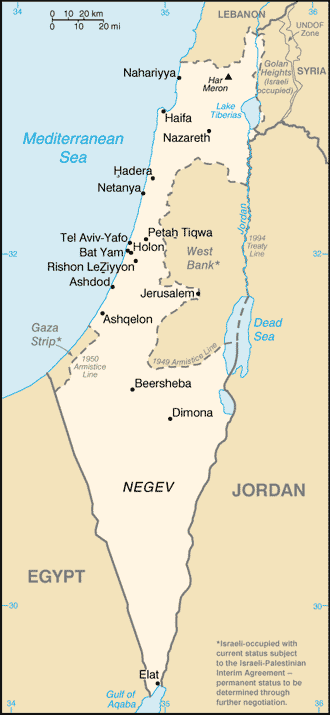

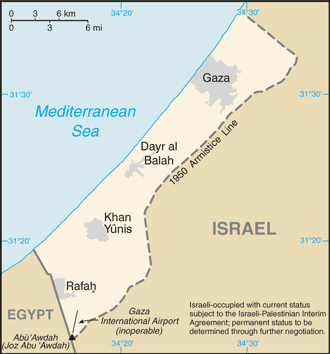


In recent days, "accusations" that Democratic presidential candidate Barack Obama is a Muslim (as if this were a crime) have emerged again, ahead of the South Carolina primary. These "allegations" first surfaced in anonymous emails, some of which were sent to Jewish organizations. Apparently, those sending them out believed that since all Jews hate Muslims, these revelations would dissuade Jews from voting for Obama - whether in primaries or perhaps in a presidential election. In the wake of these emails, all of the major American Jewish organizations issued a condemnation of the "smear campaign" (see for example this press release by the AJC). What disturbed me at the time was that no one made a point of saying that "although Senator Obama is not a Muslim but a practicing Christian, the implication that a Muslim is not fit to serve as the president of the U.S. is horrifying and goes against the principles of the American constitution."
A few days ago, I saw Obama himself responding directly to the accusations in televised interview aired on CNN's Situation Room. The day before, I had seen him emphasize his belief in Jesus Christ during the debate with his competitors in the Democratic primaries, John Edwards and Hillary Clinton. He made a point during that debate of saying that he attends church services and believes in Christianity. During the interview the next day, which may originally have aired on "CBN" (Christian Broadcasting Network), he responded angrily about the smear campaign calling him a crypto-Muslim, something which he found deeply offensive as a sincere Christian. I can certainly understand someone being offended at having their religious beliefs mischaracterized, but again, I found it strange that he was so zealous in distancing himself from the suggestion that he might be a Muslim. Maybe this is the realistic, smart politician thinking. But if Obama couldn't do it, for whatever reasons, then someone else should have stood up and said unequivocally that even if Obama WERE a Muslim, no person's faith qualifies or disqualifies her from running for public office.
Of course, the reality is that for many Americans the faith of a presidential candidate apparently does matter. Mitt Romney's Mormonism is an issue for many evangelical voters. What I find alarming is that Obama's response to the "allegations" might actually reinforce this kind of bigotry. Someone has to stand up to it and show some courage. Why couldn't any of the other candidates say: "I do not think that being Muslim would make a candidate less suited for office than being Christian."
Sunday, January 20, 2008
Secularism, Critique, Blasphemy, and the 2006 Jerusalem Gay Pride Parade
 Two of the posters ("pashkavilim") shown above are part of the campaign against the gay pride parade in Jerusalem. The one on the right reproduces a headline from Ha'aretz which states that "Religious leaders have warned that the Pride Parade in Jerusalem will cause bloodshed." The second one, on the left-hand side, is from Ma'ariv and cites Shimon Peres as saying that "The homos have crossed the line." I took this photograph in Jerusalem in late June 2006. As always: click to enlarge.
Last Saturday, I had the opportunity to see the New York premiere of "Jerusalem is Proud to Present" (ירושלים גאה להציג, 2007) as part of the Jewish Film Festival at Walter Reade theater. In Israel, it has been shown on Channel 2 and Channel 8 and screened at various film festivals.
This latest documentary by the Israeli director Nitzan Gilady ("In Satmar Custody," 2003) is about the attempts to hold a Gay Pride Parade (מצעד הגאווה) in Jerusalem in the summer of 2006, as part of the international "World Pride" celebrations. The parade, which was to go through the city center, had originally been scheduled for August 6. It was postponed several times, in part because of the war still raging in early August, and in part because of the fears that police would not be able to protect marchers from the wrath of religious protesters. Ultimately, the "march" was held as a rally in a closed stadium, guarded by thousands of police officers, on November 10.
Gilady's film begins with a surreal press conference attended by Jewish, Christian, and Muslim religious leaders in Jerusalem, watching clips from previous gay pride parades in other parts of the world, and denouncing the planned event as an abomination. Throughout, it gives space to both supporters and opponents of the Jerusalem Gay Pride Parade, though it is clear that Gilady, who said after the screening that he had only recently come out to his parents, has chosen a position.
One one side, we see the activists and members of the Jerusalem Open House (English). They include the first openly gay Jerusalem city councilor, Sa'ar Netanel (Meretz), elected at the same time as its first ultra-Orthodox mayor, Uri Lupoliansky; Adam Russo, the victim of a stabbing attack at the first gay pride parade in Jerusalem on June 30, 2005 (the assailant was eventually convicted of attempted murder); Noa Sattat, the director of the Open House; and Boodi, a 19-year-old drag queen from Ramallah, who performs at Jerusalem's only gay club, Shushan (now closed), and eventually seeks asylum in the U.S. after being kidnapped by Hamas militants.
Arrayed against them, we see Mina Fenton, a national-religious municipal politician who not only organizes a group of American-born settler women using her bad English and crude sense of taste (the Americans seem slightly more attentive to public opinion) but also solicits support in Arabic from a hijab-clad by-passer. We also encounter a Brooklyn expatriate, Rabbi Yehuda Levin, a dogged opponent of the "gay political elite." Less openly involved than these somewhat ridiculous figures, are the various religious leaders of Jerusalem - the Christian clergymen, the Muslim sheikhs, and the Sephardi and Ashkenazi rabbis. Finally, we see the anonymous masses of rioting ultra-Orthodox protesters.
As the date of the parade approaches, tensions rise and the incitement on the part of the opponents of the parade becomes ever more murderous. The director and Sa'ar Netanel find themselves surrounded in a car by a mob of haredi hooligans, beating on the windows. What follows is footage from various news channels of several days of rioting in the city by young ultra-Orthodox men. Traffic blockades are set up, dumpsters set on fire, and stones thrown. The police respond mercilessly with water cannons and beatings. One foreign commentator calls it the "intifada of the ultra-Orthodox."
The rhetoric of the Open House activists is unapologetically secularist. Netanel speaks of the forces of "darkness," and the black masses of haredi men who appear in the film, anonymous and often in conditions of near-darkness, only reinforce this rhetoric without problematizing it in any way. For Netanel and others, this is a battle of democracy against theocracy, of tolerance against bigotry, of liberalism against religious fanaticism, of progress against backwardness.
The "ultra-Orthodox" intifada invites comparison with the riots that swept across the Muslim world following the Danish cartoon controversy. In both cases, the aggrieved parties - religious believers -responded with violence to what they saw as symbolic desecration (of the Prophet or of the Holy City). The "perpetrators" of these blasphemies, however, presented their actions as a matter of inherent rights and freedoms, which had to be vigorously asserted.
Last October, I attended a colloquium at UC Berkeley's Townsend Center for the Humanities, which posed the question: Is Critique Secular? The first panel discussion of the day featured a paper read by Talal Asad (Anthropology, CUNY Graduate Center) called "Reflections on Blasphemy and Secular Criticism," with local superstar professors Wendy Brown (Political Science), Judith Butler (Rhetoric), and Saba Mahmood (Anthropology) responding.
In his paper, Talal Asad argued that
The conflict that many Euro-Americans saw in the Danish cartoons scandal was between the West and Islam, each championing opposing values: democracy, secularism, liberty, and reason on the one side, and on the other the many opposites – tyranny, religion, authority, and unreason (Asad 3).Referring to secular critique itself as a kind of violence, Asad, while claiming to stake out a position beyond the normative, blasted "Western secularists" who can conceive of blasphemy only as "a constraint on the freedom of speech guaranteed by Western principles and by the pursuit of reason so central to Western culture."
Asad wants us to see blasphemy "not simply as a bid for free speech against irrational taboos but as violence done to human relations that are invested with great value" (Asad 16). I may be wrong, but my intuition is that while such an argument finds an audience in the Western academy when the violent protesters are Muslims upset about an insult to Muhammad, it seems to lose a lot of its force when those rioting against blasphemy are ultra-Orthodox Jews upset about the "desecration" of Jerusalem by homosexuals.
Friday, January 18, 2008
INS Hanit
 The Israeli Navy Ship Hanit ("Spear")
There is an excellent article by the ever-dependable Amos Harel and Avi Issacharoff detailing, for the first time, the "intelligence failure" (it was more complicated than that), which led to the near-sinking of the INS Hanit by Hizbullah on the night of July 14, 2006. Readers will recall the discussion with Hazbani about this a few months ago.
The article also makes interesting points about the intense qassam firing of the past week.
Thursday, January 10, 2008
Lame Ducking It

The Two-State Solution (Image by Makaristos)
In the wake of Annapolis, we heard mostly skepticism and derision about the latest US-backed drive for an Israeli-Palestinian agreement. The naysayers would do well, however, to take note of the statements by President George Bush on his visit to Israel and the Palestinian Authority this week. This lame duck president does not have anything to lose on the domestic scene. In fact, he is better off immersing himself in the kinds of foreign policy ventures that will not entangle him with Congress. The announcement by national security adviser Stephen Hadley, following a speech by the president today, that Bush would be returning to the region before the end of his term is a definite signal that he means business.
The vision of an Israeli-Palestinian agreement that Bush endorsed adheres to the historic American line, as well as that of most of the international community. It is the vision of two nation-states, living side-by-side, with monetary compensation for the Palestinian refugees and their descendants. It runs decidedly counter to the dreams of a "one-state solution," which seek to turn Israel-Palestine into a staging ground for utopian experiments.
Wednesday, January 09, 2008
Putting Sderot on the Map
 Map from Wikipedia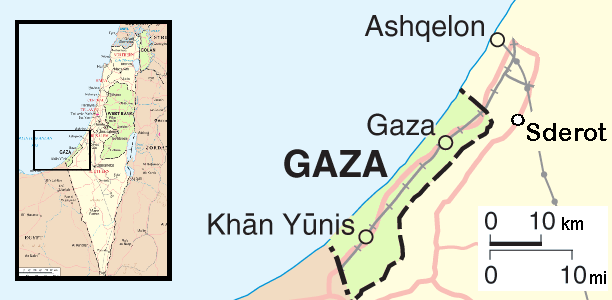
Steven Erlanger's story on the front page of today's New York Times (print edition) is, to my knowledge, the first time that the plight of the southern town's residents has made it there. The qassam attacks from Gaza began before the withdrawal of August 2005, but they have intensified greatly since. Erlanger's piece, accompanied by photographs of children peering at the destruction caused by the rockets, gives voice to the parents, sons, and daughters of the town, whose suffering has received relatively little attention until now.
There are some who try to relativize the qassam attacks, by pointing to the primitive construction of the rockets, their inaccuracy, and the low number of deaths that they have caused so far. They inevitably follow up with a comparison of the qassam to the F-15, with its deadly strikes on Gaza. This kind of comparison provides the relativizers with poetic justification, just like the image of rock throwers confronting tanks (in reality, they are more likely to face soldiers). We are entreated to view the struggle as one of heroic resistance fighters with limited resources confronting an awesome machine marshaling infinitely stronger state and military power. Or better yet, we are told that the rocket attacks resist "the occupation."
Such comparisons obscure the particularity of the terror that Sderot's residents experience every day. It is easy to remark, upon reading about one of Erlanger's teenage protagonists Razi, who "has seen 15 therapists" since seeing a rocket explode in front of his eyes, that Razi, unlike the children of Gaza at least has a therapist. This is a cynical and cruel game. The suffering experienced by Razi and all of Sderot's residents is not just and it is not unavoidable. It is the outcome of a deliberate strategy to terrorize civilians, which should be condemned as loudly as Israeli air strikes which kill innocent Palestinians.
The qassam attacks are all too often depicted as pin-point blows against the "powerful" by those sanctified as essential "victims." The reality of course is that they are aimed at one of Israel's poorest and most defenseless populations.
In this post, I have deliberately avoided the "causes" of the qassam problem and any discussion of its solution. I do not know whether the qassam attacks are being used for tactical or strategic purposes. These are issues I hope to address soon.
Monday, January 07, 2008
An American in Tel Aviv
 Will Bynum playing for the Golden State Warriors (Photo:nba.com).
I'm often struck by how hostile clubs and bars are -- an atmosphere I'm less and less comfortable in. This may sound banal, but I, for one, am continually astonished. So was this incident just good old-fashioned drinkin' and fightin' à la Americaine? I'm not sure. I would love to have been a fly on the wall. What was the dynamic here? A Boston Celtics fan blog ludicrously misread this as "Zionist" vs. Other. Some, understandably in light of a spate of recent attacks on pro athletes, see this as further evidence that heckling now involves bodily harm. And the American media hasn't picked up on the fact that, the Hebrew Israelites are, well, basically American, with an African-American pedigree that goes back to the inner circle of Marcus Garvey. Or maybe I'm making precisely the same mistake of mislabeling that Bynum and Vonteego made. Either way, the story should have been material for a perversely imaginative American writer like Ralph Ellison or Chester Himes.
Thursday, December 13, 2007
The Iranian Nuclear Program

The snippet of the National Intelligence Estimate (NIE) released on December 3 was a blow to those supporting tighter sanctions against Iran. The report, based on data from sixteen American agencies as well as shared information from the larger intelligence community - most significantly from the United Kingdom, but also from France, Italy, and even Israel (see Melman's piece in Ha'aretz) - argued that "in fall 2003, Tehran halted its nuclear weapons program." For many of those who opposed stricter measures against Iran (Russia and China) and those luke-warm about more meaningful steps (Germany), the report was welcome ammunition in the international war of words. A number of analysts declared that this American own-goal had wiped the military option off the table.
On the other hand, British intelligence sources disputed the veracity of the report, attributing the conclusions to the U.S. intelligence agents' misinterpretation of Iranian decoy conversations. Meanwhile, Israeli officials, most notably Defense Minister Ehud Barak, have vehemently criticized the American conclusions. Some American as well as Israeli commentators have raised the specter of a U.S. betrayal of its ally.
Of course, any hardline posturing by Barak should be evaluated with an eye to the domestic political front. The Labor Party defense minister in Olmert's government is trying as much as possible to profit from opportunities that the Iranian crisis as well as the ongoing qassam fire from Gaza provide him as he distinguishes his security record from that of Kadima and the Prime Minister. Nevertheless, no one is playing around merely to gain approval ratings. Israel is right to challenge the NIE and the interpretations of it advanced by those who have long been intent on throwing sticks in the spokes of the sanctions-wheel.
Iran did not stop its work out of humanitarian convictions about the evils of nuclear weapons. The regime fears both a preemptive military attack and international isolation. But it also knows the rewards that it would gain from reaching nuclear status. The Iranians, are thus going to do everything possible to continue covert work that would enable them to produce a nuclear weapon within a short period of time, even with a frozen nuclear program. As the NIE acknowledges, Iran is "keeping open the option to develop nuclear weapons (NIE, p. 9)."
Unfortunately, the NIE undermines the very mechanisms that led to increased international pressure against the Iranian regime. Without the credible threat of an American military option, the incentives for such states as Russia, China, or even Germany to support tougher sanctions against Iran decline dramatically. Where there were once two sticks - sanctions and a military strike - only one of these remains today. If the world refuses to see a nuclear Iran as a problem, Israel has no choice but to devote all its resources to developing a credible answer to the challenge.
It does not matter whether or not Iran is a "rational" actor. Iran's rise to the nuclear powers' club would be disastrous for American as well as Israeli interests in the region. This is not a moral argument about who deserves to have nuclear weapons but a simple statement of the geopolitics involved. There are some who think that the Middle East will be a better place with the Islamic Republic projecting hard power in the Gulf and in the Levant. Others appear to be longing for a day when the U.S. is no longer able to secure the world's most important oil shipping lanes without the cooperation of other powers. They will regret this when it is too late.
I have to agree with Rosner that this report should never have been published. It may very well have taken the winds out of the diplomatic struggle against Iran's drive for nuclear weapons.
Subscribe to:
Posts (Atom)