I just caught part two of the PBS Frontline documentary "Bush's War," produced by Michael Kirk. It's very well done. When I heard Kirk speak at Columbia's journalism school this fall, he emphasized that detailed chronologies were the basis for his films. A solid time line, he said, was his script. This method seemed to me to pay dividends in "Bush's War." So, of course, who remembers exactly which day (or even month) Jay Garner was appointed "viceroy" of Iraq, or when L. Paul Bremmer replaced him? But what I found startling was how compressed certain events were in time. For example, Jay Garner received notice of Bremmer's appointment the first day he actually arrived in Baghdad. Just as he was looking for a functioning toilet in one of Saddam's palaces! Or that within days of arriving in Iraq, Bremmer had disbanded the Iraqi army, not after so much as a photo-op tour of the country.
In his talk at Columbia, Kirk cast himself as a kind of know-nothing interviewer. The guy isn't trying to outsmart his subjects. In fact, he comes off as somewhat amateurish. But he does stick to a policy of not allowing interviewees to set ground rules. That was evident in his handling of Bremmer (and Ahmed Chalabi for that matter). So it turns out Bremmer doesn't remember a meeting that Jay Garner describes in which Garner, and someone from the CIA called "Charlie" confronted Bremmer over then Undersecretary of Defense Douglas Feith's draconian debathification order. Charlie tells Bremmer that 30,000-50,000 people, closer to 50,000 actually, are about to lose their jobs, their place in the new society. In the documentary, Bremmer seems to panic, he can't remember the meeting, but says the number he heard was 20,000.
Much in the film is eerie in light of current events. New York Times reporter John Burns, who was in Iraq from before the invasion until last summer, in the interview, seemingly reclining on a pillow, notes dryly, Iraqi Prime Minister Nouri al-Maliki is the kind of man, if he sat on your local school board, you would be worried about him being appointed principal of a high school. Now he's running a country of 30 million. Like Putin, Bush looked him in the eye to see what he's all about. Now Maliki's in Basra, confronting the Sadrists with what seems to be the full force of the Iraqi Army. The Bush people are calling it "courageous," while the British are standing pat at the airport. From the documentary, it seems such an operation was very nearly set in motion many times in the war's early stages. I just hope Maliki knows what he's doing; that John Burns has him wrong.
Tuesday, March 25, 2008


Thursday, March 13, 2008
Barbarians at the Gates

Israeli President Shimon Peres inaugurated the literary festival, Le Salon du Livre, in Paris today, capping a warm reception in France that is being widely interpreted as a signal of the revitalized relationship between the two nations. But has the French position on Israel really changed? I'm not sure. But I would tend to see recent developments as the outgrowth of French President Nicholas Sarkozy's own personal preference for close, public ties with the Jewish state, and not as a fundamental reorientation of the French foreign policy (as Le Monde). Sarko is special. First he married Carla Bruni, former femme fatale of the French intelligentsia, now he wants to require every French schoolchild to "adopt" a coeval victim of the Holocaust. What will make things interesting for the outside observer is that the Sarkozy administration contains in addition to the one in the Élysée an equally strong personality on the Quai d'Orsay: foreign minister Bernard Kouchner. He has deep ties to nearly everyone in Lebanese politics -- though it seems he couldn't convince the Lebanese delegation to today's Salon not to boycott, which was indeed a major loss for a Francophonie that is under assault from cultural critics. But those ties, combined with Sarkozy's energetic engagement with the Middle East, which has already included visits from the Maghreb to the Gulf, (where the French are establishing a permanent base in Abu-Dhabi), may pay dividends for the peace process, for the effort to contain Iranian nuclear ambitions, and more. Or maybe I'm too optimistic. At any rate, cheers to the Israelis whose psyches may have been salved today by those gatekeepers of the world community, the French.
Thursday, March 06, 2008
Iraqization in Gaza
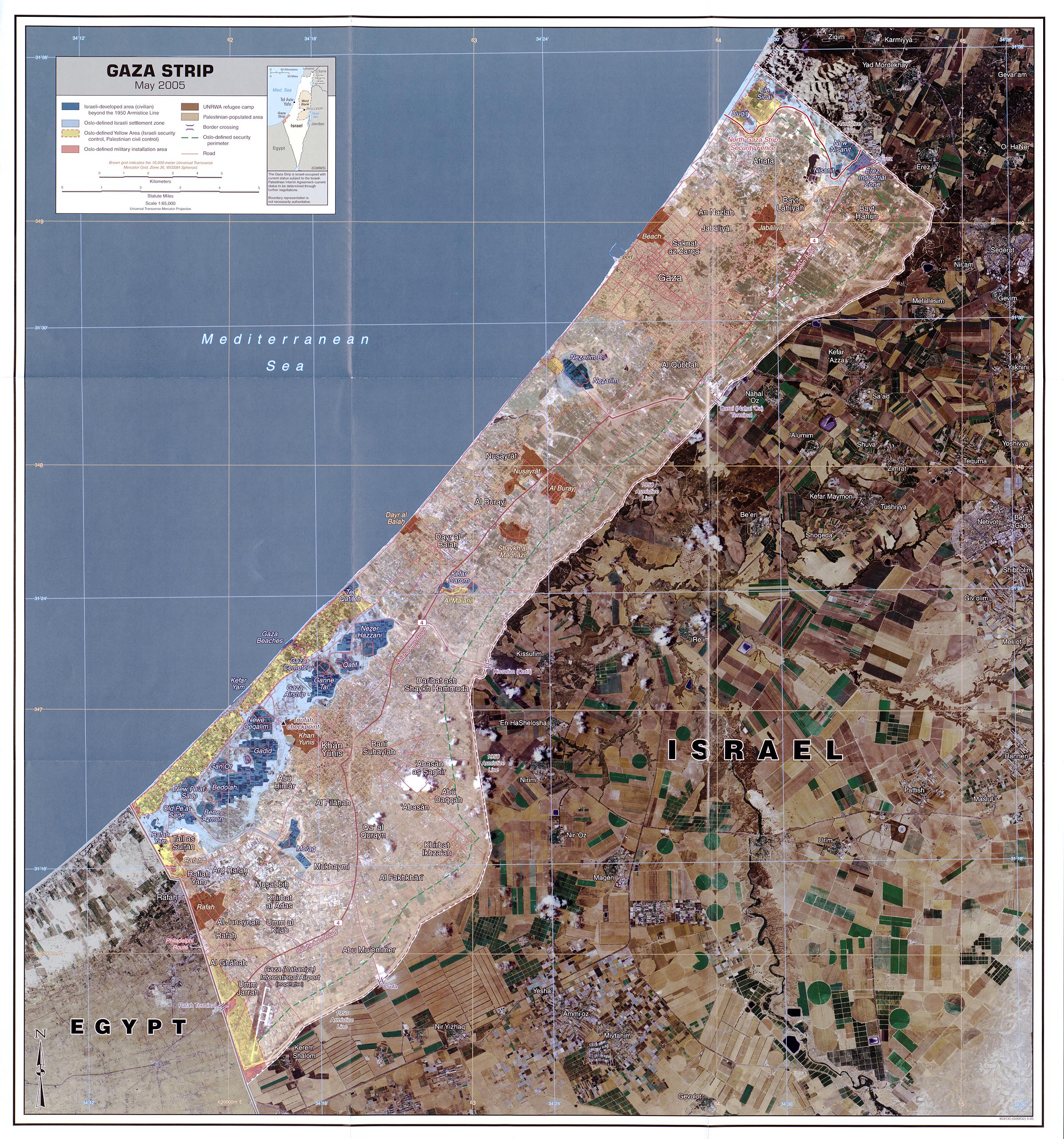
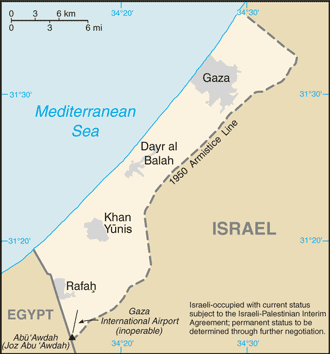
I find it curious that Israeli patrol that was targeted with an explosive today just north of the border with Gaza is reported to have been hit by "an explosively formed penetrator" (or "projectile"). The American military considers the so-called EFP to be an Iranian device, one that has to a certain extent changed the rules of the game in Iraq. It was this very weapon that the Bush administration pointed to when it accused the Iranian Revolutionary Guard of meddling in Iraq and labeled the group a terrorist organization. In fact, a US Defense Department briefing just Tuesday mentioned again the association between this particular bomb and the Iranians. Of course, the katyusha-style rocket that is now hitting Ashkelon, the "grad," is Iranian made. So what's going on here? There's an Israeli line being retailed that the breach of the border with Egypt allowed lots of weapons into the country, weapons which are now being used against the Israeli border communities. I'm skeptical of that. I view it as part of the propaganda war. These EFPs and grads sound like the most valued and hoarded elements of Hamas' arsenal. On the other hand, if, as in Iraq, the technique of manufacturing the EFP can be imported instead of the actual bomb, we may be seeing the diffusion of know-how either from Iran itself, or, alternatively, from non-Iranian individuals who fought in the Iraqi insurgency and somehow made their way to Gaza. Either way, it's clearly a disturbing development, and will make any ground campaign in the Strip that much more costly in terms of human life.
Revenge for Mughniya in Jerusalem?
 Map of Jerusalem (ArcIMS), Qiryat Moshe in orange
According to Ha'aretz, Hizbullah flagship station Al Manar reported that the "Liberators of the Galilee - Shaheed Imad Mughniya Group" took responsibility for the shooting which occurred hours ago at the Merkaz ha-Rav Yeshiva in Jerusalem. Needless to say, the authenticity of this claim is highly suspect. It is extremely unlikely that the perpetrators of the attack, which has so far claimed the lives of eight, are Lebanese or directly affiliated with Hizbullah. However, they may have been Palestinians recruited by Hizbullah handlers or sympathizers. To be sure, retaliation for the assassination of Mughniya in Damascus was expected around this time.
The shooting at Merkaz ha-Rav is the worst terrorist attack that Jerusalem has seen for quite some time. The yeshiva is located in the west of the city, in Qiryat Moshe. It remains to be seen what route the terrorists took to reach the site, and where exactly they came from. I was surprised to hear that they may have infiltrated from East Jerusalem. But perhaps they took a more circuitous route.
At this point in time, it is still unclear how many attackers were involved, and what weapons they used. There are reports of one terrorist having fired an AK-47 for several "long minutes." One witness spoke of 500-600 rounds having been shot.
If the police and security forces release details of the origins of the attackers, we can be sure that there will be a major response by the IDF in Gaza or the West Bank. Tensions are already high after a roadside explosive device near the security fence around the Kisufim Crossing in Gaza destroyed an IDF jeep, killing one soldier (a Bedouin tracker). To me, that attack had all the marks of an attempted kidnapping.
Monday, March 03, 2008
Mishkans and Mishugas: the Power of Acacia
 A mountain of acacia chips (source).
The Lies of Students for Justice in Palestine
 UC Berkeley's Sproul Hall
Today I received an email from UC Berkeley's Students for Justice in Palestine through my department list calling on students to join a "die in" on Sproul Plaza in protest of "israeli government atrocity" [sic]. The email went on to claim that
the daunting words of israeli deputiy defense minister matan vilnai areThis is a blatant and unacceptable lie. First, the organizers seem to have missed the fact that IDF operations in Gaza effectively ended on Sunday. Second, to say that "hundreds" of innocent civilians are being "gunned down" is a willful distortion of the facts. The SJP has become a mouthpiece for the likes of Khaled Meshal, it appears. It reminds me of the hysterical emails about "massacres" and "holocaust" that were circulated following the IDF incursion into Hebron as part of Operation Defensive Shield in spring 2002. Most of the dead then were armed fighters not civilians.
coming true, as a holocaust is bloodying the mediterranean sea under OUR
WATCH. Hundreds of innocent civilians are being gunned down and bombed in
their homes and cities, and we can not sit back and let this happen.
The "daunting" words attributed to Vilnai are also a distortion. On Friday, the Guardian reported that
An Israeli minister today warned of increasingly bitter conflict in the Gaza Strip, saying the Palestinians could bring on themselves what he called a "holocaust".But Vilnai actually said the following:
ככל שירי הקסאם גובר ומאריך טווחים, הפלסטינים מביאים על עצמם שואה יותר גדולהWhen people mean "the Holocaust," in Israel, the word "shoah" is preceded by a definite article - "ha-shoah." Of course, even "shoah" by itself is a strong word - but it means destruction or disaster, which is what Vilnai intended. This is quite clear from the context of the word, as it is followed by the modifier "even greater." In any case, to call what happened in Gaza this past weekend, as the SJP did, a "holocaust" in the sense of a genocide claiming the lives of millions of people is disgusting.
As long as the qassam firing increases and lengthens in distance, the Palestinians bring even greater destruction [shoah] upon themselves.
What's so galling is that this email claims that Israel's goal is to commit a genocide against the Palestinians in Gaza. There is no context for the IDF operation; it is only part of an eternal campaign of oppression. Never mind the hundreds of rockets that have rained on Israeli cities - with the deliberate intent to kill Israeli civilians.
How long will people keep up the moral obfuscation by which military operations pursuing armed fighters, who hide out in civilian areas, are equated with deliberate efforts to murder families sitting in their homes?
Saturday, March 01, 2008
War of the Missiles Redux

What we are seeing so far is eerily reminiscent of the beginnings of the war between Israel and Hizbullah in the summer of 2006. So far, Hamas has demonstrated that its rocket attacks can reach at least as far as Ashqelon, and that it is capable of firing hundreds of missiles a day, if it so desires. IDF activity, so far taking place at the brigade level (Givati) and consisting of infantry forays together with armored units, engineers, and air force, has made no dent whatsoever in the qassam firing while killing many civilians, including children - though it has also managed to engage Hamas fighters. The army has even made statements to the effect that its activity in Gaza is not directly related to the rocket launchings; the claim seems to be that it is pursuing larger tactical or strategic aims.
The army appears to be testing the waters before embarking on a larger ground offensive. Barak may very well be unable to resist the calls (indeed it serves him in his own political aims against Olmert) for the "real thing" - the much-anticipated ground operation - if qassams hit a strategic installation in Ashqelon, end up killing a family, or strike a target similar to the train depot in Haifa during the Lebanon war.בכירים אומרים בנוסף כי ההחלטה להמשיך בפעילות היא ללא כל קשר למספר הקסאמים שנורים מהרצועה לעבר ישראל, וכי הצבא ממליץ על שורה של צעדים כנגד החמאס ולא להסתפק בתגובות נקודתיות בהתאם לשיגור הרקטות
Senior figures added that the decision to continue the activity is without any connection to the number of qassams that are fired from the Strip at Israel, and that the army recommends a series of steps against Hamas and not to make do with pin-point responses to rocket launchings (Ha'aretz).
What we have not seen so far are significant casualties of IDF soldiers. This suggests that the forays are still being conducted fairly cautiously, even though the military has apparently entered heavily defended areas.
UPDATE: As I write this, there is a report of 5 "seriously injured" soldiers.
Right now, it appears that Hamas is trying hard to force Israel into a truce that would see an end to the threats of assassinating the remaining political leadership. Israel, in the meantime, hopes to achieve some kind of near-knockout blow that would make it look as if it had won this round of the conflict. Destroying a few Hamas outposts will not do for this aim. If there is no large-scale ground offensive, we may see an attempt to assassinate a key Hamas figure before this fighting ends.
One thing that Israelis and Americans must get into their heads is that neither this activity, nor the assassinations, nor a large-scale ground operation will by themselves bring about regime change. The goal of regime change will continue to elude the allies. That is not to say that there isn't a great of dissatisfaction with the Hamas government in Gaza. But a revolution from below is a very unlikely prospect, especially while Gaza is under attack.
Wednesday, February 27, 2008
Escalations

Today's escalation in qassam rocket fire makes for an interesting case study. Hamas had been slightly increasing its rocket launchings in the past few days, hitting targets in the western Negev and Sderot that led to casualties. The Israeli air force's operation on Wednesday morning, which seems to have killed at least five members of Hamas's military brigades traveling in a van (New York Times), elicited a massive response from the organization. Hamas is reaching deep into its arsenal, employing those missiles capable of hitting Ashqelon, which suffered several hits today. In response, the Israeli air force struck hard, destroying Palestinian government buildings. One thing that this episode tells us is that Hamas reacts most strongly when senior members of its organization are killed, using its ability to strike Israeli civilian targets as deterrence against Israeli air strikes. For Israel, Ashqelon seems to have become the red line, at which it turns to considering assassinations of Hamas's political leadership.
UPDATE: Amos Harel has a good analysis of the escalation, which I think supports my take.
The Jewish State Again
 Michel Aflaq, Arab nationalist (Photo)
Before I wrote my post on A Jewish State, several weeks ago, a good friend of mine took objection to my lament that no one seems terribly concerned about the fact that there are many "Islamic States" in the world or that various countries in the region define themselves as "Arab states."
I cannot do justice to his entire argument here, and I anticipate that he will view whatever I post as a distortion of what he was saying. Furthermore, since he has not given me permission to do so, I cannot quote his words directly. Nevertheless, here is my attempt.
According to my friend, the comparison of "the Jewish state" with Islamic states lacks rigor. Islamic states such as the Islamic Republic of Iran are "Islamic," he argues, because they derive their laws from shari'ah (Islamic religious law). But Israel's laws are not derived from halakhah (Jewish religious law). Rather, the Jewishness of the state, according to him, is something that resides in people not texts. Citizenship is linked to blood in a way that citizenship in Islamic states and Arab nationalist ones was never conceived. That is, citizenship in Arab states was not a matter of "Arabness" - as evidence, he cites the Armenian citizens in Jordan, Lebanon, Syria, and Egypt, and the Kurdish citizens of Iraq.
I think my friend is confused and mistaken on several fronts, but I have a feeling that this argument resonates with some people. I would like to use this opportunity to resume the discussion we began in the last post, by subjecting the argument above to critique in the comments.
Tuesday, February 26, 2008
Failed Gaza Policies

The latest Haaretz-Dialog poll shows that a majority of Israelis support direct talks with Hamas in order to achieve a cease fire and free Gilad Shalit. Most Israelis are simply fed up with the continuing rocket fire on Sderot, and they are skeptical about the military's ability to bring about a lasting solution. They also do not want Gilad Shalit to become another Ron Arad. However, significant obstacles stand in the way of such talks. Israel is bound by commitments it has made to the U.S. and the Palestinian Authority's Abu Mazen.
Both Israel and the U.S. have been pursuing a policy of regime change with respect to the Hamas government in Gaza. The aim of the blockade is not only to prevent the smuggling of weapons and materials for rocket production but also to thwart the Hamas government's ability to function. The hope seems to be that Hamas's inability to provide services and the Gaza Strip's growing isolation would lead Palestinians to reject Hamas in favor of Fatah. This policy has so far failed. While Hamas has not necessarily gotten stronger, it has not declined significantly enough. Furthermore, Fatah forces are not ready for a take-over, and even if such a thing were to happen, it is not at all clear that they would have the support of a majority of the population.
Israel's other policy vis-a-vis Gaza has evolved in the face of the continued qassam attacks since the disengagement. Today, it consists of frequent incursions to arrest wanted men, infantry ambushes of Palestinian fighters, air force attacks against qassam crews, and occasionally artillery strikes. The goal has been to dislodge Hamas and other Palestinian forces from the border with Israel. Occasionally, Israel has also assassinated military and political leaders. Alongside this activity, there has been extensive planning for a major ground operation similar to Operation Defensive Shield in the West Bank in February 2002. The aims of all of these policies are mainly tactical; they do not necessarily seek to bring down the Hamas government but rather try to make it difficult for Palestinian forces to mount attacks against Israeli military and civilian targets.
There is no doubt that Hamas will use any chance it gets - whether through a formal cease fire, informal truce, or direct talk - to build up its offensive arsenal and its defensive capabilities, taking Hizbullah as its model. Thus, the worst solution would probably be an informal truce or deescalation, of the type that has existed sporadically between Israel and Hamas. While it may guarantee temporary security to the residents of Sderot, it will endanger their lives to an even greater extent in the long-term and yields no real guarantees of any kind in the interim. Direct talks, however, are probably off the table - certainly as long as President Bush is in power. Thus, what we are likely to see is an ongoing war of attrition, that may explode into a full-out IDF offensive when a qassam rocket achieves a direct hit killing a family or a group of schoolchildren. Such an offensive, however, will hardly be able to eradicate the qassam firings. Without a diplomatic horizon, all the IDF can hope to do is to keep the various militant organizations operating in the Strip off-balance. That is a very modest aim that can hardly justify an operation with dozens of IDF casualties.
Sunday, February 24, 2008
The Gaza Offensive from Gaza

While the much-anticipated Gaza offensive by the IDF is far from operational, it appears that the Palestinians are planning an offensive of their own against Israel. We will find out in a few hours how Hamas's attempts to replicate last month's border-breaching action turn out. Unlike the well-planned events that transpired on the Egyptian border with Gaza in January, however, any such actions at the Erez crossing and other sites will lack the crucial element of surprise. It remains to be seen how the world would react to such a mass demonstration. It is likely to increase pressure on Israel to lift the blockade on Gaza, although the chaotic scenes on the Egyptian border did not exactly bolster the reputation of the Hamas government on the international scene.
A staged "popular" mass action, choreographed for international cameras, perhaps involving the deaths of a few civilians sent to the fence will provide plenty of ammunition for those long opposed to Israel's blockade of Gaza. From the beginning of this embargo, which followed the election of Hamas in January 2006, the blockade has been denounced for its injustice; the fence on Israel's southern border has been denounced as a "cage" and an "apartheid wall." Such condemnations are ludicrous. There is nothing immoral about Israel's blockade of the Hamas government in Gaza. We are talking about a fence that basically runs along armistice lines - the route of the border is not in dispute, except among those who oppose the existence of the Israeli state in toto. No state has an obligation to open its borders to non-citizens, let alone to those from a hostile country. It is quite telling that no one has ever described the blockades of Israel by the Arab states as "apartheid."
I may be wrong, but the practice of sending civilians to deliberately violate the sovereignty of a neighboring state seems to me unprecedented. It is, however, indicative of the mechanisms of rule employed by Hamas in Gaza and previously by the Palestinian Authority in the West Bank. When Israel unilaterally withdrew from Gaza, it did so with the expectation that the Palestinians would establish sovereignty in the territory and perhaps focus on building institutions resembling those of an independent state.
With Israeli forces and settlements gone, it seemed to many Israeli and international observers that the key motivations for armed struggle would be eliminated. But the Palestinians have done nothing of the sort. Instead, the terrorist organizations and later the Hamas government have banked on a kind of anarchic, anti-sovereignty to legitimate their authority and rule. From the beginning of this new state of affairs, Hamas has fostered all the attempts to improve the qassam rockets and launching operations that daily terrorize the residents of the western Negev. No real effort has been undertaken to better the economic situation of ordinary Gazans. The only improvement that Hamas rule has achieved is entirely destructive - the various gangs of terrorists have become better at firing rockets at Israeli civilians. I refer to this as "anti-sovereignty," because the Hamas government has deliberately abstained from establishing a monopoly of violence, instead fostering a competitive atmosphere of factions whose sole reason for existence is the violation of Israel's sovereignty, by continually endangering Israeli civilians.

In other words, the Hamas government cannot be expected to act like a rational state. This government thrives on the state of siege and tension that it prolongs with every qassam launch. Its domestic and international support rests on the misery of its population, which is attributed entirely to Israel - despite the fact that the occupation ended two years ago. The obvious parallel to the situation which the Hamas government is aiming for is that of post-withdrawal southern Lebanon. How one deals with such an entity - on the military, economic, and diplomatic fronts - is still an open question.
Sunday, February 10, 2008
Squeezing the Central Bank

A coalition of populist (or demagogic) forces is pressuring Bank of Israel Governor Stanley Fischer to lower interest rates (see Ha'aretz). Those pushing for the change are the Israeli Manufacturers' Association, which is suffering because of the high shekel, on the one hand, and parliamentarians ranging from Shelly Yachimovich (Labor) to Amnon Cohen (Shas). They want to see a reduction in interest rates to help workers in the export industry. If implemented, their agenda would set Israel back two decades. This kind of short-sighted intervention in fiscal policy by politicians, concerned about upcoming elections rather than the long-term economic growth of the country, will severely undermine investors' confidence in the Israeli market. The Central Bank's role is to check inflation by maintaining a strong currency; it should not be instrument of particular economic and social sectors. The export industry will have to adjust, just like the exporters in other countries who have experienced increases in the value of their currency against the dollar.
Tuesday, January 29, 2008
Legislators Propose Bills to Ban Gay Pride Parades in Jerusalem




Earlier today, two bills were presented for first reading by the Israeli parliament, both of which attempt to prevent gay parades from being held within the city of Jerusalem, by amending the municipality's Basic Law from above. One parliamentarian, MK Nissim Ze'ev of Shas (about which more below) condemned the homosexual community for "carrying out the self-destruction of Israeli society and the Jewish people" (Ha'aretz).
Much of our last discussion of the gay pride parade in Jerusalem focused on the opposition of the "ultra-Orthodox" or haredim, as they are called in Hebrew. I realize that for people less familiar with Israeli society and the Jewish world, there is bound to be some confusion about which particular groups this term encompasses. Hence, I hope that those who understand will excuse the rather long excursus on Israel's political and religious landscape that follows.
Until relatively recently, the term "haredim" ("trembling ones") referred almost exclusively to the various black-clad Hasidic and "Lithuanian" groups (Note: the term "Lithuanian," refers to those who identify with opponents of the Hasidic movement; the division between hasidim and their opponents dates to the late 18th century), most of whom either rejected the Zionist state or had an ambivalent attitude toward it best described as "non-Zionism." The main political organ of these groups is the United Torah Judaism party, which is a coalition of the Hasidic Agudat Yisrael and the Lithuanian Degel ha-Torah, and has 6 seats in the Israeli Knesset.
In the past three decades, we have also seen an increase in another kind of "haredi" or ultra-Orthodox population, which has found its political expression in Shas, a party which derives its guidance from rabbinic luminaries of various mizrahi (Middle Eastern Jewish) communities. This party, however, also draws much of its support from "traditional" and even secular mizrahim, having marketed itself as a party opposing Ashkenazi hegemony in Israel. It currently has 12 representatives in the Knesset, and is a member of the governing coalition.
In addition to these two groups, another constituency involved in the opposition against the gay pride parade was the national-religious or "knit kippah" camp. This sector, which is today identified as the ideological backbone of the settlement movement, is religious (sometimes "ultra-Orthodox") but embraced the state (at least until the evacuation of settlements from Gaza) and interprets the Zionist movement in religious, messianic terms. Its main political organ today is the National Union - National Religious Party, which has 9 seats.
When I watched the documentary about the Jerusalem gay pride parade discussed earlier, I noticed that the approaches used by these various sectors differ significantly from one another. For example, the national religious camp used language much closer to that of the Christian right in America, as I think I noted earlier. Shas, it seems to me, is using more populist language that appeals to "tradition." I think it is not an accident that the haredi parties are keeping a low profile, and that they are probably not going to become involved in this. They do not see this as an issue to gain votes or to mobilize the ultra-Orthodox. Their caution also reflects a distrust of modern party politics and mass organization (i.e., democratization).
Friday, January 25, 2008
A Jewish State
 Theodor Herzl's 1896 work The Jewish State (or the "State of the Jews")
Most Jewish Israelis and most Jews living in the diaspora take it for granted that Israel is "a Jewish state." This particular description does not elicit a great deal of controversy for them; it seems obvious and relatively unproblematic. For many Arabs, whether Christian, Muslim, or atheist, and for many Muslims living outside the Middle East, however, the phrase seems unacceptable, and usually provokes an exclamation of disbelief that such a thing should be possible. To them it seems prima facie racist. Likewise, while most Jews see Zionism as the political expression of a belief in Jewish self-determination, dating to the late 19th and early 20th centuries, for many Arabs and Muslims it is a fascist, genocidal, and/or racist ideology with none of the legitimacy granted to other nationalist movements, including Pan-Arabism.
To me, this discord invites two different lines of inquiry.
- Of course, arguments must be made for and against. Indeed, I myself have been forced to engage in such arguments ad nauseam, a fact that at this point in my life tends to fill me with resentment as soon as I hear yet another person challenging me to resist their conversionary or enlightening zeal.
- However, a different line of inquiry would proceed more phenomenologically (I think). It would ask: what do all these different people mean when they talk about a "Jewish state"? Further, it would try to investigate why some people sees this self-description as unproblematic, while others vigorously oppose it; it would, moreover, ask the same thing about the desire of many Jews (in Israel and elsewhere) to have the Palestinians as well as others accept the definition of Israel as a Jewish state. This would be a study of fears, hopes, and their consequences.
We think that the fact that there’s a Jewish state is a good thing given the history of antisemitism and our understanding of how the world works. Here in the US, we have a melting pot society. This is not a Christian or Anglo-Saxon state. It’s a liberal state. There is no one ethnic or religious group that dominates; it’s a melting pot. I don’t like the idea of living in state dominated by one culture. But around world, there are lots of states where people identify themselves largely in terms of culture – take Japan: most people there consider themselves to be Japanese. Same is true with Israel – it’s a Jewish state; the same is true for Germany. It’s not the way I like to do business; but it’s perfectly legitimate way to do it in the international system today. I believe in national self-determination. Zionism is a form of nationalism and perfectly legitimate one. There is nothing wrong with having a Jewish state. We are arguing that Palestinians are also entitled to have a state of their own. If there’s national self-determination for the Jews, it should also exist for the Palestinians. The principal obstacle to establishing Palestinian state at this time is Israel. Israel is interested in colonizing the West Bank and giving the Palestinians nothing more than a few enclaves, keeping them disconnected, controlling borders, air and water. As long as that’s the case, the Palestinians won't have a viable state. The same logic that leads us to support a Jewish state leads us to support a Palestinian state.
Subscribe to:
Posts (Atom)