Wednesday, September 24, 2008
Belleville
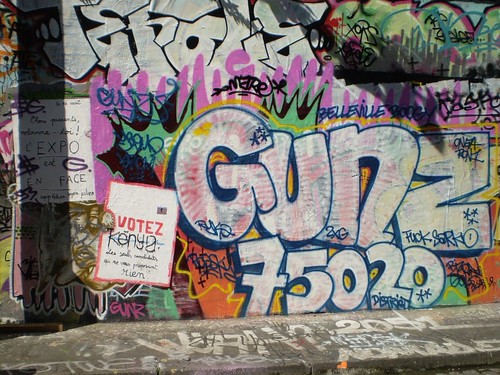
Steven Erlanger wrote a perceptive piece on Muslim-Jewish relations in Paris' 19th Arrondisement in today's NYT, which contains much of the kind of quotidian testimony one must take into account when discussing Europe's "New Anti-Semitism." Erlanger's picture is Brooklynesque: hipsters, immigrants, Lubavitch, aggressive teenagers, and a darling park where they all meet up. In recent months, a couple of religious Jewish boys have been involved in altercations with young blacks and Arabs. When 17 year-old Rudy Hadad was beaten into a coma in June French President Nicolas Sarkozy publicly shuddered at the specter of anti-Semitic motives. But what's really going on in this neighborhood?
In 2002, when worries about anti-Semitism in France were peaking, I was hanging out with a Tunisian Jewish friend of mine on these very streets, the Rue de Belleville to be exact. Alex worked in jewelry manufacture. He had attended a local technical high school where he would have interacted quite often with non-Jews, many of them Muslim immigrants from North Africa. According to the article, Jews are fleeing such schools. Along the avenue, Alex pointed to phone card signs advertising rates for Morocco-Mali-Togo-Chad. "Would you ever think this was France?" he asked, incredulously. He was French, he wanted me to see. He was different. In fact, I often felt he was desperate not to be taken for an Arab, for a "Beur" in argot slang.
Erlanger's article chalks up much of the tension between young Jews and Muslims in the 19th to simple group-think and bravado. What happens in Israel bears little on whether or not two cliques of different faiths scrap in the park. I'm very sympathetic to this viewpoint. Some of the interviews here also raise the possibility of class grievances manifesting themselves in Muslim on Jewish violence. I think one has to be very careful with such explanations. For the Jews I knew in Belleville, Jewishness was the epitome of classy; something the more well-to-do Parisian Jews, with their Arab friends and cosmopolitan attitudes, laughed at over drinks on Sunday afternoon in the Marais. What do these brawlers in the 19th think? Who knows. Maybe they just want to fight.


Thursday, September 18, 2008
A Mysterious Resignation
Shaul Mofaz, Israel's current Minister of Transportation, former Defense Minister as well as retired Chief of Staff announced his "temporary withdrawal" from politics today. He made this resignation in the wake of his very narrow defeat to Tsipi Livni in the Kadima primaries, which Mofaz, contrary to the exit polls released yesterday. lost by less than 500 votes; pollsters had predicted a 10% margin of victory for Livni. Mofaz's sudden withdrawal makes little sense. He could have easily challenged it, or at least brought pressure to bear on Livni to demand a cabinet post. It is all quite fishy, to say the least.
There were two sets of rumors circulating before and after the vote yesterday. As with every election and party primary, there were allegations about vote-buying and electoral irregularities in the Arab sectors, where particular communities or towns often vote en bloc for one candidate (see for example this story on Ghajar). Perhaps more importantly, the state comptroller is apparently investigating fiscal improprieties in the Mofaz campaign (Ha'aretz Hebrew). Apparently, the Mofaz campaign accepted donations in excess of the allowed sum per donor, which is set at 40,000 NIS. According to Ha'aretz, Mofaz received the following donations from four American businessmen:
$99,970 from Allan Meder (?)
$100,000 from Lucian Salls (sp?)
$50,000 from Yakov Menahem
$18,000 from David Amrani
I couldn't find anything on these individuals - I'm sure that more will emerge shortly.
Wednesday, September 17, 2008
The Day after the Kadima Primaries
People have been wrongly predicting the downfall of Ehud Olmert for two years now. Has his reign finally come to an end?
If exit polls for the Kadima primaries prove accurate, Tsipi Livni will be elected leader of Olmert's Kadima Party tomorrow. Prime Minister Olmert has previously announced that he would tender his resignation immediately following the results of the Kadima primaries. But there is a chance that we will be seeing Olmert on the throne for quite a bit longer. Both the legal (by which I mean the Basic Laws, not the possible indictment of Olmert by the Attorney-General) and political situations are complicated.
A Prime Minister who has resigned shall continue to carry out his functions pending the constitution of the new Government. If the Prime Minister has died, or is permanently incapacitated, from carrying out his duties, or if his tenure was ended because of an offense, the Government shall designate another of the Ministers who is a member of the Knesset and of the Prime Minister's faction to be Interim Prime Minister pending the constitution of the new Government.
Thus, when Olmert resigns, he can continue to run the country as head of an interim government until new elections are called.
The Jerusalem Post claims that
Should Olmert resign after the primary, the cabinet also resigns and the government becomes a transitional government, with Olmert at its head, that remains in power until a new government is formed. This could take least a few weeks, but might only happen after a general election, probably in the spring.By law, no minister or party may leave a transitional government. Thus, even if he is subsequently indicted, Olmert would be locked in as head of the transitional government, whether he - or anyone else - likes it or not.
I am not sure on which article of the Basic Law on the Government this interpretation is based, but if true, we may be seeing a lot more of Olmert.
Meanwhile, the political situation is dynamic, with the Labor Party threatening to leave the government, Shas trying to extract concessions in return for staying, and the opposition, led by the Likud, renewing calls for elections.
Elections would not be held until the spring, at which point many things can change dramatically. In the next few days, we should see whether Olmert decides to stay on as interim Prime Minister or whether he will suspend himself from his post and let her take the reigns until elections are called.
Thursday, September 11, 2008

South Ossetia and Abkhazia
Speaking in Sochi and appealing to the "world Jewish community" and to Israel, the president of South Ossetia, Eduard Kokoity blamed Georgian troops for destroying the Jewish cultural center in Tkhinvali, the separatist region's capital. He also claimed that a "genocide" had been committed by the Georgians in South Ossetia (Ha'aretz Hebrew).
The Russians, South Ossetians, and Abkhazians appear determined to perpetuate the allegations that the Georgians engaged in deliberate killings of non-Georgian civilians. Of course, Russia has given almost no access to independent organizations for the verification of these claims, and the main victims of ethnic cleansing are the thousands of Georgians who used to live in South Ossetian villages.
Notwithstanding the idle rhetoric of the West, the integration of South Ossetia and Abkhazia into the Russian Federation is quickly advancing. It now looks very unlikely that these territories will be restored to Georgian sovereignty any time soon. The president of Abkhazia, Sergey Bagapsh, is imagining a similar status under Russian auspices for his country as the one enjoyed by Taiwan under U.S. protection.
Israel, in the meantime, appears determined not to antagonize the Russians and is directing Israeli military contractors to freeze business in Georgia. Russia's message has reached Jerusalem loud and clear. Israel will not risk retaliatory Russian arm sales to Syria, Iran, and others. Meanwhile, the precise nature of Russian-Israeli relations since the Georgian crisis awaits further elucidation.
Sunday, August 10, 2008
Gaza and World Heritage

Philip 2 of Macedon and I, Thessaloniki
The UK newspaper the Independent ran this profile on Saturday of Jawdat Khoudary, a Gaza construction magnate with a keen interest in archaeology. This man is pouring money into an archaeology museum to house Gaza's prolific ancient heritage, but fears locals won't support his efforts. I take it that he means they won't visit the museum, and that looting will continue unabated (as apparently it did in the aftermath of the '67 war, no doubt with Moshe Dayan's approval and participation). What's the solution here? Khoudary, who seems to recognize that transnational cooperation is also crucial, hopes to pique the pride of his countrymen. It's common sense: get people to take ownership of heritage, and they'll protect, promote it, etc. Call that the "Macedonian model." But will that work in Gaza? In East Jerusalem? Unfortunately, the archaeology of these places is often at cross-purposes with a number of political, military, and economic objectives. That's why in certain cases, I'm sympathetic to a different model, that of "world heritage." This, loosely, is one of the major lines of defense mounted by former colonial powers' against repatriation of ancient artifacts. The Elgin Marbles in the British Museum belong to everyone, so the argument goes, not just the Greek state -- though of course nationalist excitement of a different kind helped bring the stuff to London in the first place. James Cuno, former curator at the Art Institute of Chicago and at Harvard, has just written a book called Who Owns Antiquity: Museums and the Battle Over Our Ancient Heritage, in which he argues that the interests of world heritage should always trump national interests in archaeology or in the management of heritage. I fear that we won't be able to purify archaeology as Cuno might like. In fact, if Macedonia and Gaza are any indication, maybe we shouldn't.
The Destruction in South Ossetia

The Russian devastation of Georgian positions in the break-away region of South Ossetia, Abkhazia, and, now, the Caucasian country's heartland signal a new reality not only in this part of the world but in Russia's role elsewhere.
As so many commentators have pointed out, this was the first time that we have seen Russia's military confront regular armed forces, as part of an international conflict, since its 1979 invasion of Afghanistan. One could nitpick and point to the fighting in Chechnya, but here Russia faced a separatist insurgency carried out by irregular though effective bands of fighters. Russia's performance in that earlier conflict, however, was interpreted by many as a symptom of its military's disintegration.
Now, Russia has asserted its supremacy, before its doorstep - in the air, sea, and on (the rather treacherous) land. It faced down a modern fighting force by a small but rising power, whose army has been supplied by Ukraine, the US, and Israel (until recently). Interestingly enough, although the news showed up only on a few tickers several weeks ago, Israel suspended its arms shipments (primarily UAVs) to Georgia - probably after Russian pressure.
After the diplomatic defeat in Kosovo, which the Russians have always argued should also mean a green light for Abkhazian and Ossetian independence from Georgia, Putin and Medvedev have upped the ante - they are talking about an outright annexation of these regions to Russia. The South Caucasus, in retrospect, was a red line for Russia, beyond which it would not allow any more encroachments. With Georgia's foolish decision to launch a preemptive attack on the separatist positions in South Ossetia, Russia has seized the opportunity to take an even larger bite.
The implications for the former Soviet republics are clear - states from Turkmenistan to Ukraine (and their would-be allies in the West or elsewhere) must now own up to the fact that whatever support is delivered to them from afar better be significant if they are to assert themselves against Russia. For the weaker states among these republics, this will mean toeing a more neutral line between Russia and the West. The belligerent factions in Azerbaijan pressing for a renewal of hot war with Armenia, over control of Nagorno-Karabakh, may have been served notice. This would be a dramatic reconfiguration of the South Caucasus, with the the "TBC pipeline powers" folding their cards to Gazprom - though it remains to be seen how Turkey, another state whose current military capabilities in international conflict are still untested will react this state of affairs. To be sure, the reduction of Georgia to a rump state around Tblisi would be good news for the other resource-poor state in the region - the Republic of Armenia.
For larger former Soviet republics, such as Ukraine, Russia's actions will accelerate coalition-building with the West and investment in their armed forces. Apparently, the Ukrainian navy is not standing idly by as Russia attempts to blockade the Georgian coast, to prevent Ukrainian arms dealers from shipping weapons there. But it remains to be seen how much force, if any, Ukraine will be able to wield against Russia in this round.
Beyond its immediate sphere of influence on its frontiers, Russia has made explicit its rejection of an international system that it perceives as stacked in the West's favor. It has also made the Western European powers preaching to it look like paper tigers. Although much of Russia's rhetoric in this conflict has been directed at the US, which it blames for inciting Georgia's attack in the first place, it has become clear that the Americans decided early on that Georgia was not worth an overt confrontation with Russia. No doubt, this will bring joy to many Russian analysts and to others riding the bandwagon of America's decline. They should be careful not to overstep the new borders demarcated for them.
Sunday, August 03, 2008
McCain's Jewish Card
This morning on NBC’s Meet the Press, the McCain campaign deployed independent Democrat Joe Lieberman, the Connecticut senator and former vice-presidential and presidential candidate, to combat the negative press flung at their candidate for airing an ad that likens Barack Obama to Britney Spears and Paris Hilton. He’s a celebrity, they’re celebrities; you wouldn’t want them running the country...so...and so the “argument” goes. Joe may have had an easier time of it after Obama’s own controversial comments this week. The Illinois senator told a Missouri audience he anticipated being attacked with charges of “‘He’s not patriotic enough, he’s got a funny name.’ You know, ‘He doesn't look like all those other presidents on the dollar bills.’” The McCain camp pounced: “Barack Obama has played the race card, and he played it from the bottom of the deck.”
Most will readily concede that the Republican strategy against Obama has of late played increasingly upon the deep-seated fears of ordinary Americans that “he’s not like us.” That, of course, was what Obama was responding to, but he slipped and gave his opponent a tactical opening when he contrasted a) his face, and b) a dollar bill. He slipped because in pointing up the difference between his skin color and George Washington’s, by so casually disassociating himself from a national symbol, he appeared to assert multiple identities: black, American, outsider, insider. While I think the outsider appeal can get him some emotional traction, the idea that he somehow secretly harbors a distinct, separate, even primary identity that most Americans don’t share is very dangerous. For what it's worth, the simultaneous presence of these various identities in a single soul is, to my mind, entirely unobjectionable, and actually renders Obama all the more American.
Contrast Obama’s tightrope act on the issue of his race with Lieberman’s freewheeling comments about his Jewishness on Meet the Press. Lieberman displayed, not for the first time, his utter lack of compunction about calling attention to his minority identity. First, Tom Brokaw asked, “Do you think running a campaign ad in which you feature Britney Spears and Paris Hilton with Barack Obama is respectful?”
It’s remarkable how Lieberman comes off as both pious, correcting “my book” to “the Book,” and ireverant, comparing, by means of the old transitive property, Moses to Britney! I suppose we’ve come to a point in American culture where the claim “I’m Jewish” is also a claim along the lines of “I can joke around in ways that border on the inappropriate.” The genius of Lieberman is he’s also signaling in very sober terms to America’s church-going population that he’s “just like them,” only fiercely loyal to his book.
Later, Lieberman returned to his Jewishness in a defense of McCain’s tolerance. After all, Joe pointed out, McCain and his wife adopted a girl from Bangladesh – and they love her! What’s more, Lieberman seemed to imply, so quickly did he move from the issue of the adoption to the issue of their personal friendship, the presumptive Republican nominee for president has been pals for twenty years with (gasp) – a Jew.

Most will readily concede that the Republican strategy against Obama has of late played increasingly upon the deep-seated fears of ordinary Americans that “he’s not like us.” That, of course, was what Obama was responding to, but he slipped and gave his opponent a tactical opening when he contrasted a) his face, and b) a dollar bill. He slipped because in pointing up the difference between his skin color and George Washington’s, by so casually disassociating himself from a national symbol, he appeared to assert multiple identities: black, American, outsider, insider. While I think the outsider appeal can get him some emotional traction, the idea that he somehow secretly harbors a distinct, separate, even primary identity that most Americans don’t share is very dangerous. For what it's worth, the simultaneous presence of these various identities in a single soul is, to my mind, entirely unobjectionable, and actually renders Obama all the more American.
Contrast Obama’s tightrope act on the issue of his race with Lieberman’s freewheeling comments about his Jewishness on Meet the Press. Lieberman displayed, not for the first time, his utter lack of compunction about calling attention to his minority identity. First, Tom Brokaw asked, “Do you think running a campaign ad in which you feature Britney Spears and Paris Hilton with Barack Obama is respectful?”
Lieberman: “I do. First off, you know, we all ought to relax a little bit. It's, it's a bit of humor. It's a way to draw people into the ad. Incidentally, the McCain campaign has another ad up in which they seem to be comparing Obama to Moses. So, in my book, that's about a good comparison as you can ask for. I should say, in ‘The Book,’ it's about a good a comparison as you should ask for.”
It’s remarkable how Lieberman comes off as both pious, correcting “my book” to “the Book,” and ireverant, comparing, by means of the old transitive property, Moses to Britney! I suppose we’ve come to a point in American culture where the claim “I’m Jewish” is also a claim along the lines of “I can joke around in ways that border on the inappropriate.” The genius of Lieberman is he’s also signaling in very sober terms to America’s church-going population that he’s “just like them,” only fiercely loyal to his book.
Later, Lieberman returned to his Jewishness in a defense of McCain’s tolerance. After all, Joe pointed out, McCain and his wife adopted a girl from Bangladesh – and they love her! What’s more, Lieberman seemed to imply, so quickly did he move from the issue of the adoption to the issue of their personal friendship, the presumptive Republican nominee for president has been pals for twenty years with (gasp) – a Jew.
Lieberman: “Let me just add a final word, Tom. In 2000, Al Gore gave me the extraordinary honor of being the first Jewish-American to run for national office, and Al Gore said he had confidence in the American people that they would judge me based on my record, not on my religion. And I urge Barack Obama to have the same faith in the American people that they will judge him on his record, or lack of record, certainly not on his name or his race.”Lieberman’s use of his Jewish identity is devastatingly cynical. He wants to be the macho minority, kicking some tail as a trailblazing Jew, only to revert to the American Everyman when he’s done bragging. Unlike Barack Obama, who will rarely ever choose the battle fields on which his black identity will be subject to the various pressures of public life, Lieberman is quite well positioned to inject his Jewishness into the mix when it’s politically expedient. In fact, I dare say Lieberman seemed to be taking advantage of the fact of his Jewishness to lend legitimacy to his attack on Obama for the gaffe. For McCain, Lieberman was the perfect operative for the week’s controversy. He played the Jewish card in order to denounce Obama for “playing the race card!”
Wednesday, May 21, 2008
The Syrian Front
Some very brief, related and unrelated thoughts on the news from today about peace talks with Syria.
1. Contrary to the claims of Shelly Yachimovich this is not a diversion. Neither the talks nor their acknowledgment have been orchestrated to save Olmert's political career. If anything, these talks put Olmert in an even more precarious position domestically than he is now.
2. We do not know what the Americans think about all this, but the agreement goes entirely against the spirit of Bush's policy since 2003. Did the Turks keep the Americans apprised of developments in the process?
3. These negotiations cannot extract Syria from the Iranian embrace. They will not deliver Hizbullah or Hamas to Israel. All they can aim at is the formalization of the relative calm that has existed on the Syrian-Israeli border since 1973 - in itself hardly be an insignificant feat.
4. The recent Doha agreement, engineered by Qatar, formally delivered Lebanon into the hands of Hizbullah and the Iranian-Syrian-(Qatari?) axis. It diverges radically from the US-Saudi policy on Lebanon that has endured until now.
1. Contrary to the claims of Shelly Yachimovich this is not a diversion. Neither the talks nor their acknowledgment have been orchestrated to save Olmert's political career. If anything, these talks put Olmert in an even more precarious position domestically than he is now.
2. We do not know what the Americans think about all this, but the agreement goes entirely against the spirit of Bush's policy since 2003. Did the Turks keep the Americans apprised of developments in the process?
3. These negotiations cannot extract Syria from the Iranian embrace. They will not deliver Hizbullah or Hamas to Israel. All they can aim at is the formalization of the relative calm that has existed on the Syrian-Israeli border since 1973 - in itself hardly be an insignificant feat.
4. The recent Doha agreement, engineered by Qatar, formally delivered Lebanon into the hands of Hizbullah and the Iranian-Syrian-(Qatari?) axis. It diverges radically from the US-Saudi policy on Lebanon that has endured until now.
Friday, May 16, 2008
Ha'aretz's (Poor?) Coverage of Lebanon
 Walid Jumblatt, Leader of the PSP (Photo: Wikipedia)
Like most of the Western media, Ha'aretz has done a very poor job of covering the events that transpired in Lebanon last week. With Hizbullah having imposed a de facto blackout early on in its coup attempt, few people inside or outside the country were in a position to gain a sense of what was happening on the ground. Hizbullah's own media war has added to the confusion, so that it is not at all clear who won, if anyone. Thus, I was more than a little annoyed by the coverage of Zvi Barel, who seems to have bought the line that Hizbullah scored a major victory:
Sad and tired, wearing shabby clothes and with tears in his eyes, Druze leader Walid Jumblatt stood on the veranda of his luxurious home in Beirut's Clemenceau neighborhood and explained his decision to television viewers. A few hours before the interview, he had called his political rival, Talal Arsalan, and asked him to coordinate with Hezbollah leader Sheikh Hassan Nasrallah the cessation of the fighting in Mount Lebanon, Aley, Chouf and the Maten region, the power centers of the Druze. In return, Jumblatt ordered his people to lay down their arms and hand them over to the Lebanese Army. Within the framework of the well-planned battle Hezbollah is conducting with the aim of changing the balance of power in Lebanon, the Mount Lebanon struggle, involving rival Druze families, might constitute Nasrallah's most important victory.
Contrast this with Tony Badran's (fiery) analysis over at Across the Bay:
Hezbollah had another thing coming. For three days of intensive fighting in the Shouf, and contrary to the lying info ops and disinformation of Hezbollah water carriers like this clueless Hezbollah willful tool (on whose propaganda for Hezbollah I've written in the past and will soon be ripping to shreds once again), not a single village in the Shouf fell to Hezbollah. Not Niha, like that Hezbollah watercarrier MacLeod wrote, not anything.
Quite the contrary. According to the PSP and other local sources, more than three dozen Hezbollah fighters were killed and a number of their vehicles were destroyed. The fact that they had to introduce artillery and vehicles (mounted with heavy machine guns, like so, and recoilless rifles, like so) only showed that they could not make advances into the villages.
Not just that, but Hezbollah's attack has led Talal Arslan's fighters to switch and fight alongside the PSP against Hezbollah, undermining Hezbollah's tiny Druze ally -- which is precisely why Jumblat put him in the forefront from the get go (it was not, as shrill commentators and dishonest flacks read it, a sign of "weakness." It was a shrewed move by a master tactician.).
At the end of the day, the PSP maintained control of the strategic hills of the Barouk to the east and Ras al-Jabal west of Aley, overlooking the Dahiyeh.
Thursday, May 15, 2008
Countering the Qassam


The capabilities that the Palestinians demonstrated with yesterday's rocket attack on Ashqelon are impressive. Despite the limitations placed on them by the blockade and by occasional IDF operations, the terrorist groups in Gaza have consistently upgraded the range and power of their missiles. In comments to Ha'aretz today, Amos Yadlin, head of AMA"N (Military Intelligence Department), warned that two years from now, even Be'er Sheva might become a target. He did not announce any specific initiatives to forestall this threat.
The aims of Hamas and the other groups rocketing Israel's southern communities are various. One of the goals seems to be to pressure Israel into a truce that would result in lifting the "siege," whose effects have of course been greatly exaggerated by Hamas propagandists. Paradoxically, the Palestinians are trying to achieve this by demonstrating their ability to bomb Israeli civilians and by blowing up crossing points designed for the delivery of food and fuel.
Another aim of Hamas, which Yadlin also acknowledged in comments to the press, is to create deterrence against Israel comparable to the deterrence that Hizbullah achieved. Just like Hizbullah, Hamas wants to be able to strike at will deep into Israeli territory, turning Israeli civilians into its hostages in order to ensure that the IDF does not attack Hamas's fighters and leadership in Gaza.
These two aims suggest a number of different responses.
- Israel might agree to a truce and to the conditions imposed by Hamas, in return for an end to rocket attacks (diplomatic solution)
- Israel might acquiesce to Hamas's regime of deterrence and cease attacking its forces, in the hopes of quiet
- Israel can opt for its own policy of deterrence (military and economic)
- offensive operations to destroy the Palestinians' rocket-firing capabilities (military)
- defensive measures to limit the impact of the rocket strikes (military)
- Gives Hamas time to build up its forces for the next round; given the organization's ideology and support/pressure from Syria and Iran, it will not be turned into a pacific neighbor
- Same as above without even a formal set of protections; liable to break down at any moment.
- Hamas does not care if Palestinian civilians die as a result of IDF operations; in fact, images of civilian deaths or injuries aid its cause.
- the IDF has so far proven unable to do this; its efforts in this area during the Lebanon War of 2006 were unimpressive.
- expensive and so far ineffective
Wednesday, May 14, 2008
Ashqelon Hit Hard

The katyusha or Grad rocket attack on Ashqelon today surely marks a new chapter in the war between Israel and the Palestinian terrorist groups in Gaza. Since the disengagement from Gaza, we have seen a steady erosion of red lines, as more and more Israeli civilians have come under fire from Hamas and other armed Palestinian groups in the Strip. It may be important at the political level to distinguish among the various factions carrying out the rocket attacks and to evaluate particular motives. For the military, however, these kinds of considerations are irrelevant. What matters is that Palestinian terrorist groups have acquired and preserved the means to strike major Israeli population centers, despite a much-maligned "siege" of Gaza and numerous air force as well as ground operations. And even though the latter have often claimed the lives of many Palestinians - civilians and fighters - Israel has not been able to establish effective deterrence. Neither diplomatic nor military means have so far been able to protect Israeli civilians from these attacks. Despite countless announcements about an imminent truce this past year, we seem no closer to calm on the southern border than before. With Prime Minister Olmert's political career in limbo and Defense Minister Ehud Barak (Labor) possibly facing challenges from inside and outside the party, we may end up seeing the kind of major ground operation that the Israeli right has been agitating for. Such an operation may also be accompanied by assassinations of Hamas's political leadership.
Friday, May 09, 2008
Hizbullah is not Hamas; Beirut is not Gaza
The reports from Beirut look eerily similar not only to scenes from the annals of Lebanese civil war but also to what we saw in Gaza before Hamas's takeover. Again, it looks like well-equipped but unmotivated US-backed militias are surrendering to their disciplined anti-American counterparts. At least this is the impression that one would get from the coverage in Ha'aretz and the Western media. The following description is rather typical:
First, the military "victory" that Hizbullah and co. are now celebrating will not automatically give the party political power. Whereas in Gaza, one entity, Hamas, basically faced another, Fatah, the Lebanese political landscape is far more fractured. Hizbullah and its allies will not be able to impose their will on the Lebanese population. In fact, while Hamas could make claims about having public opinion behind it, the sectarian politics of Lebanon make this impossible for Hizbullah. The humiliations endured by Future Movement fighters and by Sunni civilians will only stiffen their resolve against Hizbullah. The latter's claims to representing all of Lebanon and its (quickly-forgotten) promises to use its weapons only against Lebanon's enemies have been unmasked once and for all.
What then can Hizbullah gain from its victories on the ground? No one doubted that Hizbullah had the most formidable military force in Lebanon, so a demonstration of its power is not a real gain. Did the party hope to showcase the impotence of the Lebanese Army and security forces? What purpose did forcing Hariri's TV station off the air serve? All of these actions look like bullying without a clear plan. Furthermore, the longer Hariri and Jumblatt as well as Beirut's pro-government Sunni, Christian, and Druze populations stay under siege, the more restive their coreligionists in northern Lebanon, Beqaa, and the Chouf will grow. These frustrations can hardly bode well for the Shiite population, which despite the patronage of Hizbullah and Iran, is hardly economically self-sufficient.
Seeing that it cannot gain much from a military victory, Hizbullah may, as Jeha writes, very well be "looking for surrender."
For coverage see Jeha's blog (with the usual awesome graphics), Blacksmiths of Lebanon, and Charles Malik.
Hezbollah took control of Muslim west Beirut on Friday, tightening its grip on the city in a major blow to the U.S.-backed government. Shi'ite opposition gunmen seized control of several Beirut neighborhoods from Sunni foes loyal to the United States-backed government, street battles that left 11 dead and 30 wounded, security officials said (Ha'aretz).In reality, however, the situation in Beirut is quite unlike what transpired in Gaza; furthermore, various factions' pro- or anti-American orientations are less relevant than this kind of reporting assumes.
First, the military "victory" that Hizbullah and co. are now celebrating will not automatically give the party political power. Whereas in Gaza, one entity, Hamas, basically faced another, Fatah, the Lebanese political landscape is far more fractured. Hizbullah and its allies will not be able to impose their will on the Lebanese population. In fact, while Hamas could make claims about having public opinion behind it, the sectarian politics of Lebanon make this impossible for Hizbullah. The humiliations endured by Future Movement fighters and by Sunni civilians will only stiffen their resolve against Hizbullah. The latter's claims to representing all of Lebanon and its (quickly-forgotten) promises to use its weapons only against Lebanon's enemies have been unmasked once and for all.
What then can Hizbullah gain from its victories on the ground? No one doubted that Hizbullah had the most formidable military force in Lebanon, so a demonstration of its power is not a real gain. Did the party hope to showcase the impotence of the Lebanese Army and security forces? What purpose did forcing Hariri's TV station off the air serve? All of these actions look like bullying without a clear plan. Furthermore, the longer Hariri and Jumblatt as well as Beirut's pro-government Sunni, Christian, and Druze populations stay under siege, the more restive their coreligionists in northern Lebanon, Beqaa, and the Chouf will grow. These frustrations can hardly bode well for the Shiite population, which despite the patronage of Hizbullah and Iran, is hardly economically self-sufficient.
Seeing that it cannot gain much from a military victory, Hizbullah may, as Jeha writes, very well be "looking for surrender."
For coverage see Jeha's blog (with the usual awesome graphics), Blacksmiths of Lebanon, and Charles Malik.
Monday, April 07, 2008
The Economist on Israel
I do not have time for an extended analysis of the Special Report on Israel in The Economist, but I will say that it is a 60th birthday present that the country can easily do without. Not content with a decidedly one-sided critique of Israel's security challenges, The Economist exerts itself to expose the weaknesses of Israel's economy and society, in what amounts to a rather eager prophecy of the coming end of the Zionist dream.
Take for example the following claim about the "mirage" that is Israel's "miracle":
Take for example the following claim about the "mirage" that is Israel's "miracle":
Moreover, Israel's ability to capitalise on the internet boom was a lucky one-off. The big innovations of this century, argues Ze'ev Tadmor, of the Technion, a university in Haifa, will be in biotech, nanotech, smart materials, alternative energy and other things that the army's well-funded research units are not particularly interested in. Much of this kind of work must be done in academia, where Israel is weaker. Its seven big universities have a combined government research budget of around $100m, whereas America's Massachusetts Institute of Technology alone gets $950m from the federal government.I'm sorry Mr./Ms Economist, but I can't think of a more misleading comparison than this one! To pretend somehow that this particular statistic exposes the mortal weakness of Israel's economy is ridiculous.
Subscribe to:
Posts (Atom)