Friday, December 15, 2006

Pipe Dreams: Samsun-Ceyhan-Ashqelon-Eilat

A map showing the B-T-C Pipeline (Source: Wikipedia)

A number of new oil and natural gas pipelines have made the news in the past year. The most high-profile one was the recently completed Baku-Tbilisi-Ceyhan pipeline, which transports oil from Azerbaijan to the Turkish Mediterranean port of Ceyhan and is quickly becoming a major energy hub. This week, a 690 km natural gas pipeline running parallel to it began feeding gas from the Shah Deniz field in the Caspian Sea off Azerbaijan to Georgia and Turkey (Financial Times, December 14, 2006, p. 3).

The new pipeline, built by British Petrol and several partners, connects Baku to Erzurum in eastern Turkey, from where the gas will be fed to the port city of Ceyhan. The pipeline will eventually be able to carry gas to Europe. U.S. policymakers hope that it will challenge Russia's near-monopoly over gas export pipelines out of the Caspian Sea and Central Asia. Gazprom, Russia's largest company and Central and Eastern Europe's main supplier of gas, has recently raised its prices (even to allies such as Belarus), threatening the economies of U.S. allies Georgia and Ukraine. Notice also that the pipelines draw a big circle around Iran as well as Armenia.

While the Baku-Tbilisi-Ceyhan oil pipeline and this new Baku-Erzurum gas corridor aim to provide an alternative to Russian energy with an eye to Europe, a different project announced this week will feed gas, oil, and water from Russia to the Levant and possibly beyond it. Turkey and Israel are cooperating to build an underwater pipeline from Ceyhun to Ashqelon (see Ha'aretz, the Washington Times, and Zaman). Feeders will also provide water and energy to Lebanon, Jordan, and the Palestinian Authority. Gazprom is planning to increase gas delivery across the Black Sea to the Turkish city of Samsun from where it will continue to Ceyhan. Check out Encarta's World Atlas for regional maps showing Ceyhan (in the Turkish province of Adana) and Ashqelon.
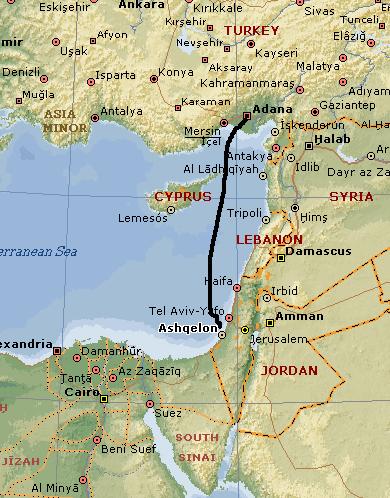

The Israelis, for their part, will make use of a pipeline from Ashqelon to Eilat. Until now, crude oil has been pumped from Eilat northward to Ashqelon and Haifa. The recently-completed "Reverse Flow Project" will allow oil and gas to be pumped in the opposite direction, from Ashqelon to Eilat (Eilat-Ashkelon Pipeline Company). From the port in Eilat, oil can be shipped further east via the Red Sea - at competitive prices (so argue the backers of the plan). The project has excited India, which is hoping to diversify its energy sources as its economy grows. China and South Korea could also benefit (People's Daily Online).

Israel currently imports most of its oil from Russia by oil tankers, which ship the crude from the Black Sea through the Bosphorus to Haifa, where Israel's refineries are located (Washington Times). Congestion on this waterway has driven up the price of shipping, which was the main reason for the recent cancellation of a deal with Turkey to provide Israel with fresh water (it turned out that the increase in shipping costs made the water more expensive than fresh water produced in Israel by its desalination refineries).

With all these pipelines, the Maccabees probably wouldn't have had to worry about making the oil last. Happy Hanukah - חנוכה שמח!

Addendum: The website of the Eilat-Ashkelon Pipeline Company mentioned above has two interactive, animated maps, giving you a very good sense of the movement of oil and gas within Israel, and from Russia, the Caucasus, and Central Asia to east Asia via Israel.

Escalation in the Palestinian Territories

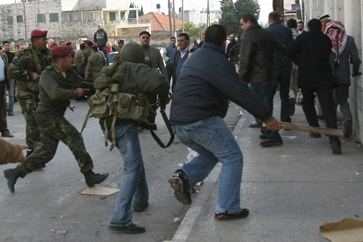
Fighting at a Hamas rally in the West Bank

My travel plans today will unfortunately prevent me from posting on the explosive atmosphere in the Palestinian territories. Suffice it to say that the alleged targeting of returning Palestinian Prime Minister Ismai'il Haniyya's car by gunmen associated with Fateh (Hamas spokespeople actually accused Abu Mazen's Presidential Guard or "Force 17") could well be the trigger that set off a Palestinian civil war in the Gaza Strip and in the West Bank. In my opinion, the events of the next 24 hours are going to be crucial. If Hamas intends to launch a full-out war against Fateh - many of its spokespeople are publicly accusing Abu Mazen of complicity in the recent events and there are rumors that a number of Fateh members in the Gaza Strip, including Muhammad Dahlan, are now on a Hamas hit-list - then they would probably start their campaign after Friday prayers (around noon their time).

Wednesday, December 13, 2006

Good News for Jews, Muslims, and Xhosa

A study by the National Institutes of Health has confirmed that circumcision reduces a man's risk of acquiring HIV from heterosexual intercourse by 50%, the New York Times reports. The NIH trials conducted in Kenya and Uganda reproduced the findings of a similar study done in South Africa one year ago. Scientists believe that uncircumcised men are more susceptible to contracting HIV because Langerhans cells found in men's foreskins easily attach to the virus. HIV positive circumcised men are also 30% less likely than uncircumcised men to transmit the virus to their female partners. A New England Journal of Medicine study published in 2002 also discovered that uncircumcised men were three times as likely to be carriers of the human papillomavirus as circumcised men. The papillomavirus has been linked to cervical cancer in infected women.

No photograph this time.

Carter Book Reviews

I've come across a round-up of reviews of Carter's new book, whose imbecilic title is Palestine: Peace Not Apartheid on the CAMERA website. We've had posts dealing with the apartheid lie in the past. It's regrettable that Carter has now joined the ranks of those on the left who are engaged in a global campaign to gradually chip away at Israel's legitimacy to exist as a Jewish state.

Tuesday, December 12, 2006

Annan Surprises with Parting Speech

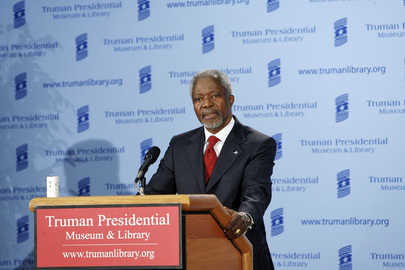
(Secretary-General Annan on Dec. 11, UN Photo)

United Nations Secretary-General Kofi Annan's final address to the Security Council is bound to raise eyebrows in the Middle East. For one, Annan scolded the Israel-bashers who have done so much to give the UN a bad name over the years:
Some may feel satisfaction at repeatedly passing General Assembly resolutions or holding conferences that condemn Israel's behavior," Annan said. "But one should also ask whether such steps bring any tangible relief or benefit to the Palestinians."

Describing decades of resolutions and a proliferation of special committees, Annan asked if this had any effect on Israel other than to strengthen the belief "that this great organization is too one-sided to be allowed a significant role in the Middle East peace process," (Ha'aretz)
.
More importantly, Annan seems to have dealt a blow to the rejectionists among the Palestinians and their allies:
The two-state solution - Israel and Palestine - must respect the rights of the Palestinian refugees, but only within the context of preserving the character of states in the region.
It remains to be seen what impact, if any, these parting words will have on the policy of Annan's designated successor, the South Korean Ban Ki Moon.

Monday, December 11, 2006

Olmert Puts Foot in Mouth Again - Or Not?

(Olmert: "It's cool. I got it.")

Israeli PM Ehud Olmert sent shock waves through the Israeli political establishment when he publicly confirmed on German television that Israel has nuclear weapons. Or that is how it is being reported. This is what Olmert actually said:
We have never threatened any nation with annihilation. Iran, openly, explicitly and publicly threatens to wipe Israel off the map. Can you say that this is the same level, when they are aspiring to have nuclear weapons, as America, France, Israel, Russia?
Israel's policy of "nuclear ambiguity" has been under the microscope again since Robert Gates's statements last week. The announcement by the incoming American Secretary of Defence raised eyebrows in Israel. It apparently came without advance warning to the Israelis and was accompanied by Gates's ominous admission that the U.S. would be unable to prevent an Iranian nuclear strike on Israel, should the Islamic Republic acquire nuclear weapons. In an earlier television appearance, Olmert had jokingly parried a question about Israel's own possession of nuclear weapons by referring the questioner to Secretary Gates. But Olmert reacted rather more seriously when asked a similar question on the SAT1/N24 channel (which, by the way, is owned by Haim Saban), resulting in the response cited above.

Israeli opposition politicians are up in arms over Olmert's alleged "slip of the tongue." Politicians from the far right to the far left called for his resignation. The ever-annoying MK Yuval Steinitz (Likud), who fancies himself to be the authority on Israel's national security dramatically referred to the PM's
"terrible statement made in Germany" which "undermines 50 years of Israel's policy of ambiguity." MK Yossi Beilin (Meretz) called into question Olmert's ability to serve as Prime Minister (Ha'aretz, Sueddeutsche).

We have previously criticized Olmert for opening his big mouth with his foot in it. But the PM's critics are the ones looking stupid now. First of all, the fact is that Olmert revealed no new information. When the American Secretary of Defence announces in public that Israel has nukes - seemingly as a justification for Iran's pursuit of nuclear weapons - is it meaningful to talk about "nuclear ambiguity"? Hardly. Indeed, it seems to me that Olmert pulled a fast one on both the Iranians and the opposition parliamentarians, who are looking rather silly with their obsolete insistence on the policy of the past 50 years. As for the "denials" by Foreign Ministry spokespeople and aides to the PM - I would not take them seriously. They are meant to assuage the parliamentarians in the short term. The point was to send a message to the world.

Notice also who did not open his mouth in protest after Olmert's "gaffe" - Netanyahu. Perhaps we will hear from him in the coming days, but I have a feeling that Bibi would have been the first to take advantage of a political opportunity if he had thought that Olmert had made a mistake. I would not be surprised if he had been previously informed of the Israeli PM's "faux pas."

So how exactly does Olmert's announcement help Israel?

Until now, Olmert has kept relatively quiet on the international stage about the Iranian threat as well as about Israel's own defensive and offensive nuclear capabilities. The Europeans, the Russians, and the Chinese have been content to split the work to allow each party to do what it is best at: i.e., the Euros have done nothing, and the Russians and Chinese have blocked American efforts to advance serious sanctions against Iran. Meanwhile, the Iranians have made terrifying announcements at Ahmadinejad's leisure, with almost no consequences for the Islamic Republic. Now, Olmert has reclaimed the initiative. He's calling the Europeans out to reveal their true colors.

Let's drop the political correctness for a second. Olmert was 100% right in framing this as a battle between civilization and barbarism. The wonderful little Holocaust denial conference that Tehran is hosting at the moment provided a wonderful background to these remarks (the Sueddeutsche has a good report; see also Genats-Lehayim). This regime must not be allowed to possess nuclear weapons. Olmert appealed to the Europe's moral conscience, just as he appealed to Germany's particular sense of moral responsibility in his talks with Merkel (see Sueddeutsche). The Europeans are now faced with some stark choices. They must decide whether to continue to equivocate and treat Israel as a pariah no more deserving of their sympathy than Iran, or to stop their relativistic moral games and come to Israel's aid. Germany and France must decide whether they really want to continue their lucrative business deals with the Iranians at the price of terrorizing Israel and threatening American troops in the Gulf. Should the international community (minus the U.S.) continue to treat Ahmadinejad as it treated Hitler before 1939, Israel will know what to do.

Iran, on the other hand, should consider itself duly warned.

Sunday, December 10, 2006

Haifa, Fixed up...

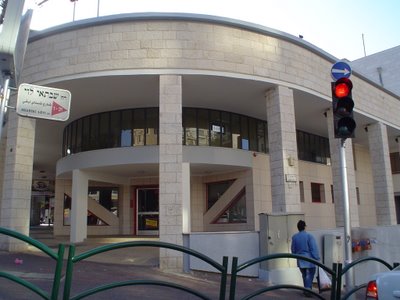
Those who followed the summer's war posts may remember some of the damage depicted in the blog. The Haifa Hadar post office has since been beautifully renovated.

Before, after having been struck by a katyusha:

After, in a recent picture:

Saturday, December 09, 2006

Narrating the Israel-Hizbullah War in Pictures

Haifa, Summer 2006 (Photo: Süddeutsche Zeitung, AP)

The New Year is approaching, which means that newspapers are starting to run their "Year in Review" pieces for 2006. I couldn't help notice a photo essay that the Süddeutsche Zeitung, Germany's best left-of-center daily, is running on the war in Lebanon, which along with Iraq and Angela Merkel, Germany's new chancellor, topped the list for biggest stories of the year. (As a side note, the pictures of Merkel with various heads-of-state, Bush, Putin, Blair, and Chirac, are absolutely hilarious and strangely sexualized; naughty editors...)

Most of the 28 images of the war in Lebanon depict the destruction and suffering of Lebanese civilians, and rightly so. What troubled me, however, was the virtual absence of any depiction of the experience in northern Israel during those terrible months of July and August. We are shown only two pictures taken within Israel itself. The first is one of those photographs of smiling children signing Israeli rockets (see John's analysis from July), which will, unfortunately, likely remain in the collective visual memory for a long time to come. The caption reads, "While in Israel, girls write messages to Hizbullah on rockets..." The second picture shows the sidewalk in front of a shattered Haifa storefront that has been cordoned off with red caution tape. The ground is splattered with some fresh blood, but it's unclear whether someone had actually died there, or "merely" been injured by the rocket that supposedly hit the store. The caption says, in characteristically pithy understatement, "Hizbullah rockets also took their toll of victims in Israel." But the victims are almost ghost-like, with no human face. The (in)human face of Israel shown to and remembered by the world is instead the smiling children who happily sent off rockets to destroy the children of Lebanon.

With the end of hostilities, the "war of public relations" becomes the war of historical representation. If this early historical narrative by the Süddeutsche Zeitung is any indication, most people in the West will be unable to remember (if they ever knew to begin with) the terror of the Hizbullah rockets documented by our Haifa resident-correspondent, Carmia, in this blog's archives. The overwhelming, and what is looking like the excessive, destruction of Beirut can be evaluated only in the context of this terror, which many have been loath to depict.

Friday, December 08, 2006

Baker is Back

The Iraq Study Group

I was hoping to read the Iraq Study Group Report before commenting but that did not work out. It actually looks quite interesting and deserves to be read and considered in its entirety, though it remains to be seen whether Baker and Hamilton will succeed in having any of their recommendations implemented.

So far, it seems that Bush has not budged an inch from his current policy, rejecting the report's call for a troop withdrawal over the next 15 months, and refusing to negotiate without prior concessions by Syria on Lebanon and by Iran on the nuclear issue ("Bush Backs Away from 2 Key Ideas of Panel on Iraq," NYT).

Meanwhile, incoming Secretary of Defense Robert Gates dropped his own bomb at his nomination hearing, telling Congress that the Iranians were seeking nuclear weapons because
They are surrounded by powers with nuclear weapons - Pakistan to their east, the Russians to the north, the Israelis to the west and us in the Persian Gulf.
The Saudi chief of intelligence
Prince Muqrin bin Abdulaziz Al Saud followed up with his own statement that
The existing Israeli nuclear capability is the most dangerous strategic threat to Gulf security in the short and medium term (Ha'aretz).
The Israelis were quick to downplay the significance of these remarks (good move) but it's clear that the writing is on the wall. The mood is changing in Washington. British Prime Minister Tony Blair's comments at a joint press conference with President Bush on Thursday that the problems in Iraq were connected to the Israeli-Palestinian conflict is further evidence that something may be afoot. Yossi Sarid seems happy about this. Maybe he is right. I wonder what Mearsheimer and Walt think about all of this.

In other news, the Kurds are apparently furious about the commission's indifference to them. See the Iraqi Kurdistan blog for more. Warning: their latest post has apparently not been edited yet.

Finally, on a less-related note, the visit of Segolene Royal, the French Socialist Party's presidential candidate, drew an ecstatic response in Israel. Daniel Ben Simon, who reports frequently on France in Ha'aretz, has a typically fascinating feature on Israel's Segolene craze. Among other things, she announced that she would pursue a zero-tolerance policy on Iran's nuclear ambitions. Sarkozy stayed fairly quiet. Instead, French Defense Minister Michele Alliot-Marie, also a presidential hopeful, stuck up for the old Gaullist, pro-Arab policy, lambasting Royal for her criticism of Hizbullah:
She must learn that irresponsible declarations could cost the lives of our people in Lebanon.
I could go with either Sarko or Royal at this point, although I am a bit concerned about Royal's less-enlightened media consultant who dropped this gem on Gaza
:
It was dreadful. Dehumanization that seemed to be taken out of one of Primo Levi's books.

Appeasing Hamas

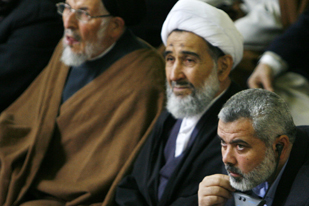
Haniyeh with some mullahs (photograph: Al Jazeera)

It's unlikely that the latest remarks by Palestinian Prime Minister Ismail Haniyeh are going to change the minds of those in Europe and elsewhere who insist that Israel negotiate with Hamas. A favored argument among these people is that the Hamas government was democratically elected, and that Israel and the U.S. are therefore obliged to talk to it. Critics of Israel's current policies vis-à-vis the Hamas government also argue that Israel's demands that Haniyeh's government honor past agreements and recognize the state's existence are somehow unreasonable. It is one thing to argue for negotiations on the basis of realpolitik. But much of the criticism of Israel and the U.S. on this particular issue is actually advanced on normative grounds of one sort or another. I have a feeling that Western Europeans and their friends in the American academy will continue to express their exasperation about Israel's policy while downplaying statements such as these, made today in Iran by the Palestinian PM:
"We will not give up our Jihadist movement until the full liberation of Beit al-Muqqadas [Jerusalem] and Palestinian land."

"The Zionists ... want us to recognize the usurpation of our land ... but these things will never happen.

"We will never recognize the usurping Zionist regime." (Source: Al Jazeera).
It is astounding that anyone would continue to insist that Israel has a duty to negotiate with the Hamas government.

Thursday, December 07, 2006

Gaza's "Besieged" Economy


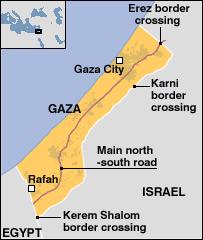
Different border crossings leading from Israel to the Gaza Strip

It turns out that the Palestinians are not doing quite as badly as everyone thinks. The International Herald Tribune reports that the UN will begin an appeal for a record $450 million in aid for the Palestinians. In the same article, however, the reporter, citing acting (Hamas-aligned) Palestinian Minister of Finance Samir Abu ‘Aisha, notes that “European aid to the Palestinians ha[s] increased by 27 percent this year.” This aid, however, is being channelled “directly to Palestinians” (to European NGOs?), something to which Hamas naturally objects. What I found especially interesting is that Hamas is actually downplaying the effect of the international "blockade" imposed on it.

According to the article,
while the U.N. emphasized the Palestinians' economic distress, the Palestinian finance minister played it down Wednesday, saying the boycott had failed to bankrupt the Hamas-led government.

Samir Abu Aisha, the acting Palestinian finance minister and a Hamas official, said his government has managed to remain fiscally afloat because Arab and European countries increased their donations to the Palestinians after the Hamas victory.
Hamas itself has managed to get its hands on more money the old-fashioned way: Abu ‘Aisha boasts that $60.5 million in cash have been carried into the Gaza Strip from Egypt.

So, who has a more accurate picture of the economic situation in the Palestinian Authority areas: The UN’s Office for the Coordination of Humanitarian Affairs, whose head, David Shearer, says that "Coming on top of the problems with access of movement, (the economic boycott) has had a massive impact on poverty levels within the West Bank and Gaza," or Abu ‘Aisha, who downplays the economic crisis and blames Israel’s seizure of Palestinian tax revenues for some financial hardship?

I think that the UN and the international community is being played or confused in a certain sense, and it’s not only Hamas who is manipulating them. Shearer highlights the fact that, "about a million people who have depended on a PA salary earner cannot do that anymore." Several weeks ago, there were a number of stories in Ha‘aretz and in the New York Times about the plight of Palestinian teachers and civil servants who were no longer getting their salaries and had gone on strike because of the embargo. The Hamas finance minister essentially refutes all these claims. He argues that all of these groups continue to be on strike not because they are not getting paid, but for political reasons, namely their opposition, as Fateh-members, to Hamas.

The lesson of all of these mixed messages is that EU donors must remain vigilant and consistent and ignore hysterical calls (from their chattering classes and other quarters) to re-instate aid to Hamas. Until the demands formulated by western donors, who have called on Hamas to renounce violence, recognize Israel and accept past peace agreements, are not met, every effort should be made to keep Hamas from getting its hands on more money.

In other news, trade in all kinds of goods continues between the West Bank and the Gaza Strip. As a trade consultant, I regularly monitor the Israel Customs Authority website. Today, I came across this interesting tidbit:

ט"ו כסלו, תשס"ז
‏6 דצמבר, 2006

תפיסת חשיש במעבר קרני לעזה

במהלך בדיקות טובין, שביצעו חוקרי יחידת הסמים של רשות המיסים במעבר קרני, נבדקה משאית שהובילה תרופות שונות מיו"ש לעזה.
חשדם של החוקרים עלה כאשר בתא הנהג של המשאית נמצאו במהלך הבקורת 4 קרטונים של חטיפים.
מבדיקה שערכו החוקרים נמצא שלקרטונים יש תחתית כפולה ובתוכה הוסלקו 20 חבילות של חומר החשוד כסם מסוג חשיש במשקל כולל של 2 ק"ג.
נהג המשאית ובעל החברה של החשוד נחקרו והועברו, יחד עם החומר החשוד כסם, למשטרת ישראל להמשך חקירה ומעצר.
המשאית נתפסה עד לסיום החקירה.

The above is a press release by the Israel Customs Authority dated December 6, 2006 in which they announce the seizure of 2 kg of hashish at the Karni crossing (from Israel to the Gaza Strip) in a truck carrying medical drugs from the West Bank to the Gaza Strip.

Tuesday, December 05, 2006

Peaceful, Modern, and Democratic: Street Life in Beirut

Hezbollah guys in wigs, Hezbollah girls showing their thongs, loofah's on poles. It sounds like last Friday's protest in Beirut was a blast. To get a handle on just how bizarre a place Lebanon is, read this short report from Annia Ciezadlo in The New Republic.

Sunday, December 03, 2006

More Idiocy Disguised as Security

Muslims leading a prayer-protest at the Minneapolis-St. Paul Airport in November

If there is one thing that at which American air safety officials seem to excel, it is inconveniencing and harassing innocent airline passengers without actually making the U.S. safer from terrorist attacks. The recent removal of six imams from a US Airways flight after they had been observed praying at the Minneapolis-St. Paul terminal, is a case in point. American "security" officials, as well as more and more "regular" Americans seem to believe that they are being conscientious when they pick on people who deviate from the norms of white bread America. Even Canada, the self-declared haven of multiculturalism, is no longer immune from this idiocy. In September, a Hasidic Jew praying on an Air Canada Jazz flight was arrested for "making other passengers nervous":
"He was clearly a Hasidic Jew," said Yves Faguy, a passenger seated nearby. "He had some sort of cover over his head. He was reading from a book.

"He wasn't exactly praying out loud but he was lurching back and forth," Faguy added.

The action didn't seem to bother anyone, Faguy said, but a flight attendant approached the man and told him his praying was making other passengers nervous.

It seems to me that North Americans simply go on auto-mode when confronted with certain "suspicious" indicators. No doubt, the airlines have an extensive unpublished list of infractions (such as praying or wearing unusual clothing) that set off specific procedures. Once an infraction is reported, it becomes impossible to reverse course - no matter how obvious it becomes to everyone involved that the person singled out is completely innocent. Meanwhile all those who seem "scary" by virtue of their difference from the rest of society - be they imams or haredi Jews - are publicly humiliated.

All this might be justifiable if security officials actually apprehended terrorists. But their current modus operandi is probably making it more difficult to catch those determined to blow up airliners. The root of the problem is ignorance - the same kind of ignorance exhibited by top American security officials and lawmakers who were unable to tell a reporter whether Iran and Hizbullah were Sunni or Shi'a (see John's post). To make up for the cluelessness of the people on the ground as well as the higher-ups, the Americans have tried to implement complex data collection systems, which present enormous costs (to the civil liberties of American citizens as well as to their pockets) with very little benefits. Again, the emphasis is on specific, isolated threat indicators, rather than on holistic assessments of individuals carried out by people who actually know things.

For example, it seems that since 2002, Homeland Security has been assigning threat scores to all travelers leaving and entering the U.S., with something called the Automated Targeting System. As is to be expected from this administration, these data collected on American citizens and foreigners are shared with private companies, state and federal government agencies, and foreign countries, without monitored travelers having any access to their "report cards." The Associated Press reports that

Almost every person entering and leaving the United States by air, sea or land is assessed based on ATS' analysis of their travel records and other data, including items such as where they are from, how they paid for tickets, their motor vehicle records, past one-way travel, seating preference and what kind of meal they ordered.

I now know why I was told by my travel agent last March that ordering a kosher meal would put me on an anti-terrorism watch list.

As you might expect, collecting data on the meal selections of history graduate students is unlikely to prove effective in catching terrorists. This might explain the government's laconic response to inquiries about ATS's efficacy. According to the same article, "Government officials could not say whether ATS has apprehended any terrorists."

Friday, December 01, 2006

France: Racism Down, Antisemitism Fairly Stable

Police officer Antoine Granomort in front of the McDonald's where
he fired his gun at the hooligans (STEPHANE DE SAKUTIN, AFP)

Le Monde reports that the latest statistics from the direction générale de la police nationale (DGPN) reveal a 24.3% drop in racist hate crimes, and a 3.5% decrease in antisemitic acts, in 2006. Racist and xenophobic crimes went down from 378 in 2005 to 286 in 2006. According to the statistics, 436 anti-Jewish hate crimes (threats, insults, harassment, and violence) took place this year. In 2005, there were 452 such crimes.

Anti-Jewish hate crimes are down significantly from the peak of 974 in 2004. However, the number of violent crimes committed with antisemitic motives rose to 97 in 2006; a 14% increase over the 85 reported in the previous year. The secretary general of France's National Commission on Human Rights, Michel Forst, commented that

En 2005, nous avions été déjà frappés par la hausse significative de la gravité des actes ... On perçoit un faisceau de phénomènes : une hausse générale des violences aux personnes en France, une radicalisation de certaines opinions, une sensibilité toujours très forte aux événements internationaux. [In 2005, we were already struck by the significant rise in the gravity of the acts. We perceived a cluster of events: a general increase in violence perpetrated against people in France, a radicalization of certain attitudes, and an ever strong sensitivity to international events.]

In other words: when there is trouble in the Middle East, French Jews must fear for their safety.

The article in Le Monde begins with a reference to the recent events at Parc des Princes, where a black police officer defended a Jewish football fan from a group of racist and antisemitic hooligans (see our earlier post).