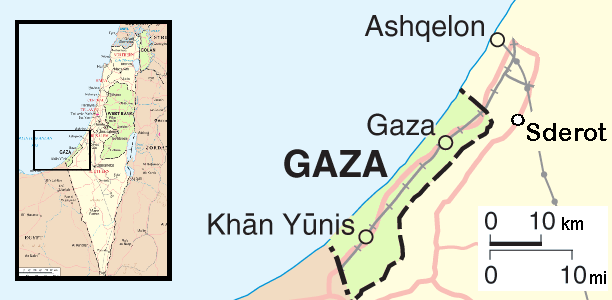
While the much-anticipated Gaza offensive by the IDF is far from operational, it appears that the Palestinians are planning an offensive of their own against Israel. We will find out in a few hours how Hamas's attempts to replicate last month's border-breaching action turn out. Unlike the well-planned events that transpired on the Egyptian border with Gaza in January, however, any such actions at the Erez crossing and other sites will lack the crucial element of surprise. It remains to be seen how the world would react to such a mass demonstration. It is likely to increase pressure on Israel to lift the blockade on Gaza, although the chaotic scenes on the Egyptian border did not exactly bolster the reputation of the Hamas government on the international scene.
A staged "popular" mass action, choreographed for international cameras, perhaps involving the deaths of a few civilians sent to the fence will provide plenty of ammunition for those long opposed to Israel's blockade of Gaza. From the beginning of this embargo, which followed the election of Hamas in January 2006, the blockade has been denounced for its injustice; the fence on Israel's southern border has been denounced as a "cage" and an "apartheid wall." Such condemnations are ludicrous. There is nothing immoral about Israel's blockade of the Hamas government in Gaza. We are talking about a fence that basically runs along armistice lines - the route of the border is not in dispute, except among those who oppose the existence of the Israeli state in toto. No state has an obligation to open its borders to non-citizens, let alone to those from a hostile country. It is quite telling that no one has ever described the blockades of Israel by the Arab states as "apartheid."
I may be wrong, but the practice of sending civilians to deliberately violate the sovereignty of a neighboring state seems to me unprecedented. It is, however, indicative of the mechanisms of rule employed by Hamas in Gaza and previously by the Palestinian Authority in the West Bank. When Israel unilaterally withdrew from Gaza, it did so with the expectation that the Palestinians would establish sovereignty in the territory and perhaps focus on building institutions resembling those of an independent state.
With Israeli forces and settlements gone, it seemed to many Israeli and international observers that the key motivations for armed struggle would be eliminated. But the Palestinians have done nothing of the sort. Instead, the terrorist organizations and later the Hamas government have banked on a kind of anarchic, anti-sovereignty to legitimate their authority and rule. From the beginning of this new state of affairs, Hamas has fostered all the attempts to improve the qassam rockets and launching operations that daily terrorize the residents of the western Negev. No real effort has been undertaken to better the economic situation of ordinary Gazans. The only improvement that Hamas rule has achieved is entirely destructive - the various gangs of terrorists have become better at firing rockets at Israeli civilians. I refer to this as "anti-sovereignty," because the Hamas government has deliberately abstained from establishing a monopoly of violence, instead fostering a competitive atmosphere of factions whose sole reason for existence is the violation of Israel's sovereignty, by continually endangering Israeli civilians.

In other words, the Hamas government cannot be expected to act like a rational state. This government thrives on the state of siege and tension that it prolongs with every qassam launch. Its domestic and international support rests on the misery of its population, which is attributed entirely to Israel - despite the fact that the occupation ended two years ago. The obvious parallel to the situation which the Hamas government is aiming for is that of post-withdrawal southern Lebanon. How one deals with such an entity - on the military, economic, and diplomatic fronts - is still an open question.