Israelis distrust the UN as it is. European taxpayers should be second on the list. The way things are looking now, it seems that they're being asked to bankroll a useless mission.
Tuesday, October 31, 2006
Hizbullah "Not Worried" About UNIFIL
Ha'aretz reports: In an interview he gave on Tuesday evening to Hizbullah-aligned satellite TV station al-Manar, Nasrallah asserted that he is not worried about UNIFIL. In his words, nothing about UNIFIL's composition suggests that its aim is to disarm Hizbullah or that it is capable of doing so. Nasrallah's rhetoric confirmed what most UNIFIL critics have been asserting all along. The latest re-incarnation of UNIFIL, with its large Italian and French components, is all show, no action. . French UNIFIL commander Gen. Alain Pellegrini has been sabre rattling against Israel on the issue of Israeli Air Force overflights in Lebanon, and his forces even prevented an Israeli raid on Hizbullah, but they have absolutely no intention of tackling Nasrallah's terrorist movement, which is at the root of instability in Lebanon. To the contrary, in his interview, Nasrallah almost makes it seem as if UNIFIL accepted his patronage. In his words, the countries contributing troops to UNIFIL contacted his organization before sending their troops to Lebanon in order to get guarantees from him, presumably regarding their safety. Nasrallah, it appears, was magnanimous enough to grant those guarantees in exchange for ...hmmm, perhaps a commitment that French and Italian troops would spend their time on the beach, rather than tracking down the militia's weapons?
Israelis distrust the UN as it is. European taxpayers should be second on the list. The way things are looking now, it seems that they're being asked to bankroll a useless mission.
Israelis distrust the UN as it is. European taxpayers should be second on the list. The way things are looking now, it seems that they're being asked to bankroll a useless mission.


Wednesday, October 25, 2006
UNIFIL-Israel Tensions Rise
 German Navy Frigate Mecklenburg-Vorpommern
On Wednesday, German newspapers reported (see e.g. FAZ) that there had been an "incident" involving Israeli F-16s and a German navy vessel off the Lebanese coast. The German press reports claimed that six Israeli fighter jets overflew the UNIFIL vessel at low altitude, and that they had dropped infrared decoy flares (which are meant to throw off anti-aircraft fire), and that two shots had been fired into the air from the cannon of one of the jets. Of course, Israel reacted at first by rejecting the account entirely, with Minister of Defense Amir Peretz denying that there had been any such incident. Later, the IDF spokesperson acknowledged that there had in fact been an incident involving a helicopter, ship, F-16s, and infrared decoys but that the reports in the German media of shots having been fired were incorrect.
According to the IDF (see Ha'aretz), the incident began when the Air Force spotted unidentified helicopter off Rosh ha-Nikra on Tuesday morning. Two F-16s were scrambled to investigate. Upon seeing that it was a German Navy helicopter, the planes returned. The spokesperson explained that the helicopter flight had not been coordinated with Israel, and that this was the reason that this situation had arisen. The Israeli government took pains to reassure the German government that UNIFIL personnel were not in danger.
Germany currently has 2 frigates, 2 transport helicopters, 4 speedboats, and 2 supply ships covering a 50 x 130 nautical miles area off the coast of Lebanon and northern Israel. The zone for which the Germany navy vessels are responsible begins 12 miles west of the Lebanese shore. There are approximately 1,500 sailors manning those vessels, with another 900 servicemen responsible for logistics and training. Their mission is to stop Hizbullah weapons smuggling (FAZ).
Thank God no one ended up being hurt. I'm inclined to believe the German reports rather than the IDF's version. This incident is not the first confrontation between IDF and UNIFIL forces. Several weeks ago, a short standoff ensued between Israeli forces and a French tank unit just across the border in southern Lebanon. The incident was not widely reported. The latest incident, of course, occured against the backdrop of the stern warnings by the French UNIFIL commander in Lebanon, Alain Pellegrini, that his forces would fire on Israeli jets continuing overflights of Lebanese airspace. Peretz has said that Israel will continue those flights. Israel expressed its hopes for better cooperation between UNIFIL and IDF forces in the wake of this event. I am not sure whether the incident on Tuesday was simply due to a lack of coordination, or whether the Israelis were also trying to "test the waters." In any case, it's worrisome that there could be more such confrontations, which might not end so well. Even scarier for Israel, of course: it's becoming increasingly clear that UNIFIL is doing almost nothing to prevent Hizbullah from re-arming and digging in again. The overflights are the only means of monitoring those activities that Israel has at its disposal. Why can't the French be a little more understanding on this point? Are they trying to appeal to Lebanese public opinion?
Sunday, October 22, 2006
Kurds, Azeris, and the Disintegration of the Middle East
 The Middle East, October 2006
An October 20 post on EurasiaNet reports that "Iranian officials are intent on keeping a lid on ethnic-minority discontent, as the country prepares for pivotal elections." The article focuses on Iranian sensitivity about an apparent resurgence in Azeri self-assertion.
Azeris, who speak a Turkic language and are mostly Shi'a, make up a quarter of Iran's population of 68 million, according to estimates. Most Azeris live in northern Iran, near the borders with Azerbaijan and Armenia. The Azeris of Iran were last in the international news spotlight when a state-owned paper published a caricature representing an Azeri as a cockroach. In the wake of that caricature's publication, which also mocked Azeris for not being able to speak Farsi, Azeris staged demonstrations, some of which turned violent. In September, protests flared up again, with a number of Azeri organizations demanding greater cultural rights. Since then, a number of Azeri activists have been arrested.
But until now, Iranian Azeris have been loyal to the state. Azerbaijan has also been careful not to antagonize its powerful southern neighbor. Certainly, tensions between the state and the Azeri minority cannot be compared to the difficult history of the country's Kurds. Iranian Kurdistan is in the northwest of the country, and is home to about 4 million Kurds. Unlike the Azeris, Iranian Kurds do not yet have a state on the other side of the border to which they might turn if things get rough. But the American invasion and subsequent (failing) occupation of Iraq has allowed the Kurds of Iraq to move closer and closer to independent statehood.
What the Kurds and the Azeris share is a history of suppression by one or more of the region's dominant ethnic groups and their representative empires: the (Muslim) Arabs, Persians, and Turks. Their claims to historic territories and to distinctive national identities were not recognized in the post-Ottoman and post-colonial orders. There are a number of other historic ethno-religious minorities in the Middle East: the Druze, Circassians, Assyrians, Armenians, Maronite Christians, and the Jews. Of all these small ethnic groups, the Jews, who benefited from a strong diasporic nationalist movement have been the clear winners of the post-colonial order. Most of the other minorities suffered genocide, deportation, and/or subjugation at the hands of one of the dominant ethnic groups. (Jews suffered the century's most horrific genocide - but mostly on European soil. Though Middle Eastern Jewry faced acute danger from Arab nationalists during and immediately after WWII, and massive displacement post-1948, it was spared genocide, and instead gained sovereign statehood together with European Jews who migrated en masse to the region after the Shoah).
Most of those watching the Iraq war and its fallout have focused on the impact of the American invasion and occupation on Iraqis. One of the most dramatic and lethal consequences of Saddam's collapse has been the civil war between Sunni and Shi'a in the country. But the current carnage represents only the preliminary phase of the far more bloody struggle that will break out to determine the new borders of incipient Kurdish, Sunni, and Shi'a states when partition becomes a real possibility (i.e., when the Americans leave). The fall of the Saddam regime also sounded the death knell for the old, Arab-nationalist (sometimes mistakenly called "secularist" - in fact, no truly secular national identity has ever emerged in the Middle East) visions of the region. The disintegration of Iraq is rendering a non-sectarian Arab national identity impossible. It is also empowering those minorities who never quite fit the paradigm.
It has become increasingly clear that Iraq is headed for a tripartite division among Kurds, Sunni, and Shi'a. While the latter two groups can count on the backing of Arabs (i.e., the Sunni states and the Islamist organizations) and Persians (Iran), the establishment of an independent Kurdistan faces the opposition of all three traditional dominant groups - Arabs, Persians, and Turks. It also unlikely to take place without the type of ethnic cleansing so familiar to 20th-century historians of Europe. In turn, the formation of a Kurdish state would provoke further crackdowns by various regimes against minority populations such as the Azeris in Iran. This would put increasing pressure on "protector states" such as Azerbaijan to attempt interventions against their more powerful neighbors, in order to liberate their irredenta. In short, the potential for momentous border revisions and waves of deadly ethnic strife has never been greater.
Thursday, October 19, 2006
Israel's Illegitimacy
 Ahmadinejad: Israel is illegitimate
The Iranian President Mahmoud Ahmadinejad's believes that Israel is an "illegitimate state," Reuters reports:
"Our nation has previously announced that this regime is illegitimate from its foundation. It is fabricated. It has been imposed on the nations of the region and it cannot survive."He is probably not too far from the consensus in much of the world today. In the vocabulary of its many critics, Israel is an unnatural, abnormal, cancerous, out of place, and anachronistic colony. For many on the "global left," it is a common-place that Jews are "not indigenous" to the area. Never mind that this is a whole lot of nonsense. Even this statement were true, I find it funny that such an argument becomes acceptable in the context of the Middle East. I mean, what would we call someone who argues that Moroccans are not indigenous to Denmark and that their presence there is therefore "illegitimate" or problematic?
"The existence of this regime [Israel] is the root of many problems of mankind today," the president said, adding that Israel had been "founded by the major powers in the heart of the Islamic world".
Cracks in the Republicans' Armor
All those who see American politics and foreign policy as driven by a well-organized and invariably unified rightist bloc should take heart. As many news stories these days indicate, the political climate is becoming less and less favorable for the Republican party in the US, with many Republican candidates running away, as it were, from President Bush, while Democratic candidates seem to put Dubyah's name in the conversation every chance they get. I noticed this the other night in a debate between Republican Senator Rick Santorum of Pennsylvania and his opponent, State Treasurer Bob Casey. Casey just couldn't say "George Bush" enough. What's more important for America's role in the world than simply the Republican Party's inevitable ebbing is the fracturing of that very party, in recent times controlled by dogmatists who intoxicated their political brethren in the center with victory after victory. This is the message of stories like the WaPo's piece today out of Kansas. The reddest of Red States, which was only two days ago profiled in the NYT of being -- of all things -- a refuge for Dick Cheney (his approval rating is 20% nationally), which hasn't put a Democrat in the Senate since the Depression, is seeing a number of high profile Republicans turn Democrat. Why? Because these guys, these mainstream Republicans, so to speak, are sick of the zealotry, the messianic politics. This marriage of convenience is a national phenomenon, but has an interesting backhistory in Kansas, where it has always been a rocky relationship, as chronicled extensively by Thomas Franks in his celebrated book What's the Matter with Kansas.
Wednesday, October 18, 2006
Sunni or Shi'a?
 Rep. Jo Ann Davis (R-VA): “It’s a difference in their fundamental religious beliefs. The Sunni are
more radical than the Shia. Or vice versa. But I think it’s the Sunnis who’re more radical than the Shia.”
According to a recent New York Times article, some US counter-terrorism officials and Congress members charged with oversight over America's intelligence agencies don't have a clue about the Middle East or Islam. Asked whether Iran and Hizbullah were Sunni or Shi'a, Willie Hulon, chief of the F.B.I.'s new national security branch took a wild guess - the wrong guess. Read more about it here. See also our recent post on general idiocy in the American security sector.
Tuesday, October 17, 2006
U.S. Lodges "Vigorous Protest" Over Entry Restrictions
 US Ambassador to Israel Richard Jones, Losing Patience (and thinking
that maybe the food at the Independence Day celebrations should have been kosher after all)
Aluf Benn writes that
The United States government has lodged a vigorous protest with Israel over its restrictions on the entry of Palestinian-Americans into the territories.Kishkushim has previously blogged about the denial of entry to Palestinian-Americans, which hit new highs (or lows) shortly after the kidnapping of Gilad Shalit. It seems that the Americans have finally had enough of Israeli foot-dragging on the matter. Although the U.S. has declared several times that it respects Israel's right to determine who may enter the country or territory controlled by it, American officials must have found it difficult to countenance the thought of some of their citizens being discriminated against at the border in this manner. The "diplomatic source" quoted by Benn as saying that the "individuals involved have been blacklisted for security reasons, based on targeted intelligence" is full of it. If we were only talking about such individuals, the U.S. would not be complaining. Certainly Israel is justified in denying entry to suspected terrorists, even those with American citizenship. But the large majority of those Palestinian-Americans being denied entry have no connection to terrorism. In fact, their investments in the local economy may some day provide alternatives to the regime of the militias (for the pessimists or realists out there, I said "one day").
ADDENDUM: My sources tell me (thanks guys!) that the embassy has complained many times previously about this issue, apparently at fairly high levels. At an October 11, 2006 keynote address delivered at the American Task Force on Palestine Inaugural Gala in Washington, D.C., Secretary of State Condoleeza Rice also implicitly referred to the problem:
I realize that the continuing problems of security are also a great challenge for many Palestinian-Americans living in Gaza and the West Bank – and for so many others, including many of you, who travel there often, who work for greater tolerance and understanding, and who invest your time, and your knowledge, and indeed your capital in the Palestinian territories. People like you have a vital role to play in the Middle East, and I will continue to do everything in my power to support your good work, and to ensure that all American travelers receive fair and equal treatment.
Next Round: Gaza

In an article published yesterday in Ha’aretz, military commentator Amos Har’el suggests that Hamas is preparing for a full-out military confrontation against Israel in the Gaza Strip. Har’el cites senior IDF officers as saying that Hamas has smuggled 20 tons of explosives as well as anti-tank and anti-aircraft missiles into the Gaza Strip since the beginning of last year. Apparently, the smuggling of military hardware and know-how has intensified in the past two months at the behest of Hamas’s Damascus-based leadership. Hamas was clearly encouraged by Hizbullah’s tactical successes in southern Lebanon. The goal of this arms build-up is to deter deep Israeli military incursions into the Gaza Strip and to thus allow Hamas to continue firing Qasam rockets and improvements on them into the western Negev. Until now, the group’s militants in the Gaza Strip have not been nearly as successful as Hizbullah at inflicting casualties on Israeli troops and armour, but the IDF has yet to conduct land-based raids into urban centres in the strip. Unfortunately, it seems almost inevitable that such raids will take place at some point in the near future. Unless there are some major political breakthroughs on the Palestinian side, I think that it’s quite likely that the IDF might even embark on an operation to re-conquer the Gaza Strip in the coming year. No one in the IDF general staff wants to be held responsible for allowing the build-up of another Hizbullah-like force on Israel’s south-western flank. Hizbullah had about six years to build an extensive network of tunnels and outposts along the Israeli-Lebanese border and to deploy thousands of short-range missile launchers in the south. Israel is unlikely to sit idly by while this process repeats itself in the Gaza Strip.
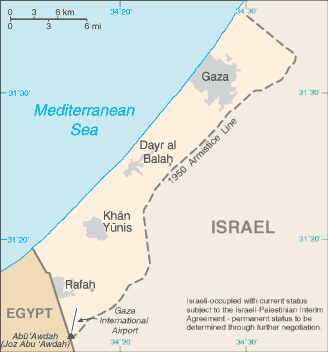
Granted, Hamas faces a few more supply hurdles than Hizbullah, which received active aid from neighbouring Syria and did not even have to contend with nominal border controls. However, Egypt’s control over the Sinai and over the tunnels that link the Egyptian town of Rafah to its other half in the Gaza Strip continues to be unimpressive to say the least. I had the opportunity to get a close look at how Egypt’s border controls work when I took the bus from Tel Aviv to Cairo in April 2005. Back then, before the disengagement, the Israelis still controlled a border crossing terminal on the Palestinian side of Rafah. Once we passed through the Israeli border inspections and reached the Egyptian side (a Palestinian driver charged about $5 for a 2 minutes bus ride between the two terminals), everything got a lot slower and less efficient. The Egyptian terminal itself looked like a mini-war zone. But I digress – it’s not nice picking on 3rd World countries in any case. The fact is that they don’t do a good job clamping down on weapons smugglers (even technologically advanced states have trouble doing so) and that their personnel is easily bribed. Meanwhile, the EU border officials/monitors deployed, together with Palestinian guards, on the Palestinian side of the border seem to play only a symbolic role at this stage. The EU’s hope of playing an important confidence building role by pretending to make an effort at interdicting terror suspects and smugglers moving from the anarchic Egyptian northern Sinai into the Gaza Strip has dissipated.
Sunday, October 15, 2006
Mearsheimer and Walt Land Book Deal, and Cooper Union Stages Tense Debate
 Crowd Favorite Rashid Khalidi
Mearsheimer and Walt simply refuse to lose. The Jewish Daily Forward reported last week that the two political scientists have signed a deal with the prestigious American publisher Farrar, Straus and Giroux to expand their controversial article "The Israel Lobby," which first appeared in March in the London Review of Books, to book length. “I think there’s a lot of interest in these ideas,” said Philip Weiss, who has covered the debate surrounding the article for The NY Observer and The Nation. “The conversation’s just begun.” And this from Sam Freedman of Columbia U.'s journalism school:
The imprimatur of being published by FSG is hard to match... When a publishing house with its credibility and its reputation acquires a conspiracy theory, it can’t help but make that conspiracy theory look more valid than it deserves to look.Contrary to Amos's post from Thursday on the "Tony Judt Affair," Walt and Mearsheimer have not withdrawn their biggest claims. Yesterday I watched a video of Mearsheimer defending all the original theses at a public debate dedicated to the question of the Israel lobby and its influence, held three weeks ago (Sept. 28) at Cooper Union in Manhattan and sponsored by the London Review of Books. The event doesn't seem to have been covered in the New York Times, but it definitely appeared in the Jewish papers The Forward and The Sun. I encourage everyone who has the time and interest to watch the video webcast of the two-hour debate, which I liken to an academic equivalent of a heavyweight boxing match. It was an open, passionate, balanced and well-moderated discussion, more reminiscent of events I used to attend at Columbia than the farce I was witness to on Sept. 7 at the "teach-in against war" at UC Berkeley--correctly described in the pages of Kishkushim as a "sickening exercise in group-think" (the very opposite of the open discourse its speakers purported to support, I might add). I guess it's not entirely fair to compare the two events at all, given that the latter was not an open exchange of ideas but rather, with little exception, a convention of students and teachers congratulating themselves for opposing Israel. For those of you willing to trust my reportage, what follows is a digest of what happened; I've tried to be as objective as possible in my analysis.
Officiated by Anne-Marie Slaughter, dean of the Woodrow Wilson School of Public and International Affairs at Princeton, the contenders included:
- Shlomo Ben-Ami, former Israeli foreign and security minister, a self-described follower of Yitzhak Rabin, author of the recently-published Scars of War, Wounds of Peace: The Israeli-Arab Tragedy
- Martin Indyk, former U.S. ambassador to Israel (1995-97; 2000-01) and director of the Saban Center for Middle East Policy and Senior Fellow in Foreign Policy Studies at the Brookings Institution
- Tony Judt, professor of history and director of the Remarque Institute at New York University (who is not as strange-looking in person as the unflattering picture included in previous posts suggests...)
- Rashid Khalidi, Edward Said Professor of Arab Studies and director of the Middle East Institute at Columbia University
- Dennis Ross, former envoy and negotiator in the Middle East under Bill Clinton, currently of the Washington Institute for Near East Policy (WINEP)
- and of course the man of the day, John Mearsheimer, professor of political science and co-director of the Program on International Security Policy at the University of Chicago.
Slaughter opened with a question for Mearsheimer that's been the touchstone of much of the discussion since March: "Do you think your article was antisemitic?" Mearsheimer obviously denied it. Indyk offered that it "is, rises--or lowers--itself to the level of antisemitism" by defining the pro-Israel "lobby" in America as a "loosely aligned group" of anyone who at one time or another has supported Israel, amounting to a sort of "cabal." Dennis Ross essentially agreed with Indyk on this point. Ben-Ami, consistently the most reasoned voice on the panel, said that M&W's article "lends itself to the accusation" of antisemitism by presenting a "single-cause explanation" for American foreign policy blunders.
The last two to speak on the first question were Tony Judt and Khalidi, who sounded similar notes throughout the debate, namely, what they've been writing in New York Times op-eds and in other publications: that American public discourse on Israel is stifled and even censored. Khalidi said, “If you believe that there are two sides to the debate in this country on this issue, then you are out of your mind.” Judt recounted an anecdote about the famous Stalinist-turned-anticommunist Hungarian-turned-British-Jewish writer Arthur Koestler, speaking 60 years ago in Manhattan about the danger of the emerging Soviet bloc, when he was accused by an audience-member of fueling Nixonism (later known as McCarthyism); according to Judt he responded by saying, "You cannot help it if idiots and bigots share your views for their reasons. That doesn't mean that you can be tarred with their views." He worried that when an article like Mearsheimer's appears, American intellectuals immediately rush to assess whether or not it is "antisemitic" instead of dealing with its actual content. I agree with Judt that efforts by people like Abe Foxman, who "tar" Mearsheimer with the names of David Duke and Pat Buchanan, can and do stifle open discourse. It should also be noted, however, that Judt went the rest of the night without so much as one peep regarding the actual content of the Mearsheimer article. Perhaps he felt that others on the panel would do it for him? Or maybe he just didn't want to jeapordise his position as the voice of the "left"? Either way, I found it somewhat hypocritical, intellectually and politically irresponsible. (Let me go on record saying that otherwise I have the highest regard for Tony Judt's scholarship.)
After the first round of answers, the battle lines were drawn. There was a clear divide between the agendas of the speakers. The political scientists and establishment figures--Ben-Ami, Ross, and Indyk--wanted to keep the debate to the topic of Mearsheimer's article in order to expose its errors and bury it once and for all; the non-establishment professors--Judt and Khalidi--clearly thought the panel should be about how censored and one-sided the "discourse" around Israel is in the U.S. The tension resulting from these divergent agendas (not to mention views!) made for some nasty exchanges and probably could have degenerated into an actual fist fight had the speakers been 30 years younger and hadn't been held in check by Slaughter. It didn't help that Ross, the current director of a think-tank Khalidi once called "the fiercest of the enemies of the Arabs and the Muslims" and "the most important Zionist propaganda tool in the United States," was seated directly next to him. [Kudos to whoever orchestrated that.] As if it were planned, about midway through Ross's microphone failed, and Khalidi gave Ross his and said, "You mean, this is the first case of a Palestinian giving permission to narrate?" The audience roared joyously at this quip. Ross had some disappointing comeback about his having always tried to empower Palestinians, but he stood no chance against the crowd favorite.
To the accusation of having created the impression of a Jewish cabal, Mearsheimer replied that the Israel lobby was not secretive, thus not a cabal. He repeated his typical argument that interest-group politics are completely legitimate and normal in a democracy, and then proceeded to quote a passage from "Chutzpah," the 1991 best-seller by Alan Dershowitz (whose name drew spiteful laughter from the audience): "My generation of Jews became part of what is perhaps the most effective lobbying and fundraising effort in the history of democracy. We did a truly great job as far as we were allowed ourselves and were allowed to go." Mearsheimer used this to show that the very Dershowitz who came out most vociferously against the M&W paper admitted the Lobby's power. Indyk rebutted that what M. lumps together as the "Lobby" is actually a fractious group of people and organizations that often differ wildly on policy issues; for example, Indyk himself was branded by AIPAC as "anti-Israel" when he pushed the Netanyahu government to work toward peace. Furthermore, Indyk continued, M.'s use of words like "distort" and "bend" (as in, the Israel Lobby distorts and bends American foreign policy) and "ubiquitous" implies a sort of Jewish conspiracy.
Judt then intervened: "If I can just shift the angle of the conversation..."
Slaughter: "Maybe."
"Okay, try me." Judt went on to say that it is the nature of lobby groups to "distort" -- just as the NRA distorts foreign policy. "This is the crucial point about the Israel lobby--or group of lobbies, or whatever you want to say: there are hundreds of distorting lobbies. It's one of the ways in which our political system is defective. This is the only significant lobby I know of which not only acts to advance the interests of its cause but acts constantly and very effectively to silence criticism of its cause. This is not the case with other lobbies."
[RAUCOUS hollers and applause]
Ross: "[...] Tony maybe you haven't paid a whole lot of attention to the NRA. I think they're pretty good in terms of trying to silence their critics [...]."
Khalidi jumped in at this point, in a way only a professor would. "I think there are several problems with the whole discussion that's preceded," he said. To my surprise, unlike Judt Khalidi did actually voice his disagreement with Mearsheimer on the issue of the the Israel lobby's influence over American foreign policy - in particular its influence over the decision to invade Iraq, which Mearsheimer believes would not have been made without it. [Note: at one point in the debate, when M. said, "[...] in [the Lobby's] absence, we probably would not have had a war," the crowd erupted in hoots and hollers applauding him.] But if M. overestimated the lobby's influence in that regard, Khalidi claimed, he UNDERESTIMATED it with regard to domestic legislation and "public discourse" in the U.S. Khalidi then made several vague and cryptic remarks that seemed, at least to this observer and to at least one audience-member who asked about it in the Q&A session afterwards, to imply a type of Jewish domination over Congress and American media. What bothered me was that he never came out and said it; instead he danced around the issue, protecting himself in a cloud of ambiguity - but his point was fairly clear. Slaughter correctly recognized that Khalidi's argument about the power of the Israel lobby was "actually far broader than Mearsheimer's." In essence, he was saying that Mearsheimer had identified the culprit but mistaken the crime: The Israel Lobby wasn't responsible for the Iraq war (thanks, Rashid!), but it WAS guilty for post-9/11 legislation limiting civil liberties and for the stifling of "public discourse" on the Middle East. Again, he never actually said the words, but to me there was no mistaking the implication.
Indyk drew hisses when he claimed that there had been no censorship on discussion of the Mearsheimer article since March, and loud "boos" when he said that "if [the article] wasn't published in America, it was probably because it was such a dreadful piece of scholarship." [Indyk was the audience's clear choice for villain of the debate.] Judt replied on the question of censorship that when he submitted an op-ed to a "very well known North American newspaper" (most likely the NY Times, where he published this on the M&W debate), the editorial page editor asked him whether or not he was Jewish. "But they published it!" Indyk said. Judt responded, "I told them I was Jewish!"
Finally, after the Khalidi-Judt tag-team intervention, Slaughter directed the speakers back to the content of the M&W article. Ben-Ami, insisting again and again that the Israel lobby should not be scapegoated, had some great lines. For example, "You [Americans] have elected, twice, a president who is a political theologian without Jewish votes. [The war] is an American responsibility... [The Bush administration] doesn't NEED a Jewish lobby to do the things that it does." He also made the important point that the government of Israel is almost entirely absent from Mearsheimer's account. Israel as an entity is in common dialogue with the U.S. administration as a major ally. On the issue of Israeli settlements in the occupied zones [Ben-Ami is an outspoken opponent of them], Ben-Ami said that we must hold Knesset politicians responsible, not the American Israel lobby. Various geopolitical factors, not AIPAC, prevent the United States from "imposing peace" on the region or pressuring its ally to force out settlers. Indyk concurred, adding that sometimes, you can't get sovereign countries to do what you want them to do. Judt, like Gideon Levy (see Amos's recent post) a vocal advocate of U.S. "strong-arming" in Israel, predictably countered that most of the time the U.S. can get what it wants.
At another point in the debate, Judt, raconteur par excellence, told another story about a party in the 1960s given for the outgoing Israeli ambassador to the United States. Amos Elon, senior Ha'aretz editor, was overheard asking the unnamed ambassador [Avraham Harman?] off the record what his greatest achievement during his time here was, to which the latter answered, "to convince American politicians that anti-Zionism equals antisemitism." It brought to my mind a speech that Martin Luther King, Jr. gave at Harvard in 1968 equating those two things. "We need to unravel this connection," Judt said. But Judt never explained what he meant by "anti-Zionism"; he remained narrowly focused on how inhospitable a place America is to have a conversation about Israel.
Regulation period ended with a final word from Ben-Ami, then it was on to the audience Q&A session (15 minutes). The first question was for Khalidi:
"You have said that the influence of the lobby is far greater than Mearsheimer said. This reminds me of the Protocols of the Elders of Zion [boos and hollering from the crowd]--other people here who believe in freedom of speech will allow me to finish my question!--How would you distinguish your views from the Protocols, which are very popular in Muslim countries? How great is the Jewish domination of America?"
Khalidi smugly replied that the question demonstrated part of the problem in this country. The impact of the Lobby--for him it seems to be a capital-L--is "both greater and less" than Mearsheimer holds. Less on foreign policy, but more on domestic legislation and public discourse. I found it horrifying and cowardly, though not entirely surprising, that he could suggest such a thing without backing it up with even a shred of evidence.
The rest of the final period passed fairly uneventfully, with the usual combination of students and crackpot conspiracy theorists lining up at the mic. The undisputed question of the night came from a man who claimed to report for the venerable American Free Press, a copy of which he held prominently to his chest (these types never miss the opportunity for a plug!). His question was, "Don't you feel that one of the factors in the drift toward war is the growing British influence in this country?" And it was directed to Tony Judt, of all people!
The panelists were granted the opportunity for brief final statements. Indyk took one last jab at Mearsheimer: Now that we've had an open and vigorous debate about his article, M. can no longer play the underdog, he said. When they neglected to discuss the Arab lobby in the U.S., and in particular the oil lobby coming from countries like Saudi Arabia, and its infuence on American foreign policy, Walt and Mearsheimer proved their approach to be unbalanced. This drew some applause but an equal amount of boos from the audience.
Khalidi retained his title as crowd favorite, receiving loud, extended applause. Slaughter thanked the participants, the audience, and the London Review of Books, and the meeting was adjourned.
Canadian General: Marijuana Forests Provide Cover for Taliban
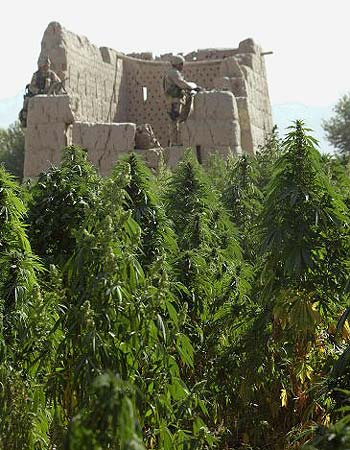 Canadian Soldiers Stare Down Sticky Green
Ynet has a funny story on the "unexpected enemy" that Canadian troops are facing in Afghanistan: thick swathes of marijuana "forests," home to three-meter plants. General Rick Hillier is cited as saying that attempts to clear the brush have failed so far. I haven't found the report in English, so the following are translations of the citations in the Ynet article. Hillier recounts that a recent operation ended when
the wind blew the smoke [from the plants] onto our troops and influenced them in a bad way. That's when we understood that it might not be such an appropriate solution to burn the plantsThe general also reported that after this incident one of the soldiers told him
Sir, when I joined the army three years ago, I did not imagined that I would find myself saying, "Ooof, this marijuana sucks."[ADDENDUM: Thanks to Redel and Elie for sending me a link to the English version of this. You will find the original quotations there - they are slightly different from my translation of the Hebrew translation of the original. And since it's an American report, the plants measure 10 feet rather than three meters].
Thursday, October 12, 2006
French Legislature Passes Law Outlawing Denial of Armenian Genocide
 From Hürriyet, Armenians in France Celebrate Passage of the Bill
The French lower house has passed a resolution making it a crime to deny that the killings of an estimated 1.5 million Armenians in the Ottoman Empire during World War I constituted genocide. The resolution passed by a margin of 106-19, though the large majority of the legislature's 557 parliamentarians did not show up. The Turkish newspaper Hürriyet ran a headline suggesting that France had chosen "stupidité" instead of "liberty, equality, and fraternity" [thanks again to Anne for helping me with Turkish verbs!]. French President Jacques Chirac had previously expressed his disapproval over the vote, calling it "redundant and unnecessary," since France already recognizes the Armenian Genocide. But the law means that those who argue that the killings, while regrettable, were not genocide are liable to face the same kind of punishment as those who deny the Shoah - one year in prison and fines up to 45,000 euros.
The bill was proposed by the Socialist Party but also supported by UMP legislators. Indeed, its most prominent advocate was MP Patrick Devedjian, who is close to presidential hopeful Nicolas Sarkozy. Turkish leaders were voiciferous in condemning the resolution in the lead-up to this vote, threatening serious consequences for Franco-Turkish relations. In light of the bellicose rhetoric emanating from Anakara, which apparently hoped to scuttle passage of the bill, Chirac might think twice before officially signing the resolution into law. The resolution might have significant repercussions beyond France, as many Turks see this as a larger European or even Western conspiracy against their country - there are already theories to the effect that the vote was timed to coincide with the awarding of the Nobel Prize for Literature to Orhan Pamuk on Thursday. Pamuk is one of Turkey's most critical voices, who has challenged the taboo on the Armenian genocide and suffered accordingly for his dissent.
At this point, it seems impossible for Turks to accept this as anything but an insult delivered specifically at them, together with the recent slights by various EU members who seem ever more wary of admitting the country to their club. That opposition, of course, is not based on moral concerns about Turkey's failure to confront its past but on much greater European anxieties about this non-Christian other.
One question is how Turkey will actually be able to respond in the short term. Will France suffer economic consequences? If so, how significant will these really be? But the more important problem is what effect this will have on Turkish society and politics. Who will gain, and how will the country's orientation to the rest of the world change?
See also earlier coverage by Kishkushim of this bill's pre-history (it was shelved in May).
The Tony Judt Affair
On Monday, the Washington Post reported that two “major Jewish American organizations” had “helped block” New York University professor Tony Judt from speaking at the Polish consulate in New York on October 3, apparently because he was “too critical of Israel and American Jewry” (“In N.Y., Sparks Fly Over Israel Criticism”).
"I'm not some kind of victim here. That's garbage," said Mr. Judt on Oct. 7. "I don't even regard this as censorship. But I regard it as serious exercise of censorship by someone on someone else, with me in the middle,” (New York Observer).
"I am a firm believer in First Amendment rights, and would have no problem with Judt speaking at some other forum, as long as an opposing view would be heard," Rabbi Weiss wrote to the Holocaust center's leaders. "But having someone who is a State of Israel denier speak at a Holocaust forum is a desecration of the memory of the six million," he wrote.
Rabbi Weiss, a longtime activist and neither a stupid man nor an extremist, who has taught and mentored many progressive Orthodox Jewish leaders over the past decades (including my local rabbi), was referring to Judt’s previous arguments against a two-state solution and for a binational secular state in
would speak on his mainstream views concerning the legacy of the Holocaust. [And that] [h]e would not speak about
But Judt saw this as an unacceptable condition.
I thank B.D. and J.C. for forwarding me some of the articles cited above.
Wednesday, October 11, 2006
Israeli Under-21s Qualify for European Championship
 Toto Tamuz (right) about to take it past some Frenchies
Finally some good football news for Israel. The under-21s team beat France 1:0 in Herzliya to qualify for the European U-21 Championship, which will be held in the Netherlands next summer. We caught France coach Rene Girard talking some trash before the game:
"Israel is the favorite to qualify for the European Championship. After all, from what I understand, that's what all the papers here are saying," Gerard said with a sardonic smile.
"In the first leg our players didn't manage to show their regular ability in front of their home fans. But even though it was a bad result for us, we were still much better than the Israeli team. I expect a tough, physical, fast paced game," he added (Ha'aretz).
Idiocy in the American Security Sector
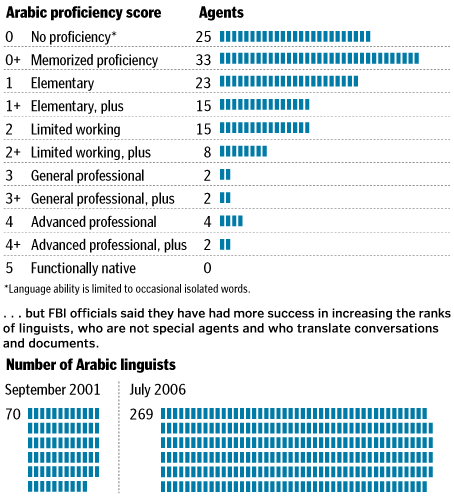
Chart from the Washington Post Showing
FBI "Progress" in Hiring Arabic Speakers
Hardly a big surprise. The Washington Post reports that five years after 9/11 only thirty-three FBI agents have even minimal Arabic proficiency. Guess how many of those work in international terrorism sections? Zero. Yes, that's right. The numbers are not much better for Farsi.
What seems to be the hold-up? Apparently, the FBI cannot bring itself to hire "foreigners" - basically anyone who has relatives overseas. It's American provincialism at its worst. Among those who are routinely rejected by the FBI - I have this on anecdotal evidence - are Jews from Iraq, Yemen, North Africa, and Iran who came to the US as children or teenagers.
Great quotation from Georgetown professor Daniel Byman, head of that university's Security Studies Program:
It is easier to get a security clearance if you don't have any interaction with foreigners, which is not what you want if you want better interaction with foreigners.All of this came to light during a lawsuit filed by Special Agent Bassem Youssef. Youssef, who happens to be one of the Bureau's highest-ranked Arabic speakers, is suing the FBI and the Justice Department for "retaliation." Instead of protecting Americans by having people on staff who actually understand what al Qaeda members are saying, the FBI decided to cut Youssef out of terrorism cases post-9/11. After he complained about his treatment to a congressman, the FBI blocked Youssef's promotion.
Way to go, chumps!
Subscribe to:
Posts (Atom)